April Fools! 6 Gluten-Free Pranks to Play Today

I’ll be back soon with more absences of answers to ever-present questions about celiac disease and other gluten-related disorders, but I thought I’d take a break for April Fools Day.

This day last year, I convinced a few people that Dunkin Donuts would be going all gluten-free by 2015 (sorry!). Between then and now, the chain announced that, although it wouldn’t be dropping wheat from its pastries entirely, as I’d “predicted,” it would introduce wheat-free goods to every store nationwide in 2013.

The gluten-free community got pretty excited about that. But sadly, the joke was on us: Dunkin Donuts reversed the decision months later, with little explanation, before I even got to try one of those shrink-wrapped muffins. A lot of people were disappointed, and truth be told, I felt a bit responsible, as though I’d jinxed it. So this year, none o’ that.

However, superstition aside, there’s no reason not to get what laughs we can out of our chronic disease. If you haven’t yet decided what jokes to make today, here are a few you could try:

“Guess what! I don’t have celiac disease after all.”

Just as it’s good to have an all-purpose GF flour blend (if such a thing really exists), a good all-purpose trick comes in handy, too. Play this prank on just about anyone. Take it to the next level by whipping out a sandwich (which should of course be made with a reasonably uncrumbly gluten-free bread, unless you’re a truly dedicated prankster) and taking a big bite.
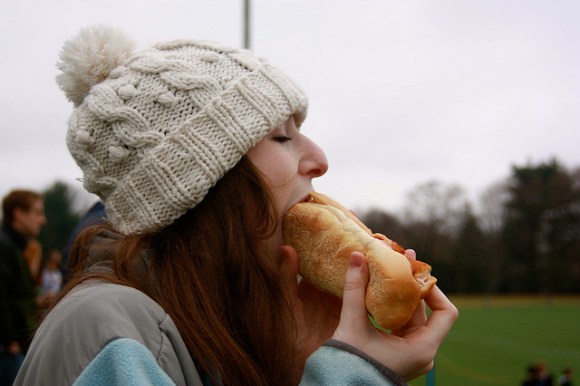
Girl eating sandwich

This “gluten” sure is good!
Photo © Jessie Jacobson | Flickr

“Soooo . . . celiac disease is contagious.”

Said with a bit of a wince and an “oopsie” expression, this is handy for that annoying coworker who’s always sticking his gluteny hands into your gluten-free snacks. To kick it up a notch, come up to him later, stare intently at his elbow, and when he asks what you’re doing, say, “Oh, I thought I saw some dermatitis herpetiformis. It’s probably nothing, though.”

“Bad news. They just found out potatoes contain gluten.”

This joke has limited utility. Most people with celiac won’t believe it; most non-celiac people already do.

Mr. Potato Head and family

Personified potatoes: Creepy? Yes. Glutenous? No.
Photo © Jeremy Page | Flickr

“I’m going back to school to become a [dietitian/gastroenterologist/celiac disease researcher].”

This is another good one to use at work, though probably not on your boss. If your parents are still paying off loans from your undergraduate English degree, maybe you’d like to try it on them, too. To really go for it, forge a letter of acceptance to display to the skeptics.

“Turns out, gluten is bad for everyone.”

Several savvy authors have made a killing off of this classic, so why not get in on the fun? Arm yourself with statistics and direct your chosen fool to the library to learn more. If it’s in a book, it must be true.

girl eating bread and yelling

Breeeaaddddd. It’s coming for you!
Photo © Eltjo Poort

“Hey, did you hear about that new gluten-free and vegetarian restaurant opening in Washington Heights next month?”

That’s not funny.

gluten-free restaurants in New York - Gluten-Free Fun map

See this map of gluten-free-friendly NYC establishments created by Erin of Gluten-Free Fun (interactive version here)? Cool, right? See how many are north of Central Park? …yep. But hey, it’s home.

Happy April Fools Day! Hope the jokes are on everyone else and not on you.

Tagged , , , , , , , , , , ,

Is a gluten-free diet good enough?

Last week, I had the pleasure of attending Columbia University’s Development of Therapies for Celiac Disease Symposium. Doctors and researchers from around the world gathered to present fascinating talks and Powerpoints full of text almost all too small to read.

Also attending were patients, like myself, and some folks doing fantastic work on behalf of the gluten-free community. Hearing their stories was my second favorite part of the conference. Glimpsing the most cutting edge of celiac science was my third.

First, of course, was the food. Everything served was gluten-free; and, it seemed, everything was served. Bread baskets overflowed, and entrees and sides kept even us vegetarians happy (saag paneer—yum). There was dessert after every meal, even breakfast—which was itself essentially dessert, consisting primarily of muffins, donuts, fruit, yogurt, and “coffee” cake.

In two days I ate more desserts than anyone should eat in a month. I can’t tell you how many exactly, because a) it would be embarrassing and b) I lost count, but brownies, crème brûlée, polenta cake, kheer (Indian rice pudding), and pound cake were not excluded. Some treats were from Pink Poppy, others from By the Way Bakery. So. Much. Sugar.

gluten-free muffins, donuts, and bagels at conference

The lighting doesn’t do them justice, but trust me: delicious unfrosted cupcakes muffins.

As if all that weren’t enough, we were also encouraged to take samples, and take them I did: The Simply Bars, Crunchmaster multi-grain crackers, NoGii paleo bars, Schar multigrain ciabatta rolls, and Le Veneziene chocolate hazelnut cookies. The cookies expire in a month, so we’ll have to eat them fast.

Okay, okay, I admit: the point of the conference was not the food. The point was to learn about gluten-related disorders. And I’m evading that point because the conference’s unofficial motto was “Good question! We can’t answer it.”

Much about celiac disease and gluten sensitivity remains uncertain, due to conflicting study results, lack of longitudinal and prospective data (meaning, collected over a period of time as events unfold, unhampered by subjects’ flawed memories), lack of appropriate controls, or the fact that serious research attention hasn’t been paid to this field until recently.

Celiac disease is not a simple disease. You know that, I know that, scientists know that, and (some) doctors know that. Unfortunately, that’s about all we know.

Still, because I did learn a lot about what we don’t know, this will be my first in a series of posts about the questions the conference raised, and the answers that may someday prove to be true—at least in part. I call it “Sprue/False.”

We start with a big one:

This question was at the symposium’s heart. If “go gluten-free” were all we needed, no one would be developing therapies (other than snake oil peddlers). “Go gluten-free and wait” is another option. Multiple presenters affirmed it can take years for adults to heal. But is that the best we can do?

Unsurprisingly, the drug developers say no. Glutenase (a.k.a. ALV003, and importantly distinct from “Glutenease”) researchers had a pool of about 200 gluten-free celiac patients keep a seven-day symptom diary. Over 90% had at least one day of symptoms, and 44% reported five to ten symptoms. Three quarters called their symptoms “moderate,” “severe,” or “very severe,” and 20% missed social events or called in to work.

Also potentially significant is the fact (stated in another presentation) that even on the gluten-free diet, adults’ villi may never rebound to “normal” length—meaning, possibly, we don’t regain the ability to absorb nutrients as well as we should. Yet another presenter suggested we may be wrong to assume that all is peachy—from a health perspective—for diagnosed kids.

We see an unmet medical need,” said Daniel Adelman, of Glutenase. “The gluten-free diet is all we’ve got, and it’s not enough.

But doctors aren’t so sure. Dr. Julio Bai’s comment that his patients did not make such complaints met with widespread head-nodding from clinicians. More than one expert scolded the drug developers for not surveying a control group. “For all we know,” their argument went, “everyone would report weekly gut symptoms if given the opportunity.”

I’m disappointed they didn’t include controls, but otherwise, I’m with the druggists. I’ve been scrupulously gluten-free for well over a year and still don’t feel well. And faulty memory, schmaulty memory, I know it wasn’t like this before. There has to be something more I can do. The question is, what?

Patients can help answer that. Both Larazotide and Glutenase—drugs being developed as adjuncts, not replacements, to the GFD—are in clinical trials. Neither trial is currently requiring participants to deviate from their usual diet, and both have been through extensive safety testing.

I’m investigating Glutenase’s CeliAction Study, myself. Celiac changed my life and so far the GFD hasn’t changed it back. I’m ready to try something new. Worst case scenario, I get a placebo or the drug doesn’t work. Best case? My life returns to really, truly good enough.
gluten-free Fridays Vegetarian Mamma
Over the next few weeks I’ll explore more unanswerable questions about gluten-related disorders, with less preamble about brownies. In the meantime, tell me: In your experience, is the gluten-free diet enough? Would you ever participate in a clinical trial? Have you already?

Post #2 on the conference is up: check out “More on Drugs” and share your thoughts!

Tagged , , , , , , , , , , , , , ,

Test your gluten-free knowledge! (A National Foundation for Celiac Awareness campaign)

As I’ve said before, despite or because of being an SAT tutor, I’m not really into standardized tests. Still, some (like the Patient Autonomy Test!) are genuinely useful assessments.

In 2012, the National Foundation for Celiac Awareness (NFCA) tested the gluten-free knowledge of foodservice professionals attending a National Restaurant Association Show. According to this report, the results were abysmal. Under 50 percent of the restaurant pros could name a single gluten-containing grain other than wheat. That’s one test I wish chefs (and waiters, too) would invest a little time and energy prepping for.

Since you’re reading this blog, I’m willing to bet you can name more than one gluten-containing grain. But how much do you really know about gluten and its related disorders? If you’re brave enough, you can find out! The NFCA has come through with another quiz, this time with a different audience in mind: us, and our family and friends.

Rudi’s, everyone’s favorite grilled cheese maker (don’t tell Udi’s) is sponsoring the 10-question quiz and providing 10 gluten-free prize packs to quiz-takers. You get an entry even if you get a couple questions wrong—and you’re sure to learn a thing or two.

Take the quiz here, then challenge a friend to take it, too!

Why take the quiz (besides the prize packs)? To answer that, I look to another campaign by the NFCA, which urges us to “Restore your health. Reclaim your life. Take the pledge.” You can commit to take the pledge here, and it’s really simple: educate, empower, advocate.

At its most basic level, the pledge is about self-preservation. When you get diagnosed with a gluten-related disorder, you have to educate yourself in a whole new way of life, feel empowered to make the right choices for your health, and be willing to advocate for your needs in situations that demand it. (I wrote this as part of a testimonial I provided to the NFCA earlier this year. Read more testimonials here.)

I truly believe that the very most important thing we can do for our health is to learn about it, and after that, to educate others. If we don’t learn all we can about celiac disease, gluten sensitivity, and gluten, how can we expect people like chefs—or even doctors—to bother with it? Cheesy as it is, in the case of GRDs, health does start from within.

So what are you waiting for? Take the quiz, then come back and tell me how you did! I’ve modestly held out until now to say this, by the way, but—woohoo!—I got ’em all right.

As for the prize pack, I wish you some belated St. Patrick’s Day good luck. If you, like me, managed to get celiac disease despite having a 132 out of 133 (or about 99.25%) chance of not getting it, then you probably need some.

National Foundation for Celiac Awareness (NFCA) Test Your Gluten-Free Knowledge campaign logo

Have you taken the pledge? Does it resonate with you? Do you feel educated and equipped to educate others about the gluten-free diet?

[Disclosure notice: I was offered two free Rudi’s product coupons valued at $10 in return for posting about the campaign. Although I’m looking forward to the grilled cheeses—or maybe giving the coupons away to one of you—I’d have posted about this anyway in accordance with my strict post-about-stuff-that-is-interesting-to-me-at-the-moment-when-I’m-writing-it policy. I was not otherwise compensated.]

Tagged , , , , , , , , , , , ,

20 Ways a Gluten-Free Diet Prepares You to Be the Best Mom or Dad Ever

It occurred to me as I was dutifully packing my own lunch the other day that I’m getting pretty good at this. Maybe not Pinterest good, but I could definitely do a bento box. I’m totally ready to be someone’s mom!, I thought.

I started wondering what other overlap my GF lifestyle has with parenting, and I came up with quite a list. Can you relate?

  1. You pack lunches every day (“love you” notes to yourself probably not included, but I bet you’d rock it).
  2. You’ve lost all discomfort discussing and dealing with poop. Accidents (and maybe vomit) included.
  3. You plan ahead—obsessively—in often vain attempts to prepare for all eventualities.
  4. You spend a significantly larger portion of each day feeling stressed than relaxed.
  5. Looking and feeling pregnant are not foreign to you. (However, if reports are true, no celiac-induced pain you’ve experienced rivals childbirth. Comforting?)
  6. You cook three meals a day, not (necessarily) because you like to, but because someone has to.
  7. You grapple with preparing single meals that satisfy a group of people with completely different wants and needs (allergies, vegetarian/veganism, low-carb, paleo, lactose intolerance, likes and dislikes, and of course gluten-freedom).
  8. You document everything, even the most insignificant milestones: First gluten-free homemade flour blend! First from-scratch cookies! First time eating out! First holiday!
  9. You carry snacks in your bag (and sometimes baby wipes—nothing gets gluten off like ’em).
  10. You’re always tired.
  11. You just know when someone is lying to you (though sometimes after the fact).
  12. You shamelessly ask people to wash their hands before eating. (Only if you’ll be sharing finger food after they just ate, say, fried chicken in front of you. And, okay, there’s a bit of shame.)
  13. You’ve also been known to ask suspiciously, when someone last brushed his/her teeth.
  14. You take grocery shopping very seriously . . .
  15. and keep an eagle eye out for deals. GF food’s not cheap!
  16. You understand the importance of a good burp.
  17. You’re used to not having much of a social life outside of your home.
  18. You’re extremely familiar with saying “no.”
  19. The first thing you look for in any new place is the bathroom.
  20. Sometimes, you can’t remember what life was like before all this. And if a cure is discovered within your lifetime, you’re not totally sure you’ll know what to do with yourself.

See? Child-rearing and chronic disease, two of life’s enduring mysteries, are essentially the same. Both look just . . . like . . . this (with Snyder’s of Hanover GF pretzels, of course):

Yes, I focused on one particular set of symptoms (that is, mine), which many people with gluten-related disorders may not have; there’s a laundry list of other possible symptoms, including infertility (which makes becoming a parent a bit tougher, though certainly not impossible).

And, yes, there are some ways in which they differ. For example:

  1. GF bread prices and loaf sizes being what they are, you do not cut off the crusts.
  2. Celiac disease doesn’t demand bedtime stories—though I’ve got you covered if it ever comes up.
  3. Strollers and playgrounds are also optional.

There’s one more, utterly crucial distinction: When you yourself are gluten-free, all that extra energy you expend and stressing you do are about YOU. Taking responsibility for your own well-being is admirable (and, for many of us, critical), but as a parent you must take that endless worry, attention to detail, and physical and emotional care and turn them outward.

If it’s your child who eats gluten-free, you already understand that. For those of us who aren’t yet but may become parents, assuming a cure doesn’t come, we’ll continue to manage our own diet while caring for the tiny human beings in our charge. We’ll be taking the “tired” we feel and doubling it, at least.

That, more than anything on the list above, makes parenting sound pretty intimidating. From what I hear, though, it’s pretty fulfilling work—so if anything is stopping you from having kids, I hope celiac disease isn’t it. Some (far-off) day, I won’t let it stop me!

Am I missing anything on my lists of similarities and differences? Parents, did I get any of this right?

Tagged , , , , , , , , , , , , ,
Design a site like this with WordPress.com
Get started