Author Archives: Molly

Got worms? A review of The Wild Life of Our Bodies, by Rob Dunn

“You should rewild your gut,” my sister said to me one day, conversationally, over the phone. She said this in part because it’s the kind of thing people say to me all the time, but also in part because she’d just read The Wild Life of Our Bodies (Harper, 2011) and was eager to proselytize. When it comes to books, there’s a vacuum in me that yearns to be filled (perhaps by an intestinal worm—but we’ll get to that later), so I was an ideal soul to target.
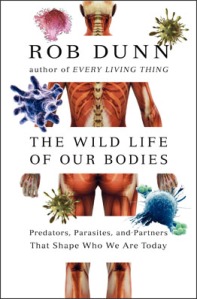
wildbodies_cover

Althea tells me I’m the first person she recommended the book to who actually read it. Too bad, because it’s solid pop science (I, as a generally non-pop-science reader, enjoyed it), and it’s full of a lot of great tidbits for those of us who spend our days preoccupied with parts of the body that normal people are fortunate enough to forget exist.

Subtitled Predators, Parasites, and Partners That Shape Who We Are Today, the book’s central takeaway (which author Rob Dunn makes explicit only on the second-to-last page) is that “our bodies and lives only make sense in the context of other species. Only by looking at other lives do we really understand our own.” Although Dunn is careful to make clear just how much of what he’s writing is unproven, the ideas he presents do make good sense of senseless things.

For instance, why do we have allergies or autoimmune diseases? How did our bodies get so darn stupid? In a childhood game of “stop hitting yourself,” there’s always a sadistic older sibling in the background causing the trouble. When our own insides won’t stop hitting themselves, though, what on earth is to blame? Tell me you haven’t wondered this yourself once, twice, or every day. Dunn wondered, too. The hypothesis he describes in response is sort of the opposite of “stop hitting yourself.” It’s not that some outside force is taking the immune system by the hand and making it hurt itself; it’s that the immune system, used to having a force to act against, is hurting itself out of what amounts to habit—or boredom.

Life, as a wise candlestick once said, is so unnerving for a servant who’s not serving. Like the servant in that awkwardly classist formulation, the immune system, finding its original function unneeded, casts about for something to do with all of the useful skills it’s evolved. And in the process, it manages to mess things up for us pretty thoroughly. Here’s what Dunn thinks went down.

Once, he suggests, we all had intestinal worms. They snuck in through unfiltered water or burrowed up through the soles of our feet, and they made themselves at home within our guts. In response, our immune systems sprang into action, producing antibodies to oust the unwanted guests. But, if the worms stuck around long enough and seemed not to be causing much damage, peacekeeping cells developed, too, allowing our bodies to settle into equilibrium. “This isn’t so bad,” they told the immune system, in essence. “Chill out.”

Now, clean as we are, we have no worms, but our systems, having evolved to defend us, remain slap-happy. In the absence of true parasites, they attack other stuff—stuff that isn’t in itself bad, like pollen or gluten or choice bits of our own intestines. And, unfortunately, in the absence of real threats, our peacekeepers, which might have buffered us against such needless attacks, seem to have assumed we’d be okay on our own and departed on a long, naturally selected vacation.

Dunn adds on to that one more idea—his favorite, he calls it—that a parasite, if present, would also have secreted compounds that could calm our immune systems, even bamboozle it into thinking the worm belonged. Without this gentle resistance to which it is accustomed, the immune response is even more vicious. Like the kid whose arm continues reflexively to bat back and forth even once his brother has tired of the game, our immune systems carry on lashing out—or, really, lashing in, since there’s not much to lash out against—and causing us more harm than good.

The solution? It is, of course, to dose yourself with worms (rewild your gut). Maybe. You’ll have to read chapter 4 to figure out whether or not that’s a good idea.

Other highlights, for me, included discussions of:

  • making germless animals
  • gut bacteria’s role in metabolism and obesity
  • hand sanitizer’s counterproductive legacy
  • anxiety and panic disorders as remnants of our past lives as prey
  • hairlessness as a protection against bugs and the diseases they transmit
  • the relationship between disease and disgust

Throughout, Dunn uses far clearer analogies and demonstrates a much stronger grasp of science than I have in this post (although my neuroscientist sister did approve its content). For anyone who’s ever wondered what good an appendix is, or what causes Crohn’s disease, or how bad for us city living is really, The Wild Life of Our Bodies is well worth a read. If you do decide after reading it to go get yourself some worms, I hope you’ll tell me all about it.


Tagged , , , , , , , , ,

Gluten-Free Astrology: Cancer (born June 21 – July 22)

Omigosh, my dear GF Cancers, you who are the worst possible sign to flake out on, I find that I am one day late in devoting this post to you. I had my dates confused and thought I was on time, but alas—my distracted Gemini core must have trumped my Taurus-cusp dependability. Or it was brain fog.

Whatever the excuse, I’m here now, so stop pouting and listen up. Here’s what this month has got in store for the lovable crab.

Photo © cliff1066™ | Flickr

Photo © cliff1066™ | Flickr

As a GF Cancer, you are emotional, nurturing, and fiercely loyal: traits that sometimes manifest as overbearing and possessive. You forge bonds for life, so you probably shed tears over your gluten-free prescription, scared it might strain your social relationships or bar you from enjoying your treasured restaurants and traditions. Once committed to a thing, though, you never let go, and so it is with gluten-free. You likely pledged allegiance early on to one flour blend or brand, and you seek every opportunity to break gluten-free bread with your lived ones.

Although you prefer to invite friends into the bosom of your safe, comforting cooking at home, you’d balk at being left out of any of their gatherings simply because of your diet. So, more than many, you may be inclined to eat out and chance the cross-contamination. Still, because of your deep-seated anxiety and pessimistic outlook, you approach every meal with the niggling sensation you’ll end it running for the toilet. At times, this makes you a sullen, brooding companion, picking at your food suspiciously. At other times, you seek constant reassurance that the dish you were served is gluten-free. When mistakes do happen, your early anticipation of the worst doesn’t save you from going into a full-on sulk. Still, your closest friends know better than to leave you out of an invitation: your sensitive side will come out in full force should your company be rejected. Clingy? Well, a little.

More vulnerable than most to feeling lonely or left out, your desire for connectedness may have led you to join a support group or other gluten-free network. If not, this month might be just the time. You may find a satisfying sense of community at, for example, one of several Celebrate Celiac events going on this summer. If one will be in your vicinity, check it out and enjoy the feeling (as only a Cancer can) of being surrounded by potential new friends who understand your troubles. I’ll be at the New York event in July!

Even more than any other gluten-freer, GF Cancers are likely to have gastrointestinal troubles, sometimes even in the absence of gluten. Take it easy on your gut this month, but don’t let your anxiety cripple your social life. If you do run into tummy trouble, you’re likely to have several friends waiting in the wings to nurse you back to health; your loyalty and generous care are usually rewarded with more of the same from anyone with a weak enough fear of commitment to enter the lifelong embrace of your acquaintance. This summer, I predict you’ll make new friends and keep the old—and perhaps bring them all together for a gluten-free cookout or two. Just steer clear of crabcakes. You’re a Cancer, not a cannibal.

GF Cancers are often well-to-do, because you have a way of discovering (sometimes indirectly) nice financial prospects. But unfortunately, that doesn’t always translate into fame. I had a bit of trouble finding gluten-free Cancers for you this time around, but please let me know if you come across any in your crabwalking across the internet.

Meryl Streep

Meryl Streep

Meryl Streep is a Cancer, and we might say she’s an honorary GF Cancer, given how many Google hits pop up when you search for “gluten-free Meryl Streep.” Maybe it’s just that you could search for anything plus Meryl Streep and turn up tons of hits. But there aren’t that many famous GF Cancers, so we’ll have to take what we can get. Meryl is known as a versatile actor (and it makes sense, since Cancers are often creative and artistic, not to mention smart), but she’s also quite steadfast and monogamous, as a Cancer should be. She’s been married—to one person—since 1978. Not too shabby for a celebrity.

As always, the “information,” such as it is, in this post has been largely ripped off from The Only Astrology Book You’ll Ever Need, by Joanna Martine Woolfolk, which is in fact the only astrology book you’ll ever need (need here being a relative term).

See also: AriesTaurusGemini

If I haven’t managed to get past your tough exterior and offend you with this post, let me know whether I got it right, GF Cancers. By the way, my GF Gemini prediction came true for me—three out of four of my first-degree relatives have now gone in for celiac testing, thanks to my quicksilver powers of persuasion.

Tagged , , , , , , ,

Turns out Dunkin’ Donuts ain’t no fool

Looks like the top donut dunkers at a certain nationwide pastry shop got word of my April Fools post and decided to make it a reality. Thanks to my friend Jessica for tipping me off to the Bloomberg article saying so.

mall-334-e1359140947345According to the article, Dunkin’ Donuts “will sell gluten-free cinnamon-sugar doughnuts and blueberry muffins across its U.S. stores this year.” That’s confirmed by real spokespeople at the company, and it beats my prediction of a 2015 nationwide rollout by two years. Not too shabby. (Given my stellar forecasting abilities, I hope that all you GF Cancers are getting ready to heed my predictions when I roll ’em out in a few days. I promise to have everything right, give or take two years.)

No word yet about going all gluten-free by 2020, but I’ll keep my fingers crossed if you keep yours.

I’m excited that there will be more opportunities for all of us to try a Dunkin’ Donuts GF treat very soon, and it’s nice to see our “needs” being recognized by such a large industry player. By the way, the Bloomberg article claims Dunkin’ Donuts will have “the fast-food industry’s first gluten-free pastries nationwide,” which I imagine might have Au Bon Pain a little annoyed, considering that they partnered up with GG’s Original back in 2012 and have been serving gluten-free congo bars and other goodies since then. (Then again, Au Bon Pain may not be quite “fast food,” and congo bars may not be quite “pastries.” Webster tells me pastries are “sweet baked goods made of dough having a high fat content”…but what does that mean? Discuss).

Whoever came first, it seems other national chains may soon follow their lead. Stay tuned. My crystal ball tells me Starbucks is next.

Alongside breaking the good news and highlighting the recent rise in demand for gluten-free products, the Bloomberg article also quotes some buzzkills who point out the false health halo surrounding gluten-free goods. If you happen to have stumbled across this post in search of a miracle weight loss trick, I must warn you that donuts—gluten-free or otherwise—probably aren’t it. (And, at 350 calories and 36 grams of sugar, neither are congo bars.)

Gluten-free Cronuts, on the other hand…those will take inches off your waistline in seconds. Just as soon as someone gets around to developing some.

Tagged , , , , , , , , ,

So…was the popcorn gluten-free?

For those of you who have been eagerly awaiting word on the Arrowhead Mills popcorn question, I have an update. I finally got around to calling their customer service line yesterday (there was no great rush since I had, after all, already eaten it all).

Photo © Joakim Wahlander | Flickr

Photo © Joakim Wahlander | Flickr

The woman I spoke to—following some appropriately corny hold music—confirmed my suspicion: the popcorn is not made on dedicated gluten-free lines or in a dedicated facility. However, she assured me that they follow “good manufacturing practices” of sterilizing lines between runs, etc. She said that any of their products that have already been found to contain less than 20 ppm gluten would have the gluten-free symbol on the bag, and that they’re working on testing their way through all of their products. They have not yet tested the popcorn.

I asked, “So, conceivably in six months’ time, the popcorn might have a gluten-free symbol?,” but she said she didn’t know and couldn’t speculate on the timeline. Fair enough, because I’m sure the last thing any company wants is some blogger hopping online and posting false promises that, say, all of their products will be gluten-free by 2020. Plus, unless I stumbled across a Time-Turner, it’s not as though knowing their product will be confirmed gluten-free in six months would do me any good.

I wondered why they would test some of their products but not others, and why it takes so long to test everything. Is testing for gluten that expensive and/or time-consuming? Does anyone have any insight into this?

A couple of you commented that most popcorn should be safe. Personally, I’ve noticed some issues after eating popcorn, but there’s a good chance my weary GI tract just isn’t happy about handling large bowls of air- and fiber-filled corn right now. That’s not going to stop me from eating it, but I am going to check around for another popcorn brand. Though the Arrowhead Mills stuff might be safe, I’d feel better knowing the popcorn was either tested for gluten or processed far, far away from gluten. I will still buy other Arrowhead Mills products that say “gluten-free” on the bag, because it sounds like they have their act together.

Since the Arrowhead answer was a resounding “I don’t know,” I don’t really know whether or not to doubt my old air-popping cauldron. It’s been starting to die anyway, so I may just take the road of “When in doubt, throw it out” and get a new one.

On to another kind of testing: this morning I got NINE vials of blood taken out of my arm, to find out if my gut is still gutting itself. (The phlebotomist assured me I still had plenty of blood left in me; I’m not so sure.) As I left the lab, I found myself thinking, “Celiac’s blood…that’s got to be an ingredient in some kind of potion.”

Tagged , , , , , , , , , ,
Design a site like this with WordPress.com
Get started