Author Archives: Molly

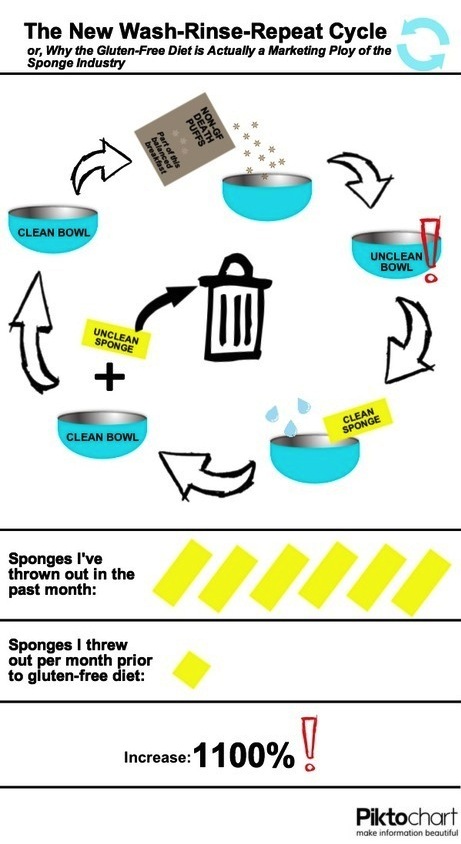
As it turns out, celiac disease was invented by the sponge companies.

lunapic_136236069235976_4

Of course, the dishwasher manufacturers aren’t making out too badly, either.

Which do you use? Dishwasher, or elbow grease and a prayer? Do you, too, get twitchy if you so much as drop your gluten-free sponge into the gluten-full sink?

Am I overdoing it? Or underdoing it?—should I simply use only my own dishes for everything, regardless of material

What incidental, non-food costs have shot up for you on a restricted diet?

By the way—in case you were wondering, the image quality isn’t bad; your eyes are. My math also isn’t bad. I hope.

Tagged , , , , , ,

Happy hump day!

Photo © blue_quartz | Flickr

Photo © blue_quartz | Flickr

Wednesdays after a vacation are so much harder than other Wednesdays. I had a great visit with my parents last week, then hosted my sister over the weekend, and then had a half day yesterday because of my doctor’s appointment. All of this means I should be well rested and bright-eyed as I tackle the rest of my week, but instead, I’m dragging. (I blame my lack of nutrient absorption; what’s your excuse?)

To keep my enthusiasm up, I’m focusing on a few small pre-hump triumphs:

1. I had my first dinner party since going gluten-free. Hello, amaranth-polenta-stuffed peppers! Did you know amaranth is rich in, like, everything holy? Protein (including lysine), fiber, magnesium, iron, zinc, calcium, B vitamins…all that stuff veg-heads and gluten-freebies crave. I am not the first to compare it to manna. I’m eating my way through the leftovers and still have half a package left to use in another recipe. Thanks again, Mom, Dad, and Bob!

2. I made the Bob’s Red Mill brownies for my writing workshop and they were widely agreed to be delicious (by the same pals who said terrible, terrible things about the chocolate chip cookies). I filled them with about three times the recommended amount of chocolate chips (1/4 cup? Really?) and frosted them with Betty Crocker fudgy chocolate frosting (a bit sacrilegious for a girl whose parents would always opt for homemade ganache, but hey, they’re the ones who bought me a baking mix). They were even better the next day after chilling out in the fridge. Thanks, everyone, for recommending the brownies.

3. My new doctor is great. She listened to my concerns, she ordered a few more tests, she reassured me that everything takes time. She also felt my ankles and said, “You really run a lot, don’t you?” I have no idea if those two things were connected, but it amused me.

4. While at the doctor’s, I picked up a copy of the latest edition of Columbia’s Ultimate Guide to Gluten-Free Living (the linked edition is not the most recent, but I’m not sure the 2012 printing edition can be found online). It’s pocket-sized (if you are a man—if you’re a woman, you know the only thing pocket-sized is lip balm) and packed full of goodies. I read a lot of books, articles, and blogs about celiac disease and gluten-free living and often find the same information over and over again, but the little kernels of new knowledge make it worthwhile. This book lists a whole bunch of gluten-free brands I can check out and also highlighted Montina (Indian ricegrass), which is a new grain on me. I think it’s similar to Kamut (not gluten-free), in that the name is a registered trademark and it seems to be produced by one company only. On a less happy note, it also seems tough to find. Anyone tried it or know where to buy it?

5. I also found it adorable that the guide included the misspelling xantham gumSeriously, it’s so much cuter that way.

6. Plus, it included one of those dining cards you are supposed to give to baffled waiters at restaurants. Do you carry one of these? I’m hoping I won’t mistake it for a business card—not that I give out many of those anyway.

7. Finally, when I pulled out the book I triggered an awkward but pleasant subway interaction with the guy sitting next to me. He told me he has a friend who needs to eat gluten-free, and I mentioned I was vegetarian as well, so we talked about soy. It was the first time I have ever heard someone say the word phthalate out loud. I looked back down at the book after a bit and he got up at the next stop, whether because it was actually his stop or because I made him feel unwelcome, I do not know. I hope it was the former. Although I don’t handle stranger banter all that well, I do love these chats because they remind me that the other people on the train are real people with interiority, not strange cyborg commuting machines, which also reminds me that I too am real.

What’s helping you remember you’re real this Wednesday? (Lots and lots of coffee? Oh, me too. Me, too.)

Tagged , , , , , , , , , , , ,

Remember you are not the doctor.

Photo © Josh Clark | Flickr Creative Commons

Photo © Josh Clark | Flickr Creative Commons

Doctors’ receptionists have a tough job. They deal with stressed, unhappy, contagious people all day, and when they aren’t doing that, they file and photocopy paperwork, deal with ancient fax machines, and, I bet, put up with crap from the doctors. I’ve read that some offices don’t even provide their front-desk staff with internet access—which, to me, is practically a human rights violation. They probably get ill constantly from all the germs, and when they aren’t physically sick, they’re sick of their job.

Knowing this, I try not to be one of “those” patients. I’d say I’m pretty friendly, and I know I’m polite. In return, I hope for civility and, ideally, a bit of compassion. In my most recent medical experiences, I’ve encountered neither. My doctor never called me with my positive bloodwork results, and when I scheduled a follow-up, he and his staff forgot to check my results until I asked about them specifically. They were brusque and unapologetic and they sent me a duplicate copay bill.

When the time came to get my biopsy results, I didn’t want to go in and do it all over again (not to mention pay another copay or two). Instead, I tried to find everything out over the phone, and it got messy. In the end, the receptionist got fed up with me and said, “Remember, ma’am, you are not the doctor.”

This stuck with me, and not only because I found it funny that she called little ole 23-year-old me ma’am. It was also simply good advice. As I gear up for my first appointment with a brand-new doctor, I thought I’d share it. If you are a doctor, this may not apply to you. But otherwise:

Remember you are not the doctor.

Remember you do not have the doctor’s medical training, or credentials. Remember that to many, your understanding of your own health will never count. Remember you are presumed ignorant. Remember if you speculate or self-diagnose, you will be accused of hypochondria. Remember that not everything you’ve read or heard is true. Remember you may be biased, and remember fear can cloud your judgment.

But also: Remember it’s okay to be scared.

Remember to stay calm. Remember you care more about your health than anyone could who is paid to do so. Remember you have spent many recent hours researching your symptoms, and that if your doctor hasn’t kept up with latest research, you may in fact be better informed. Remember you are open to new ideas. Remember you do not have hundreds of other patients to keep track of. Remember you are focused. Remember you are the world’s leading expert on your own medical history and feelings.

Remember you are you.

Remember it is you, and not your doctor, who must live with whatever treatment—or lack of treatment—you’re prescribed. Remember you can seek a second opinion, or a third, or a tenth. Remember instinct counts for something, too. Remember it is easier for you to walk out on your doctor than for your doctor to walk out on you. Remember you’re worth more than a copay. Remember there are people rooting for you or relying on you to get well. Remember you are your own best advocate, but you are not your only advocate.

Remember you are loved.

Remember you are smart, and strong, and beautiful, and kind, and worthy, and interesting, and special, and whatever else you need to remind yourself of before you walk into the waiting room for your next appointment; but for God’s sake, remember you are not the doctor.

And remember you’re important anyway.

Tagged , , , , , , , , , , ,

Celiac disease is not a game. But it should be!

I’ve always wanted to invent my own board game. As a kid, I was the mastermind behind several new games, including Cops and Robbers II—an elaborate affair involving a three-strikes-you’re-out-via-electric-chair rule (the strikes cleverly tracked by attaching clothespins to the unlucky robbers’ T-shirts)—and Orphans, which was exactly what it sounds like and always starred a resourceful eldest orphan child who thrived in her new pseudo-maternal role (played by me, every time). These games were a hit in my neighborhood (or at least in my own head), but a decent board game was always beyond my reach. Turns out, it’s hard to invent a board game. You need a head for logistics, design skills, and, above all, I felt, an imaginative concept.

Then again, if you pay attention to the board games market, you begin to see that innovative concepts are few and far between. I swear, every board or card game introduced in the past ten years has been a remake of an older game that required no special equipment, a mash-up of several previously published games, or yet another addition to the -Opoly family. If there’s one thing I’ve learned from my extensive research, it’s this: forget innovation and just rip someone off.

With this rule in mind, I’ve come up with a new board game called Sorry!—The Celiac Edition.

Photo © schrierc | Flickr Creative Commons

Photo © schrierc | Flickr Creative Commons

For this game, you’ll need a board, pieces, and numbered cards from the game Sorry! (which is, by the way, itself a ripoff of Parcheesi).

Although it could be said that for 3 million Americans, this is already the Game of Life, the game is for 3 to 4 players. Every player except one represents a celiac patient and, unlike in the standard version, receives just one of the 16 pawns.

The remaining player represents Gluten. Assigned based on highest cruelty level as determined by popular vote, this player gets all the remaining pawns.

As in Sorry!, the object is to get your pawn from Start to Home, here known as Health. The players all have their own Start and Health spaces, because every road to health is unique.

Play proceeds clockwise, beginning with the sickliest player—again, determined by popular vote. Players draw one card per turn and move their pawns according to the numbers on the pawn. To move his/her pawn off of Start, a player must draw either a 1 or 2 (or, for added realism, 1 only). Gluten is not bound by this rule and may proceed from Start as soon as at least one other player has a pawn in play.

If Gluten moves one of his/her pawns onto a space already occupied by another player’s pawn, that pawn must be returned to Start and the player begins again. Sorry!

If a player draws a card directing him/her to move his/her pawn onto a space already occupied by one of Gluten’s pawns, the player’s pawn must still be returned to Start, because gluten is gluten, no matter how you come by it. Sorry!

Because Gluten has many more pawns in play than anyone else (it’s everywhere!), most players will likely return to Start many times over. Sorry!

If a player besides Gluten moves his/her pawn onto a space already occupied by another player’s pawn, a card is drawn. If even, the players advance each other’s knowledge of the gluten-free lifestyle and are both allowed to remain on the spot. If odd, they confuse each other with misinformation they learned on the internet and must both return to Start. Sorry!

When any player besides Gluten reaches the midway point on the board, Gluten must take one pawn out of play permanently. This signifies the players’ improved ability to manage a gluten-free lifestyle and increases the likelihood that they will eventually make it to Health.

As in the standard game, when a player’s pawn occupies one of his/her own “safe” spaces, he/she is safe from Gluten but may still draw a negative numbered card and be forced to leave the safe space of his/her own little gluten-free counter in his/her own little gluten-free kitchen.

Also as in the standard game, at various designated “slides,” players may skip their pawns forward a few extra spots toward Health. However, if a pawn encounters Gluten at any point along the slide, it must be returned to Start. Once again—sorry!

Photo © LifeSupercharger | Flickr Creative Commons

Photo © LifeSupercharger | Flickr Creative Commons

An accepted—and encouraged—variant calls for beginning the game with all players (except for Gluten) blindfolded. Players must keep their blindfolds on until they reach the midway point; until this time, Gluten reads their cards and implements their moves for them. Depending on personal preference, the player representing Gluten may choose to disclose information about other players’ progress toward Health and say “Sorry!” when sending their pawn back to Start, or leave the players completely in the dark until they have progressed far enough to take their blindfolds off. (I often feel this is the way I’m playing: unsure of how far I’ve come, what mistakes I’ve made, or whether I’ve even moved from Start.)

The first player to reach Health wins—unless that player is Gluten. When one of Gluten’s pawns arrives at Health, it is returned to Start and remains in play. Gluten will never go away, but provided the other players persevere, Gluten never wins.

Sorry!

Tell me about your favorite board game (with a gluten- or allergen-free twist, if you like) in the comments…as long as it’s not Monopoly, because seriously? No one really likes that game.

Tagged , , , , , , , , ,
Design a site like this with WordPress.com
Get started