Tag Archives: celiac disease

26 bulletproof reasons why NOT to go to the gym: from A to Z

Do you like Scattergories? I love it. If you aren’t familiar with the game, the point is to come up with words or phrases that begin with a certain letter (as determined by a die roll) and that fit into various categories on a list. One of my favorite categories is “reasons to be late for school or work,” because there are a million reasons—from “attacked by rabid squirrels” to “zephyr carried me away”—to be running late.

Another category I think I’d excel at, if it existed, is “reasons to skip the gym in the morning.” Once upon a time, I was almost machinelike in my adherence to the six-a-week workout schedule. But these days, despite knowing that exercise is an important part of staying healthy, even (or perhaps especially) for us chronic types, I truly manage to find an excuse for every letter of the alphabet.

Like so:

  • After all, tomorrow is another day
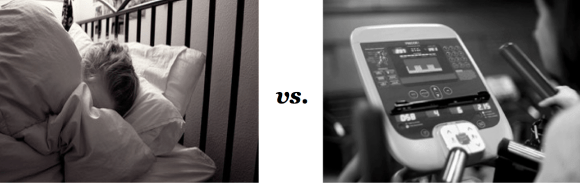
  • Bed’s too warm
  • Can’t find sneakers
  • Dreamed about going (close enough)
  • Eating breakfast sounds better
  • Fitness is overrated
  • Gotta write a blog post
  • Have a chronic disease
  • It’s [snowing/raining/sleeting/windy/dark/cold/hot] outside
  • Just don’t wanna
  • Kept hitting snooze; now it’s too late
  • Lots to do
  • My stomach hurts
  • No energy
  • Over it
  • Playlist is stale
  • Quit caffeine
  • Rest days are important, too
  • Sick (see: H)
  • Toe cramp (see: J)
  • Up too late on Twitter
  • Vile thing, that elliptical
  • Whatever, I look fine
  • Xercise, schmXercise
  • Yeah, yeah, I’ll go in a minute
  • Zzzzzzzzzzz…

gymEvery morning, one must win.

Photos © Allie HolzmanJoint Base Lewis McChord (Flickr)


Do you make excuses? What’s your favorite? Let me know in the comments.

Want more posts like this? Follow me via TwitterFacebook, or email to get them all.

Tagged , , , , , , , , , , , , ,

Hair today, gone tomorrow: hair loss, celiac disease, and a WebMD-style battle of the sexes

I’ve been posting a lot of serious stuff lately, so I thought I’d take a break to talk about something fun: hair loss.

I’ve always had thick hair. Like every other girl and probably plenty of guys, I’ve always wished it were different. When it was stick-straight, I longed for curls. When by the magic of hormones it went curly, I started straightening it. But never have I wished it were thinner.

Unfortunately, wishes don’t have much to do with it.

A couple of months ago, it became clear: I was shedding. Not a normal amount, but an “Is there even any left?” amount.

Okay, not quite this bad. Photo © boris drenec | Flickr

Okay, it was never quite this bad.
Photo © boris drenec | Flickr

“Your hair is everywhere,” Althea said. And she was right. It was on my pillow, my sweaters, my jacket, my desk and chair at work. It coated the floor like carpet and landed in most dishes of food I touched (you can gag, it’s okay).

According to the American Academy of Dermatology, everyone bids farewell to 50 to 100 strands of hair over the course of an average day. I’m pretty sure that’s how many I remove from the shower drain each morning.

Hair loss—like bloating—is associated with just about everything, including normal aging. And it’s not just for men; 40 percent of women show visible signs of hair thinning by age 40. And, like bloating, it’s upsetting.

In a rare departure from its usual brisk style, WebMD explains, of women:

Unfortunately, society has forced women to suffer in silence. It is considered far more acceptable for men to go through the same hair loss process. . . . the psychological damage caused by hair loss and feeling unattractive can be just as devastating as any serious disease, and in fact, can take an emotional toll that directly affects physical health.

and, of men:

Contrary to societal belief, most men who suffer from male pattern baldness are extremely unhappy with their situation and would do anything to change it. Hair loss affects every aspect of their life. It affects interpersonal relationships as well as their professional life. It is not uncommon for men to change their career paths because of hair loss.

Am I the only one who imagines these articles were written by one sad balding female staffer and one sad balding male staffer without consulting one another?

Anyway. When my problem showed no signs of going away on its own, I got a doctor’s appointment and, from there, a dermatology referral. The dermatologist took a two-second look at my hair, plucked out a strand, and started talking about “telogen effluvium” and “androgenic alopecia.” Finally, my ears caught a word I knew: “Rogaine.” Oh my god.

“So…it’s definitely falling out?”

“Yup!” the doctor replied, cheerfully, for all the world as if he’d never read that WebMD article about how distressing this was for me.

He went on: “Diseases sometimes accelerate stuff like this. You probably would have lost it anyway, but it’s happening four or five decades early because of celiac disease.”

I nodded, wide-eyed, and wailed internally, My hair, my beautiful hair!

Meanwhile, the good doctor concluded with a flourish: “Diseases suck!”

Got that right.

He wasn’t able to say why this would have developed months after I went gluten-free, or even if my “alopecia, unspecified” was definitely linked to celiac. He was able to give me a shampoo prescription, a few blood tests, and a “See me in six months.”

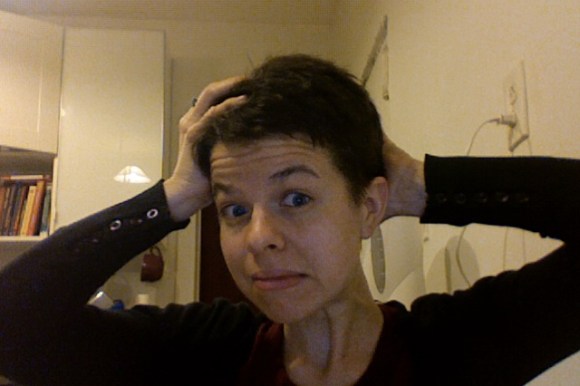
After that, there wasn’t much to do except pick up my (exorbitantly priced) shampoo, console myself with candy corn, take my new favorite doc’s advice, and wait. But I did ignore one piece of his guidance. He said cutting my hair wouldn’t help, but I’d had enough of finding it everywhere. So I marched myself into the salon, told the stylist to take it all off, and emerged with a new ‘do.

So it's still falling out. But at least shorter pieces of it are falling out.

It’s still falling out. But at least shorter pieces of it are falling out.

Having taken some decisive action, I immediately felt less “psychologically damaged.” 

A couple days later, the doctor’s receptionist called. “Your ferritin levels are low,” she said. “You need to take iron.”

Though they aren’t so low as to be out of the reference (normal) range, it seems they are low enough to be of dermatological concern. Some kind of nonstandard iron deficiency might also—I’m conjecturing, i.e., making this up—explain why I’ve never gotten that mystical gluten-free energy boost.

But who knows? I ordered my 324 mgs, and I’ll let you know in six months.

Till then, I’ll be rocking my new lack of hair. It’s a boon, really, because it opens the door to a whole new world of Halloween costumes, like this one:

Happy Halloween eve! May you receive only treats, no mean dermatological tricks.

Have you ever experienced hair loss from celiac, or from something else? How do you cope? And what are you dressing up as for Halloween tomorrow?

Tagged , , , , , , , , , , , ,

Do you wear your snake-eating-a-unicorn tattoo on your sleeve? (Or, do you call yourself a “celiac”?)

Does illness define you? I’ve joked about this before, but it’s worth serious consideration. How much of a part of you is your health? And how much should it be?

Plenty of people identify with their illness enough to name themselves after it: diabetics, celiacs, Crohnies, Lymiesspoonies. The use of these names is vehemently opposed by others who consider them dehumanizing. “You wouldn’t call yourself ‘a cancer,’ would you?,” they prod. 

It’s a fair point, although many do call themselves “cancer survivors”—another way of identifying themselves by their disease. (Also, according to Wikipedia, some folks with terminal cancer reject this name in favor of cancer “diers.” I was unable to independently verify the name is used by anybody outside of Wikipedia. Have you heard of this?)

Look at just about any medical condition and I’m willing to bet you’ll find a subculture and nomenclature to go with it. You’ll find people affected by the condition who don’t participate in the subculture (or who don’t even realize it exists), and you’ll find people who have thrown themselves body and spirit into it. You’ll find people who hate that the subculture exists, and people who can’t imagine existing without it.

And in between you’ll find lots and lots of people totally confused about how much to participate, what to call themselves, and how much to allow their condition to matter in their lives.

Diagnosis identifies the disease, but we have to decide, afterwards, how to identify ourselves.

Author Hilary T. Smith, in her book Welcome to the Jungle, suggests diagnosis is like waking up one morning to find “a big old snake-eating-a-unicorn tattoo” on your bicep.

Seeing the tattoo, she writes, you might react in several ways:

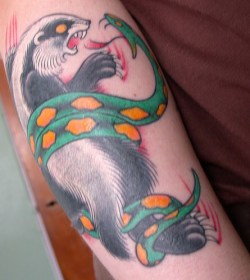
tattoo of badger fighting snake

I was unable to find an image of a snake-eating-a-unicorn tattoo, but I did turn up this snake-fighting-a-badger tattoo that I am thinking about getting sometime.
Photo © BreadnBadger | Flickr

Underidentification: “Ho ho ho! This is surely but an amusing temporary tattoo placed on me as a prank. It will certainly wash off in the shower.”

Medium-Low: “This tat is real, but I am going to wear long-sleeved shirts for the rest of my life to cover it up.”

Middle: “Living with this tattoo is going to be a b**** and a half, but it’s also kind of dope.”

Medium-High: “Short sleeves for me, baby.”

Overidentification: “This tattoo defines me, man. I’m going to tattoo the rest of my body with snakeskin and have a horn surgically implanted on my head.”

(Smith, Welcome to the Jungle. Conari Press, 2010)

The book is about bipolar disorder, which I myself don’t have (and no, I’m not just underidentifying). Still, especially as I got to the end of the list, I knew this applied to me.

Although I prefer not to call myself “a celiac,” I do give celiac disease, and being gluten-free, a lot of space in my life and identity. Sometimes, I wonder whether I’ve given it too much.

For example, when I renamed my Twitter handle @spruestory, I wondered if that was taking it too far. I mean, that’s my only Twitter handle, and it’s now named after my celiac disease blog. Was this really how I wanted to “brand” myself? Would I look back one day and wish I hadn’t?

Clearly, I decided it was worth it to change the handle (and that Twitter isn’t worth so much existential angst). After all, I’ll have this disease for life, so I doubt I’ll be looking back five, ten, fifty years from now and thinking, “Gee, I wish I hadn’t told everyone I had celiac disease.” Unless the whole world goes gluten-free or they discover a cure, five, ten, or fifty years from now I’ll still need to be upfront about my disease. I’ll still need to announce it on dates, to new friends in response to dinner invites, to strangers at restaurants before I order, to bosses and colleagues at work. It may not be the first thing I’ll talk about, but it will come up.

But will I one day wish I hadn’t talked so much about celiac disease? Will I wish I had identified with it less? Maybe. I wish it already, sometimes. But, as I said, this disease is for life, so I’ve got plenty of time to figure it out. Until I do, I think I’ll stay far away from tattoo parlors. No snakes, unicorns, badgers, or Xed-out sheaves of wheat for my bicep, thank you very much.

What about you? What do you refer to yourself as? Where do you fall on the snake-eating-a-unicorn identification spectrum? Has that changed over time? Are you happy with where you’re at now?

Tagged , , , , , , , , , , ,

Don’t know much about chemical sensitivity?

Have you seen the movie Safe?

It’s about a woman (Carol, played by Julianne Moore) who develops a mysterious and steadily worsening illness—most likely multiple chemical sensitivity.

I watched it in college. Though it was a great film, it encouraged me to dwell on my own mysterious illness, which had begun earlier that year. The film set up questions like, “Is her illness even real? Will she ever get better?” Watching it, I couldn’t help but wonder the same things about me.

Later, of course, I found out I have celiac disease, and that it could get better. I just have to not eat some things (okay, a lot of things). Except for avoiding crumbs, I don’t have to worry too much about my environment. I won’t find gluten in the air anywhere besides a bakery, and the worst chemical I contend with is natural flavorings.

cover of Allergic to Life by Kathryn Treat

But I remained curious about chemical sensitivity, which I didn’t know much about beyond its portrayal in the film.

Now, I’ve learned about it from Kathryn Chastain Treat, one of my earliest readers and strongest supporters. She blogs about her extreme chemical sensitivity, and she’s just finished a book: Allergic to Life.

To celebrate her book’s release, I asked her a few questions about what is still a misunderstood and mysterious disease.

Readers, we’d love to hear your answers to these questions, too!

What do you feel your experience has in common with the experience of people with celiac disease, gluten intolerance, or food allergies? What’s most different?

Kathryn: I feel that in some ways we are very similar. We can’t just go and eat anywhere or anything. I have food allergies, which causes issues similar to those that someone with celiac disease encounters when dining out or with family and friends.

What makes me different is that I have not only food allergies, but also sensitivities to chemicals (perfumes, colognes, fabric softeners) and mold. I do a lot of dining at outdoor cafes if they can tolerate my food allergies (which include foods that may contain mold, like vinegar and soy sauce) and if I can manage to find seating far enough away from someone who is very scented.

What misconceptions do people have about your illness? Which get you mad? Which do you think are just funny? How do you respond?

Kathryn: I believe people, including many in the medical profession, feel that my sensitivities to chemicals and mold are not that serious. They believe that if I can manage a short time in a store (with my mask) that I should be able to go anywhere anytime I want. I also feel that people believe because I do not work and stay at home that I just sit and watch television and eat bon bons in my fluffy slippers.

What makes me the maddest is not taking my symptoms seriously. I think the perception that I have all the time in the world because I don’t work is probably the funniest. They have no idea how much work it takes to stay as well as I have managed to get and how long it takes to clean my house.

I have responded that my total load of what my body tolerates varies from day to day. If I am having a good day, then I can make a trip to the store. I can’t do this every day or spend all day doing this because despite my mask, my body gets too overloaded with chemicals and I end up sick. Sometimes I just ignore it all together because it is hard to convince someone once they have their own preconceived ideas.

What’s the funniest thing that has ever happened to you as a result of being ill?

Kathryn: My younger daughter was here for a visit and we were scheduled to visit my older daughter. My younger daughter had her hair done earlier in the day. Not thinking (I blame my off and on again companion—brainfog), we just jumped in my car. Of course she put on one of my required tyvek suits to avoid bringing any fragrances or chemicals into my car. We started down the road, and about ten miles into our trip I was having difficulty. I was getting a headache, congested, and my voice was slowly getting more of a crackle in it. Suddenly it dawned on both of us that her hair was making me ill.

As soon as possible I pulled to the side of the road and we both jumped out. How were we going to make it safe for us to continue on our journey? We couldn’t go on the way things were and I couldn’t call anyone to come help us. We searched the back seat and then the trunk to find something we could put over her hair.

Aha! There it was, a white plastic garbage bag in my trunk. I always keep some in the car for emergencies or having to put someone’s belongings in it before they can ride with me.

We got the bag out of the trunk and tried to put it over her hair. The wind was blowing and gusts of air would get under the bag and fill it like a balloon. We fought and fought the wind and the air in the bag. Here we are on the side of the road, she is already wearing the white tyvek suit, and we are now trying to put a bag over her head.

Enter the highway patrol cruiser. Just as I thought things couldn’t be worse or crazier than they were, the officer gets out to see if we need assistance. I have to explain as simply as I can without appearing to be a lunatic that I have sensitivities to chemicals and my daughter has just gotten her hair done, making me ill. I also explained that we were trying to cover her hair up with the bag but the air kept getting inside the bag. I purposely tried to ignore the fact that she was dressed in this white suit. The officer, however, noticed and made some funny comment about her tyvek suit and Ghostbusters and then calmly walked over and helped us get the bag on her hair. I was then asked to move aside so that he could write down my license plate number, which was required because he had stopped to check our status. As he walked away, he said it bothered him too when his wife got her hair done.

The story doesn’t end there. A few weeks later our tenant came to pay rent. He was talking about having coffee with his highway patrol officer friends. One had commented about these two women on the side of the road and how he had to help one put a bag over the other one’s head. I immediately started laughing and told him that I was one of the women he rescued that day. Our tenant knows all about my sensitivities and about my story. He started laughing and said he couldn’t wait to tell this particular officer that he knows the women.

I knew the officer would most likely go back and tell the story to all his buddies. I mean, how often does this kind of thing happen?

Okay, now what’s the least funny?

Kathryn: The least funny thing was when I made a quick trip with my daughter into Target. We were getting what she and I needed when we ran into a woman pushing her shopping cart with a little girl trailing alongside her. She saw me with my mask and made the fastest turnaround I had ever seen someone make with a shopping cart. I am sure she thought that I was contagious, and what she never knew was that I was more likely to get sick being around her than her from being around me.

What book or movie character would you nominate as the mascot for chemical sensitivity?

Molly: This was my final question, but we’ve both been wracking our brains and haven’t come up with anyone yet (there’s gotta be a Harry Potter reference in here somewhere). I don’t want to nominate Carol, because Kathryn and Carol don’t seem too similar (watch the film and you’ll agree).

Can you think of one? Let us know if so! Also, be sure to share your own funny and unfunny health stories. And, of course, check out Kathryn’s book.

She is offering a giveaway of three autographed copies through Rafflecopter, and her book is available at Barnes and Noble and Amazon (prices vary). Autographed copies (US Only) will be available on her website.

This is stop #7 on her book blog tour, and you can find the rest on her blog.

Tagged , , , , , , , , , , , , ,
Design a site like this with WordPress.com
Get started