Tag Archives: celiac disease

Thanks and No Thanks: A Thanksgiving Game (with gluten)

Here’s a twist on Two Truths and a Lie to play at your Thanksgiving get-togethers this year: provide everyone with slips of paper and pens and have them write, on separate pieces of paper, one thing they’re thankful for this year, and one thing they’re not.

Collect the papers after a respectable amount of time (once all the Mary’s Gone crackers are gone and a few people have resorted to the veggie platter), and take turns reading them aloud. The group then tries to guess who wrote it, and whether he or she is thankful or unthankful for it. If you’re competitive, you can award points to those who guess right, and make the loser do the dishes. That’ll net you some thankful guests.

Untitled

Original image © woodleywonderworks | Flickr (cynicism is all mine)

To get you started, here are a few examples from me. This year, I find I have many things to be thankful for. But there are others for which I’m shaking my fist at the universe. Go ahead…see if you can guess which is which. (Highlight for answers—the whole page at once, if you’re lazy.)

Celiac disease diagnosis
  Thankful, I guess, though a miraculous recovery would’ve been better.  

That I stopped biting my nails
  Thankful.  

That I stopped being a slob
  Would be thankful, if it had happened.  

My totally GF NYC apartment
  Thankful. Although don’t ask me that at the bottom of the stairs.  

That my apartment-mate (Sprue Jr.) got stuck being GF too
  Not thankful! Boooo, universe.  

The 2013 GFAF Expo in Secaucus and other events
  Thankful.  

The way my stomach felt after sampling way too many things at said events
  Less thankful.  

Getting nominated as Rookie of the Year in the 2013 WeGo Health Activist Awards
  Super thankful! If you pop over and “endorse” me, I’ll be even more so.  

Bob’s Red Mill GF line
  Thankful: sorghum, flaxseed, amaranth, millet, cornmeal, brown rice flour, hot cereal, brownie mix, CHICKPEA FLOUR, and probably more make this one a no-brainer. 

Bob’s Red Mill GF chocolate chip cookie mix
  We all make mistakes.  

The weight I lost by going gluten-free
  Hahahahaha!  

Amazon Prime
  Thankful, but guiltily so.  

Corn and Rice Chex
  Ask my coworkers about the 16-box cartons of each that arrived to my attention courtesy of Amazon. Call it thankful but ashamed.  

The gluten-free tax break
  Ten months’ worth of lost receipts say no.  

The FDA ruling on gluten-free labeling
  Thankful. So good of them to wait till I was diagnosed to do anything.  

The few restaurants I can actually visit without it being considered an act of self harm
  I guess I sorta gave you that one.  

Dunkin Donuts going gluten-free
  I’ll believe it when I see it.  

The miraculous power of the human body to repair itself
  Check in with me next Thanksgiving.  

Games aside (and not to get all sappy on you), I have more in this almost-a-year of being gluten-free to be thankful for than not. Oh, sure, would I give back the incurable disease, the copays, the media scoffing at my diet, the bagel crumbs in the office kitchen? Yup.

But I’m grateful to have loving and supportive friends and family members; to live in the golden age of gluten-free food; and to be here at my childhood home, surrounded with stockpiled gluten-free equipment and ingredients waiting to come together into a meal we’ll all be able to enjoy tomorrow (the low-carbers, veg-heads, hockey-puck cranberry saucers, gluten-freebies, and all).

Oh, and I know I said I wouldn’t get sappy, but one more thing I’m thankful for is:
  You!  

Happy Thanksgiving! What are you thankful and not thankful for this year?

Tagged , , , , , , , , ,

The ABCeliac of It: Why Children’s Books Matter, and Are Secretly All About Celiac Disease

Since the moment I heard it existed, I’ve meant to visit the New York Public Library’s exhibit “The ABC of It: Why Children’s Books Matter.” Finally, on Sunday, Sprue Jr. and I found ourselves nearby while seeing our friend Jimena off on the bus back to DC, so in we went.

photo (31)On our way, we stopped in to the Winter Village at Bryant Park to look at knickknacks and watch the first of the season’s skaters wobble ’round the rink. We couldn’t resist stopping at a stand prominently displaying the phrases “gluten free” and “we bake it fresh daily”—music to our freezing-over celiac ears—and selling pão de queijo, a Brazilian cheese and yucca bread. (Another one of those “even better than the rolls you went in search of” naturally gluten-free foods.)

We tasted eight different delicious buns (they’re small!), among which my favorites were the pesto & goat cheese, chocolate chip, and pizza. If you’re nearby, I recommend you check it out, although I goofed on asking my normal questions about cross-contamination (taking it on faith, since the pão was the only thing being sold), so I suggest you do better due diligence than I did. For what it’s worth, I felt fine.

Now, to the exhibit. The library is beautiful; if you’ll be in New York around the holidays, you could get a wonderful afternoon out of the Winter Village plus the library, which is free to the public and as good as any museum (less crowded, too). We passed through another exhibit on games and plan to return soon for one on AIDS activism. There are murals and old books everywhere, and I didn’t spot a single typo in the descriptive placards (unlike at some otherwise awesome museums…cough MSI Chicago cough).

Because it was Sunday, the library closed at 5, when we were only halfway through the exhibit because we’d both been distracted by sitting down with some of our favorite books. I was struck, as usual, by all the hidden gluten-free plot lines waiting to be unearthed.

Take Madeline, for example.

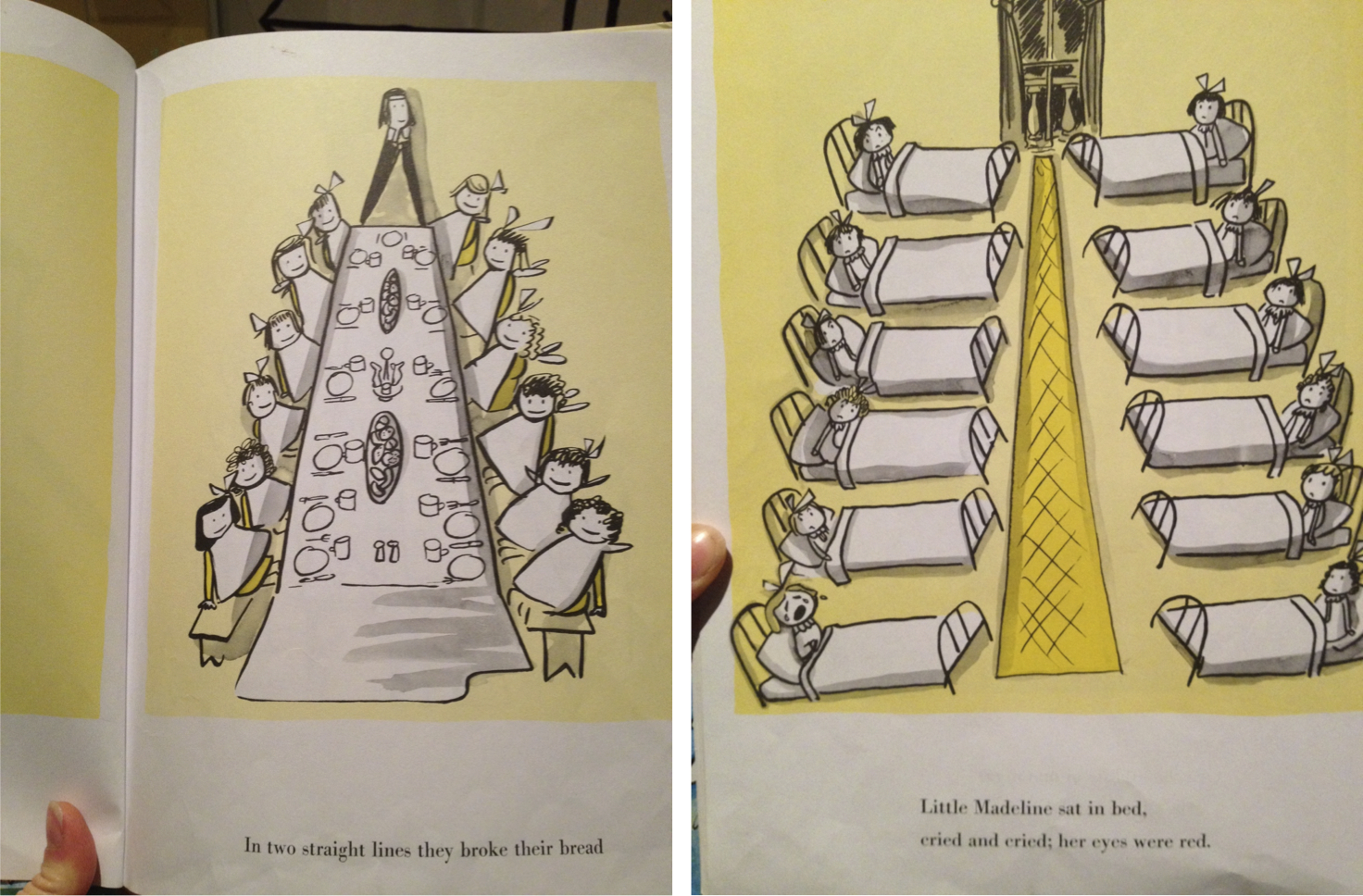
Cheerful little Madeline is the smallest, bravest, and all-around coolest kid among all the girls who reside in that old house in Paris that was covered with vines. But one night, after a long day of adventures trotting about the city in two straight lines…

madelineLook at that cause and effect! First Madeline eats bread, then she wakes up, crying, in terrible pain. Of course, the devoted Miss Clavel rushes her to the hospital, where a well-meaning doctor promptly removes little Madeline’s little appendix. Afterwards, Madeline seems good as new, but I can’t help but wonder if they got it right. (You know doctors.)

photo (33)

Celiac disease is, after all, often mistaken for appendicitis (with this study showing that appendix-removal surgeries are superhigh in undiagnosed celiac patients compared to healthy controls—the very low “P” value, my scientist sister explained, indicates the result is significant). Madeline’s small stature is also suspect. And I looked closely at her hospital food and didn’t notice a bit of bread on her tray. Maybe that’s why she perked up.

Of course, whether Madeline felt better because she lost her appendix or because she went gluten-free, the story would end the same: all the other girls want to be her. That little trendsetter.

Then there’s In the Night Kitchen.

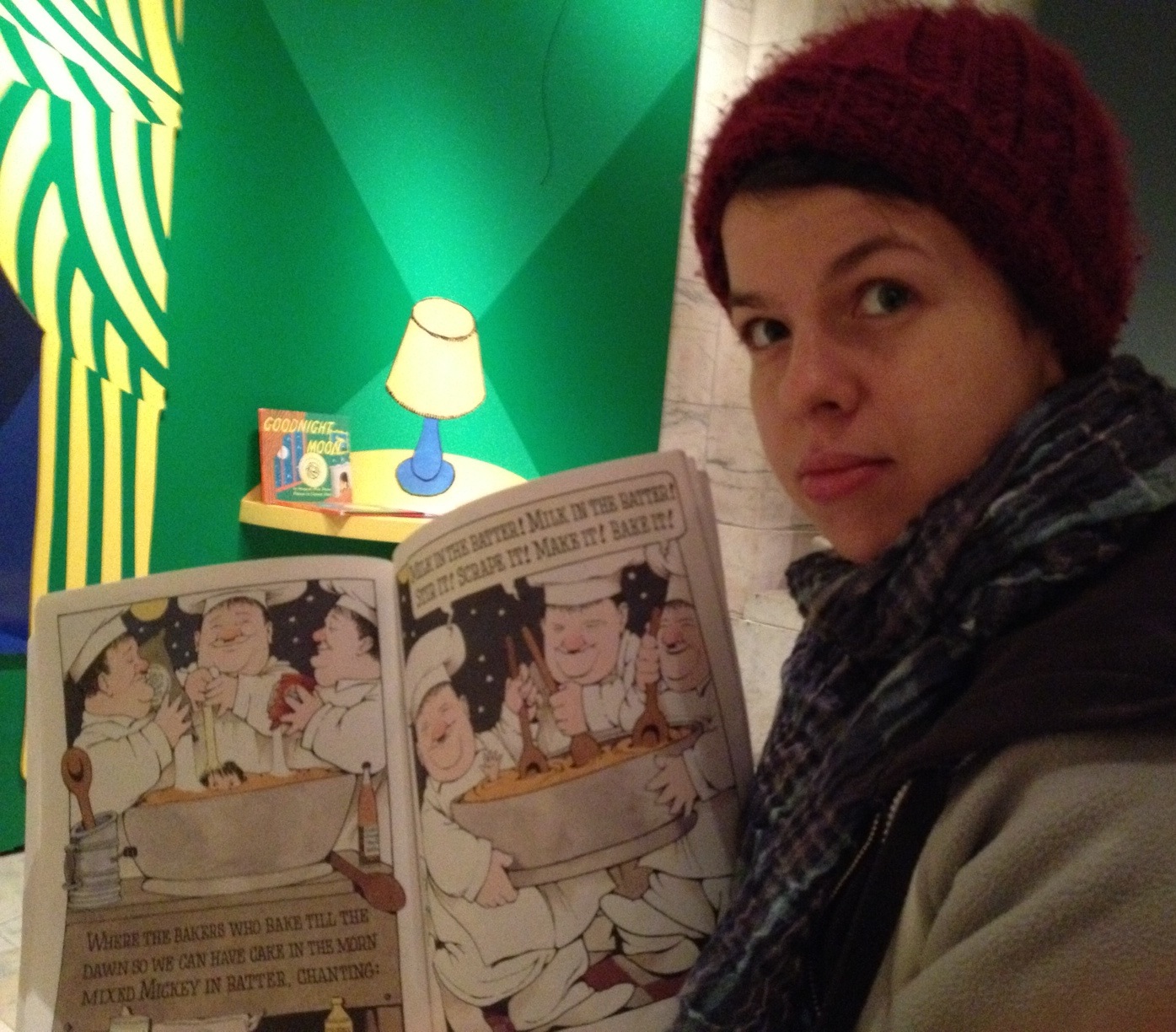
This book, by Maurice Sendak, explores the adventure of one little boy through a wild dreamscape in which gigantic chefs try to use him as milk in their “morning cake.” The illustrations are surreal and somewhat disturbing, verging on nightmarish—made even more so by my new perspective on the idea of being plopped into a huge bowl of batter. That’s one glutening I’m not sure I’d want to wake up from.

Click for a closer look at poor little Mickey sinking into the cake, but kindly ignore my “I’m still freezing even though I’m indoors” attire. New York got cold.

Click for a closer look at poor little Mickey sinking into the cake, but kindly ignore my “I’m still freezing even though I’m indoors” attire. New York got cold.

Bakers, please note: I’m not the milk, and the milk’s not me—I’m Molly. So take your enormous bags of flour and stay out of my dreams.

I also sat in a Phantom Tollbooth–style car, watched Alice grow till her head hit the ceiling, and paged through CorduroyThe Stinky Cheese Man, and other tales that still matter to me as much as they ever have. I won’t turn all of them into celiac stories, but I’ll leave you with one more:

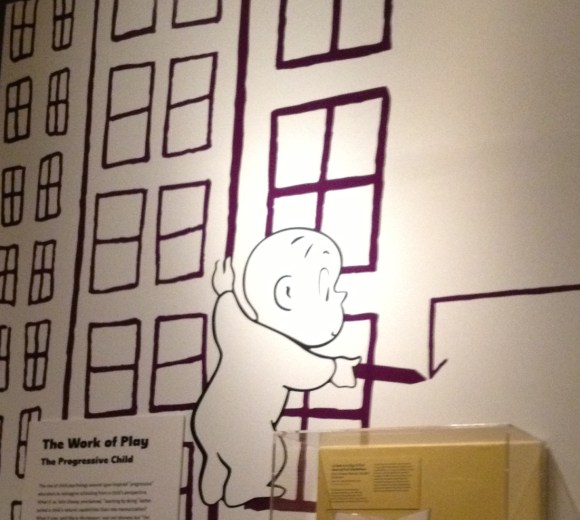
That’s Harold and the Purple Crayon, of course.

photo (34)

With his crayon, Harold shows us what we should be doing every single day: creating around ourselves the world we’d like to see.

Do you, for example, want to see a more gluten-free world? What about a peaceful world, a happy world, a just world? Regardless, take a page out of Harold’s book, and get out there and make it. If just one children’s book inspires just one child or adult to change just one part of their world, I’d say that children’s books matter indeed.

What’s your favorite children’s book? Did you have any fun gluten-free adventures this past weekend? And when’s the last time you pulled out a crayon and started drawing?

Tagged , , , , , , , , , , , , ,

Gluten in beer? Little is clear. (On Omission, “English beer,” the Gluten Summit, and other mysteries)

You know the old saying, “Beer before liquor, never been sicker. Liquor before beer, you’re in the clear”? Then you may also know that neither half is true: it’s not the kind, but the total amount of alcohol (and water) you drink that determines how ill you feel the morning after.

But, for those of us with celiac disease or non-celiac gluten sensitivity, beer—in any amount, before or after the tequila shots—contains enough gluten to make us sick. That, my friends, is true.

Or is it? This past week, the internet’s been abuzz about two surprising claims regarding gluten in beer.

various beers in glasses

Not gluten-free. (Right?!)
Photo © Cambridge Brewing Co. | Flickr

Omitting Omission no more?

On Monday, the Celiac Sprue Association (CSA), one of several organizations we rely upon—for better or worse—to certify gluten-free products, announced that it has recognized Omission beer as gluten-free.

If you happen to have missed it, Omission is a beer made with hops, yeast, water, and…malted barley. As I’m sure you know, gluten is found in wheat, rye, and barley. Going simply by that definition, one might suspect that Omission is not gluten-free.

However, there’s an added confusion (isn’t there always?): according to Omission, the barley has been processed in such a way that the gluten may be considered removed (or as good as removed). Any “small pieces” that remain supposedly won’t set off our jumpy immune systems the way gluten usually does.

Omission’s own website helpfully (and buttcoveringly) includes an archive of the tests they’ve run on every batch of beer brewed, where skeptical consumers can see for themselves that their beer tested below 10 ppm gluten. The only problem is…we don’t know for sure that the test they used (RIDASCREEN® Gliadin competitive ELISA [Art No. R7021], if you’re curious) actually works.

Gluten is not just one protein; it’s a composite, and slightly different versions of it appear in wheat (gliadin), barley (hordein), and rye (secalin). Although the test is intended to detect all of them, others think it might not be sensitive enough to hordein (in barley and, therefore, Omission). If the test can’t find the particles, there’s no way to know whether they’re there or not. The Omission website admits, “Although scientific evidence supports the testing, the evidence is not conclusive.”

Because of all the confusion over Omission (further explained, very well, here), many of us have chosen to skip it. So when the CSA gave its seal of approval to the beer, the outcry began. Posts at Gluten Dude and Gluten-Free Fun, among others, pointed out contradictions between the CSA’s described standards for certification and its stance in the press release on Omission beer.

1402449_648992828474258_911669928_o

From my perspective, the main issue is the way the CSA gave us the news. The press release indicates that it tested Omission using not the perhaps-faulty ELISA test, but rather mass spectrometry testing, perceived to be more accurate for detecting hordein.

Unfortunately, the press release didn’t address the differences between the tests (and introduced further confusion by including a blurb, presumably provided by Omission, that references the company’s own ELISA testing). So for us reading at home, it’s hard to see why the CSA has suddenly reversed their stated position that “‘Ingredients ‘specially processed to remove gluten’ [are] not allowed—with present available commercial methodology the extent or consistency of the processes is not measurable.”

The CSA has now updated that portion of their “Defining the Term Gluten-Free” page to also read, “Allowed if documented absent of celiac toxic amino acid fractions.”

There are two problems with this revised definition:

  1. The old definition still appears, so it’s an internal contradiction. If available methodology can’t measure the extent of gluten in specially processed grain ingredients, then how could those ingredients be “documented absent” of gluten? The CSA needs to take a position on mass spectrometry testing as an improved alternative to ELISA testing, not just put both “It’s not okay” and “It’s okay” in their guidelines.
  2. The change went up after the press release. You can’t just change your standards to make way for a product you want to approve—and I’m not sure that’s what the CSA was doing, but it sure looks that way. If you’re updating your standards, update the standards first, then approve the product that now fits them.

We now have trouble understanding the CSA’s guidelines and less ability to trust their judgment. So is Omission beer really gluten-free? Hard to know.

Some people won’t eat or drink anything that contains a gluten-containing grain, no matter how processed. But most of us do drink distilled spirits (such as vodka) derived from wheat, rye, or barley, since they’re considered to be gluten-free according to the best possible tests.

If new, validated technology indicates that beer can now be processed similarly to vodka to destroy its gluten content, then fine. Great! But I’m not sure yet that the technology is validated, and the CSA hasn’t convinced me (or really bothered trying). We’ll see what statements come next, but they’ve already messed up by not making their position on mass spectrometry testing clear before stamping Omission as approved.

Oh, but actually, all beer is gluten-free. Wait, what?

On the other hand, Dr. Michael Marsh—yes, he of the “Marsh” I, II, and III classifications of villous atrophy, a celiac expert for sure—might say that all this hullabaloo is for nothing. At the “Gluten Summit” on November 11th, he went on record that it’s perfectly fine for those with celiac disease to drink “good English beer.”

I bet he doesn't know if it's gluten-free, either. Photo © Erik Gustafson | Flickr

I bet he doesn’t know if it’s gluten-free, either.
Photo © Erik Gustafson | Flickr

If you skipped the Gluten Summit, I don’t blame you. Such a mishmash of experts and quacks I have never seen united in one place. In the Marsh interview—the only one that I watched in full—the interviewer asked leading questions (which Marsh answered with such polite negations as, “Ah, [sigh], well, maybe it would be nice to think of that in that way. I’m really not sure [pause] that that is so”), and didn’t manage to establish an agreement with Marsh on the actual definition of gluten sensitivity (fair enough, since no one has).

So when Marsh announced there’s no evidence that beer (specifically English beer) contains gluten, I thought that either it was true (because he seemed like the reasonable one) or that he was pulling his interviewer’s leg. When I scouted around, I found:

  1. Dr. Marsh has made this claim before.
  2. No one else seems to be making the claim.
  3. The gluten content in beer has been tested—here, for just one example—and proven to exist.

Is “English” beer, like Omission, processed in such a way that the gluten is absent or no longer harmful? And have most sensitive measures (e.g., mass spectrometry testing) proved it? I don’t think so! So far as I can tell, the answer is “no.” English beer comes in as many varieties as any other beer, if Wikipedia can be believed, and English beer brewers such as St. Peter’s distinguish between gluten-containing and gluten-free varieties.

If there’s a loophole here, I’m not seeing it, and Marsh didn’t prove it.

To conclude…

The CSA and Dr. Marsh are experts, in their respective ways, on celiac disease and gluten. But I don’t just take the word of experts—no informed consumer does. We look to their evidence, and their standards for gathering it. In this case, neither Marsh nor the CSA has convinced me of anything. They’ve left me with more questions than I had before.

Now, I don’t even like beer. Never did. So while everyone else bickers about mass spectrometry vs. ELISA testing, English vs. Omission beer, I’m happy enough to just move on. If you, like me, prefer wine anyway, I hope that we can share a cheers to that, and work this out later.

Have you been following one or the other of these controversies, and where do you fall? Are you in favor of developing gluten-removed ingredients or would you rather steer clear? And what the heck is “English beer”?

Tagged , , , , , , , , , , , ,

How I accidentally terrified my peanut-allergic friend

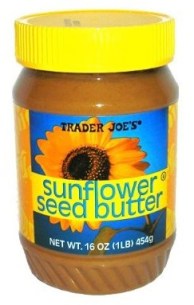
trader-joes-sunflower-seed-butter…and you can, too—not that you should—in three easy steps:

Step 1. Buy sunbutter.
Step 2. Make buckeyes.
Step 3. Serve.

See, I like peanut butter. I like peanut butter a lot. Give me Thai peanut sauce, Reese’s cups, Nutter Butters, any flavor of Peanut Butter & Co.—if it’s peanuts, I’ll eat it.

I have a friend, whom I’ll call B., who is allergic to peanuts. When I discovered that sunflower seed butter (or sunbutter) has a taste and texture like peanut butter’s, I was surprised to learn B. had never tried it. No peanut butter and no peanut butter substitute? How did he live?

Sprue Jr.—that’s Althea, who thought she should have a special name on my blog, and should be more careful what she wishes for—loves peanut butter, too. We always have a jar in the fridge, and we sometimes even make our own. (Lightly salted Planter’s peanuts make the best peanut butter ever, and if you add in pumpkin puree and pie spices, it’s all over.)

So, at a party we threw, we decided to show B. what he was missing. We made all the food not only vegetarian and gluten-free, but also peanut-free, tree nut–free, and soy-free (because a soy-intolerant friend of ours was also attending). We wanted to ensure everyone could try everything, without feeling nervous. It’s just nicer that way.

Now, buying groceries with gluten in mind is annoying enough, but this was harder still. I’ve never been more grateful for my smartphone. I scrutinized package labels and manufacturers’ websites until I thought my eyeballs would fall out and roll away down the aisle. It seemed every brand of chocolate that wasn’t processed alongside wheat was processed alongside nuts—or, failing that, contained soy.

Once I had found acceptable ingredients and resecured my eyes in their sockets, Sprue Jr. and I had a wonderful time rolling slightly-too-warm sunbutter balls around in not-really-tempered chocolate. By the way, the forks method only works for the first dip.

Clockwise from top, we've got white-chocolate- and dark-chocolate-covered no-bake cake truffles, dark-chocolate buckeyes, more truffles, marshmallow-swirl brownie bites, and milk-chocolate buckeyes. And you probably recognize the berries.

Clockwise from the top, we’ve got white-chocolate- and dark-chocolate-covered no-bake cake truffles (made with KAF vanilla cake mix), dark-chocolate buckeyes, more truffles, marshmallow-swirl brownie bites (made with Bob’s brownie mix and marshmallow fluff), and milk-chocolate buckeyes. You probably recognize the berries.

Despite the not-fit-for-the-Cooking-Channel preparation, the buckeyes, once set overnight in the freezer, tasted perfect. When I carried the desserts platter around at the party (to collect the oohs and aahs and you-MADE-this?s), I thought B. would be thrilled.

Instead, he took the candy with trepidation and said, “It smells like peanut butter.”

Silly me, I nodded enthusiastically. Sprue Jr., who was standing by, did too. We know!, I suppose we were both thinking. Isn’t it great?

“Are you sure there’s no peanuts in this?” B. said, and it finally dawned on me he was nervous. We assured him it was safe—not processed alongside nuts or anything—and he took a bite.

“It feels like death coating my tongue,” he said.

Crestfallen, we began a chorus of apologies and oh-nos.

“No, it’s good,” B. continued, “but it tastes just like what I imagine peanut butter would taste like.” Later that evening, he exclaimed—more than once—that he couldn’t believe he wasn’t dead.

He later elaborated, in email,

At the time it felt really strange…I had this visceral sense that I was eating poison. Whenever I smell peanut butter there’s this burning in my nose—not because of an allergic reaction, I don’t think, but my body just knows it’s poison, and it mixes my immune system with a fear reaction and the adrenaline starts pumping and I just know something is terribly wrong. And sunbutter smelled exactly the same way to me, or at least my body had the same response, so it was hard to force myself to just eat it…

Of course, I didn’t intend to scare B., or make him feel like he was being poisoned. All I wanted was to share something I enjoy with him, the best way I could. But he hasn’t had sunbutter again since the party, and though he said that the aftertaste was clearly sunflower seeds, not peanuts, and that he’s not opposed to trying it again, he clearly didn’t respond with the “here’s what I’ve been missing all my life” sense of joy I’d been expecting.

The experience showed me how different it is to have celiac disease, diagnosed in my twenties, than to have anaphylactic food allergies from birth. There are specific things I have happy memories of eating, and therefore want to recreate now. For someone who has never had anything but scary or painful memories associated with a food, there’s understandably less reason to find a substitute. And, although I can certainly relate to being nervous that something I’m eating might turn out to contain gluten, accidental peanut exposure poses a more immediate risk for B.

The lesson here is this: If you, like me, love peanuts, and have a friend who can’t eat them, by all means make and serve these delicious buckeye knockoffs (taking, of course, the same cross-contamination measures you’d want someone to take for you).

But remember: one man’s favorite is another man’s poison. Your friend may not run right out to buy a year’s supply. If not, well, more sunbutter for you. And the only thing scary about that is how quickly you’ll go through it.

Do you like to eat “free from” substitutes for old favorite foods? Is there anything you draw the line at trying? And are you a peanut butter or sunbutter fan, too?

Tagged , , , , , , , , , , ,
Design a site like this with WordPress.com
Get started