Tag Archives: celiac disease

Not enough celiac awareness? I’ve got plenty.

So we’ve come to Celiac Awareness Month. I’m excited for all of the special features and extra blogging everyone will be doing this month, and maybe I’ll even get out to an event or two in the real world. But for myself, I’m mostly going to keep doing as I’ve been doing. Because I’m already celiac-aware. Celiac-hyperaware, you might say. If you split open my skull to check, my brain might look something like this:
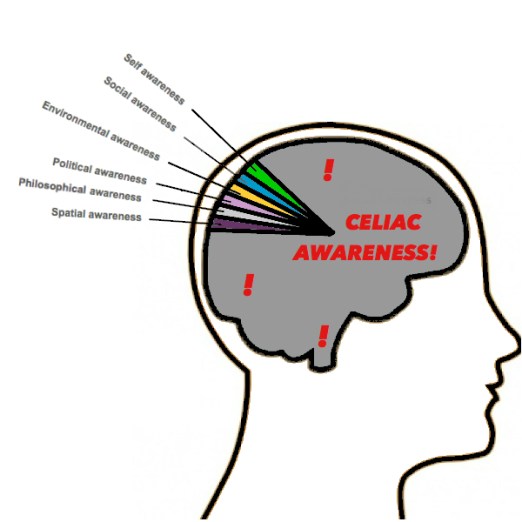
celiac_aware_brain

Okay, maybe with a little less space for spatial awareness. But you get the picture.

Point is, I already devote a lot of gray matter every day to thinking about, talking about, writing about, obsessing about celiac disease. If I could only remove tiny hunks of my brain tissue and implant them in other people’s brains to repopulate their awarenesses, then they could think a bit more about it, I could think a bit less about it (and more about my novel), and we’d have ourselves a healthy celiac awareness ecosystem. Like a fecal transplant!

In a small way, that’s what I’m trying to do with this blog. (The awareness transplant, not the fecal kind.) Although, let’s be honest here, most of you are pretty darn celiac-aware already.

When I learned I had celiac disease, I started from a point of heightened awareness. I’d been researching food-related illnesses for some time—call it a hobby—and in my professional life I worked (and still do) with gluten-free cookbooks. I also reaped the benefits of living in a place and time that is in fact more celiac-aware (or at least gluten-aware) than ever before.

But I definitely became more aware once I had it myself. I started this blog, I saw celiac symptoms in everyone I knew, I began musing on grandiose ideas like hosting gluten-free speed-dating events or providing gluten- and allergy-free birthday cakes to kids whose parents can’t afford them. So far, these ideas have foundered on the shoals of logistics. If you live in New York and want to talk about any of them, please get in touch!

Although I’m enjoying this blog and being a part of the smart, supportive, friendly community here on the internet, I’ve struggled with this. Given that I have celiac disease and I think a lot about celiac disease, I feel vulnerable to the claim it’s “self-indulgence” more than “celiac awareness” that fills my brain. I feel guilty.

For example, when I wrote about the connection between hunger and celiac disease, I looked into how one could donate gluten-free food. But then I thought, where was I before I knew I had celiac disease? And even setting that aside, where have I been in general? The hurricane that wiped out huge portions of the New York metro area happened months ago, and no doubt the best time to begin contributing would have been in October.

Plus, hunger was of course a fact long before that, a systemic problem affecting an enormous population nearby me and worldwide. I knew that well before the fall of 2012. Why haven’t I been better about contributing to the solution? Why has it taken me having a problem to want to help others? And why is the idea of donating Rice Chex so much more appealing to me than the idea of donating money to a general fund for the hungry?

Then I get cynical. I wonder, does every celiac disease advocate have celiac disease? Are all food allergy advocates people who have, or whose family members have, food allergies? Are all antiracism activists all people who have experienced racism? Are all GLBTQ activists GLBTQ? Are all feminist activists women?

Is all activism selfish?

Are we all too wrapped up in ourselves to get involved in helping people whose concerns are foreign to us? And is a disabled person who spends his life advocating for disability awareness less noble than an abled person who does it?

I believe the answer to all of these is no. There are people who advocate for others almost reflexively, whether or not there’s a personal connection. There are entire industries built around nonprofits and public service that allow many, many people to work or volunteer in support of awareness or advocacy campaigns of all kinds.

And furthermore, I don’t think activism is really cheapened by being beneficial to its advocates. If someone spends a lifetime advocating for the rights and happiness of a population to which he happens to belong, is that so bad? Plenty of other people are part of the same population, and not doing much to help it or any other group.

A life of service is a good life. Sacrifice and selflessness can support a life of service—but only to a point. If you feel unconnected to your work, you’re more susceptible to burnout. And if you have the impulse to help but allow yourself to be stymied by regret that you didn’t help enough before, or aren’t helping enough people, or aren’t helping for the right reasons, then you won’t end up being helpful at all.

Part of any awareness campaign must be an awareness of just how many things there are to be aware of. There are good and bad causes, selfish and selfless concerns competing for everyone’s attention at every moment. By focusing our energy on one concern, we’re setting aside others.

I aspire to be aware of suffering, injustice, and inequality, broadly speaking. I hope that my daily words and actions demonstrate this, and when they don’t, I hope to be called on it so I can do better. I hope that as my life evolves and settles, I find the time and the energy to help more people more than I do now. And in the meantime, I’ll strive to be self-aware about my own divided awareness.

That said, bring on the Bob’s Red Mill giveaways. I’m ready.

Happy Celiac Awareness Month, folks.
Tagged , , , , , , , , ,

Gluten nightmares (plus gratuitous cute baby photos!)

Do you dream in gluten?

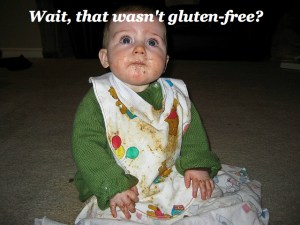
If so, maybe you’re familiar with this nightmare: Someone presents you with a plate of cookies and tells you they’re gluten-free, then after you’ve eaten several…

2251078825_031ea94673_z

Original photo © tgilbers | Flickr

6696505675_c139d8c12d_z

Original photo © Lesley Show | Flickr

3680125_570588ff55_z

Original photo © Kris Krüg | Flickr

My first-ever gluten nightmare was like that (but without the adorable baby photos). I think in the dream it was my mom who gave me the cookies—sorry, Mom, I know you’d never really do that!

Last night I had a new one: I dreamed I ate a box of Triscuits. When someone pointed out Triscuits aren’t gluten-free, my dream self was baffled. “I just…forgot!” she said.

Ha, ha, dream self. No forgetting allowed.

And, of course, there’s the ever-recurring waking nightmare of the newly diagnosed: It’s a year from now, and my doctor is showing me my chart and saying, “Turns out, you’re an asymptomatic celiac who just happens to have lots of other stuff wrong with you!”

Terrifying.

Luckily, even after a sleepless night, cute photos of children eating cookies always cheer me up.

Tell me your gluten nightmares! And if you’re dozing off at your desk this Monday morning, here’s wishing you sweet but gluten-free dreams.

Tagged , , , , , , , , , ,

Help me write a letter to my doctor

Last week (erm, two posts ago…gosh, I’ve been lazy) I asked why doctors can’t just talk to each other. I wondered if all my docs could have put their heads together and figured me out faster. The consensus was “maybe, maybe not.”

Photo © Ben Weston | Flickr

Even though celiac disease is associated with a huge range of symptoms affecting virtually every system and function of the body, with implications going well beyond the gastrointestinal, it’s GI doctors who are overwhelmingly responsible for diagnosing it. Other doctors are less likely to be trained in recognizing it, and apparently also less likely to care. (Back in February, Jess of The Patient Celiac posted a selection of anonymous comments on an online doctors forum that included this gem: “Ugh. Is there any disease more boring and worthy of turfing to the GI guys than Celiac Sprue?”)

So although in an ideal world, any of my doctors could have diagnosed me separately or in collaboration (or a supercomputer could have), in the real world it was pretty much down to the one who specialized in intestines to diagnose me.

But she didn’t.

I saw a gastrointestinal doctor for the first time back in December/January of 2011 after half a year of symptoms (my insurance made it hard to see a doctor earlier, since I was in college out of state). In that half a year, I’d had an emergency room visit, I’d tried a strict low-FODMAP diet with no results (besides an initial placebo high that wore off after a week), and I’d worried a LOT.

The GI doc did a colonoscopy but—inexplicably—not an endoscopy or at the very least a blood test for celiac disease. She wasn’t interested in talking about food (turfing it to the dietitian guys, I suppose, though she didn’t set me up with one), and she sent me on my way with OTC meds and all but a pat on the head.

Since I first got my positive bloodwork results, even before I had a fully confirmed diagnosis of celiac disease, I’ve been toying with the idea of calling or writing to this doctor. Now that it’s nearly May—celiac awareness month, as you may be (heh) aware—it seems like a good time to follow through.

What I want to accomplish here is:

1) Tell her my story
2) Understand why she didn’t test me for celiac disease (or, if she did without my being aware, why she never contacted me with the results)
3) Let her know, if she doesn’t, that my particular symptoms are commonly associated with celiac disease
4) Encourage her to test for celiac disease before diagnosing IBS in the future.

What I don’t want to do is:

1) Come off as whiny
2) Come off as condescending
3) Offend her sense of her own expertise
4) Be immediately dismissed
5) Threaten a lawsuit.

Unfortunately, I’m a whiny, condescending, offensive, easily dismissed person prone to making accidental threats. So I need your help!

Have you ever written this kind of letter? Whether or not you have, do you have any tips for me? Any specific things I should say or not say?

Is it better to do this in writing or over the phone (in your opinion or experience)?

Do you feel this kind of patient-to-doctor education is possible and worthwhile? What are other ways to go about it?

Tagged , , , , , , , , ,

Why don’t doctors just talk to each other?

You know that old conversation starter/essay prompt, “If you had to pick five people, famous or not, dead or alive, real or imaginary, to invite to a dinner party, who would you choose?”

There are variations with different numbers and types of people, but the question’s basic thrust, I think, always comes down to a mix of “Who do you most want to talk to?” and “Who do you most want to talk to each other?” In other words, what combination of people in all the world and all of history do you feel would produce the most interesting dialogue?

This question was an option for my college admissions essay. I didn’t choose it, probably because I feared my taste in famous and historical companions would not pass muster. I’m still not sure it would, even after my four years of cultural grooming.

But lately I’ve been thinking about it again, not so much in terms of a fantastic philosophical discussion I could arrange, but in terms of a conversation I could trigger that would have immense utility for me personally. What if, a couple years ago, I’d thrown a dinner party for all of my different doctors—my old general practitioner, the emergency room doc I saw one time, the gastroenterologist who prescribed OTC medication, the ob-gyn, the dentist—and proposed the conversation starter “Diagnose Molly”? (Personal health makes for great dinner conversation.)

Could they have done it? Could they have laid out all my different symptoms on the table and connected the dots, instead of each focusing myopically on a different piece of my health? Or would they refuse to talk to each other, kick each other under the table, pick at their meals? Would the GP look down on the GI doc and the emergency room doc fixate on his beeper and the dentist drift into fantasies of his future yacht?

Maybe they’d manage it if I threw a celiac disease expert in there. Or gave them access to WebMD.

Wouldn’t it be nice, though, if instead of a splintered, segmented health care system, we had doctors who spoke to one another? Of course, doctors have so many other patients to deal with that they would never have time for a little conference focused just on me.

But what if they . . . you know . . . shared their records with one another in an organized way, using the advanced technology we have available for preserving and sharing information? Might that not have helped? Might the pieces not have come together faster?

Is that such a fantasy? Is it science fiction? If you ask me, it shouldn’t be.

I’m off to Washington, DC, today to visit my brother and see some cherry blossoms. Have a nice weekend, and tell me who you’d invite to a dinner party if you could pick any five people.

Tagged , , , , , , , ,
Design a site like this with WordPress.com
Get started