Tag Archives: celiac disease

Good news, bad attitude

Guess what.

My test results came back!

I had been anticipating them with the same bated-breath anxiety that has preceded every report card or grade posting in my life (like I said, total Ravenclaw). When the email appeared in my oft-refreshed inbox, here’s what I found:

My tTG antibodies, which in January were hovering at some nebulous above-100 level, are down to 4. Single digits, baby! With the “negative” range defined as 1 to 3, that makes me practically normal.

My vitamin levels, which we all know I was having some trouble getting up, are now normal to HIGH, thanks no doubt to the multivitamin I’ve been dutifully taking (increasing my risk of cancer with every milligram, if the New York Times is to be believed). The one exception is the still somewhat low vitamin D, which is hard to believe considering how much sun I get. I mean, look at this healthy glow:
Photo on 6-27-13 at 8.51 PM

My WBC is just barely low and my RDW is just barely high, which according to Google indicates anemia, or maybe AIDS, or, most likely, nothing.

Everything else? Normal, normal, normal. Normal!

This is good news. It means my body is backing off. It means I’m doing this gluten-free thing right. It probably means, as my sister reminded me, that the Arrowhead Mills popcorn was perfectly safe. Phew!

With the active siege nearing an end, I suppose it also means that my little sprue city has begun to recover. Somewhere deep inside me, villi are getting to their feet, stretching out, feasting on now-overabundant nutrients. At peace at last, my body will, I suppose, turn its attention to patching wounds and rebuilding infrastructure and, from there, to business as usual. The battle is won.

But, like any good pessimist, I’m not satisfied. Eating away at the sense of victory is the fact that I still feel about the same.

If you’ll permit me to return to the report card metaphor: It’s a bit like getting an A in a class without feeling that you actually learned anything. There’s a sense that the instructor missed something, that the serviceable papers you wrote and the multiple-choice bubbles you filled in merely concealed the depths of your ignorance. That if the grader were just a bit more perceptive you’d have failed.

Thus, the picking through the results for abnormalities; thus, the restless Googling of unfamiliar abbreviations; thus, the overwhelming urge to diagnose myself with latent adult-onset type 1 diabetes or Sjögren’s Syndrome or acute hypochondria. Like any objective, abstract metric, the test results are unconvincing in the face of my subjective but oh-so-concrete feeling of being unwell.

I’ll see my doctor in a couple weeks to discuss the results, and if the visit is anything like the last one, she’ll tell me not to worry, that this takes time, that a handful of months—however long they’ve seemed, however many blog posts you’ve crammed into them—are brief in the scope of celiac recovery.

In the meantime, I’m curious to know, for those of you with celiac experience: which went first, the symptoms or the antibodies? 

And, for everyone: how do you think I should celebrate?

Tagged , , , , , , , ,

So…was the popcorn gluten-free?

For those of you who have been eagerly awaiting word on the Arrowhead Mills popcorn question, I have an update. I finally got around to calling their customer service line yesterday (there was no great rush since I had, after all, already eaten it all).

Photo © Joakim Wahlander | Flickr

Photo © Joakim Wahlander | Flickr

The woman I spoke to—following some appropriately corny hold music—confirmed my suspicion: the popcorn is not made on dedicated gluten-free lines or in a dedicated facility. However, she assured me that they follow “good manufacturing practices” of sterilizing lines between runs, etc. She said that any of their products that have already been found to contain less than 20 ppm gluten would have the gluten-free symbol on the bag, and that they’re working on testing their way through all of their products. They have not yet tested the popcorn.

I asked, “So, conceivably in six months’ time, the popcorn might have a gluten-free symbol?,” but she said she didn’t know and couldn’t speculate on the timeline. Fair enough, because I’m sure the last thing any company wants is some blogger hopping online and posting false promises that, say, all of their products will be gluten-free by 2020. Plus, unless I stumbled across a Time-Turner, it’s not as though knowing their product will be confirmed gluten-free in six months would do me any good.

I wondered why they would test some of their products but not others, and why it takes so long to test everything. Is testing for gluten that expensive and/or time-consuming? Does anyone have any insight into this?

A couple of you commented that most popcorn should be safe. Personally, I’ve noticed some issues after eating popcorn, but there’s a good chance my weary GI tract just isn’t happy about handling large bowls of air- and fiber-filled corn right now. That’s not going to stop me from eating it, but I am going to check around for another popcorn brand. Though the Arrowhead Mills stuff might be safe, I’d feel better knowing the popcorn was either tested for gluten or processed far, far away from gluten. I will still buy other Arrowhead Mills products that say “gluten-free” on the bag, because it sounds like they have their act together.

Since the Arrowhead answer was a resounding “I don’t know,” I don’t really know whether or not to doubt my old air-popping cauldron. It’s been starting to die anyway, so I may just take the road of “When in doubt, throw it out” and get a new one.

On to another kind of testing: this morning I got NINE vials of blood taken out of my arm, to find out if my gut is still gutting itself. (The phlebotomist assured me I still had plenty of blood left in me; I’m not so sure.) As I left the lab, I found myself thinking, “Celiac’s blood…that’s got to be an ingredient in some kind of potion.”

Tagged , , , , , , , , , ,

Playing spoons

Are you a spoonie?

Photo © Holger Eileby | Flickr

Photo © Holger Eileby | Flickr

No, I didn’t mean Moonie. The word spoonie is a catchall term for people with chronic illnesses or disabilities. I first learned it from Rachel’s fantastic blog Do I Look Sick?and then I started seeing it all over: in other blogs, Tumblrs, Twitter bios and hashtags, even tattoos.

It’s a catchy name, in my opinion, because it’s a bit silly (and therefore a more pleasant self-descriptor than, say, patient or sufferer—ugh) and because it brings together people who share similar concerns but risk never realizing it because of the differences between their particular conditions.

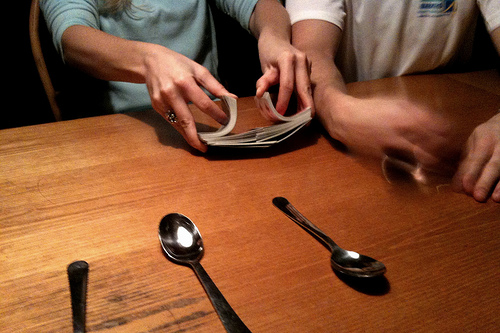
The term comes from “The Spoon Theory” by Christine Miserandino, Christine’s story of explaining to a friend how it feels to live with lupus. Since they were at a diner, Christine used spoons as a visual aid. She collected a pile of them and said that these were her spoons for the day. Everything she needed to do for the day, simple or complex, would require one or more spoons. She then talked her friend through her daily routine to demonstrate the choices and sacrifices involved in living with a limited amount of spoons. There’s a sweet end to the story—click the link to read it in full. (You can also play a demo to get the idea.)

The spoons, of course, are simply a metaphor for energy. Not necessarily a perfect one: After all, sometimes energy just seems to disappear for no reason, which spoons do not, unless they’re being collected in someone’s bedroom awaiting a dishwashing session, or being snuck out from under your nose in a game of Spoons.

Photo © tsmall | Flickr

Photo © Tom Small | Flickr

Still, the story spoke to me in a way that stories in this genre generally don’t. It perfectly captured how I feel when my friends want me to, e.g., stay out later than I planned: If I do it, I’m choosing to throw away my entire next day because I’ll be too tired to do anything. And if I’m too tired on a Sunday to do my errands and laundry and cook for the week, those things most likely won’t happen at all that week because I’ll be too tired after work to do them. Not to mention that my body does at least a little better with routine, and I hesitate to lose that edge by messing too much with my sleep cycle. To say all that is so much more whiny and defensive than simply, “I’m out of spoons.”

Of course, everyone has their own energy level, and many healthy people—particularly mature people—do think about how best to parse out their energy to avoid burnout. But I, with my lack of nutrient absorption and all that, have fewer spoons than a lot of my healthy 20-something friends do, and more to lose by using them unwisely.

Lately, despite careful GFD adherence, I seem to have even fewer spoons. Avoiding cross-contamination in a shared kitchen adds extra little steps to my routine, all of which take spoons. Gluten fear probably snags a few more spoons. Plus, giving up caffeine has been like dumping an entire cutlery drawer into the trash. (Upside: I’m sleeping more. Downside: All that sleep is really cutting into my writing time.)

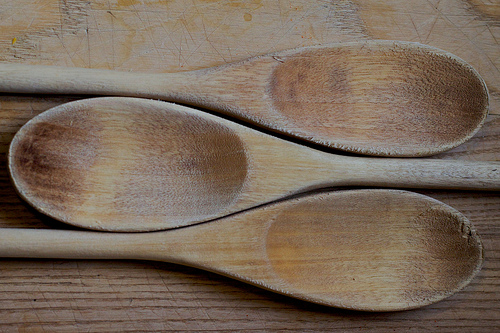
Pretty, and probably super gluteny, wooden spoons  © Alan Levine | Flickr

Pretty, and probably super gluteny, wooden spoons © Alan Levine | Flickr

Since learning that I have an actual disease with a real name, I’ve cut myself more slack when I don’t feel up to doing something, and my friends have, for the most part, borne it patiently—though it has been suggested that I use being sick as a crutch for laziness or antisociability. Probably in at least a few cases that’s true (and a tendency I need to work against), but overall it’s more that I see this as a time to be extra careful with my health. To use my energy well in hopes it gets me through this healing stage more quickly. To keep up with the things I most want and need to do now, and save some things for, say, six months from now. To be the best spoonie I can be.

Although I identify with the spoonie community (that’s a fun phrase to say out loud), I recognize I’m extra fortunate in that, with just diet changes and no medication, my energy should increase, eventually. Eventually, I should have more spoons. I’m also well aware that I have a whole lot more spoons than a whole lot of people, and that I’m very fortunate and privileged to have the ones I’ve got.

This is the last day of Celiac Awareness Month, and I started the month intending to be more aware, generally, not just celiac aware. Although I’ve had fewer blogging spoons available this month than I hoped (spent a few of them on giveaway-entering), I’m ending it on the same note, aware not just of celiac disease and gluten sensitivity but also the full spectrum of spooniedom. We’re not the same, but we’re similar. If you’re a spoonie, you’re welcome here. Use your spoons as you choose, and no, I won’t steal them from you while you’re focused on the other cards you’ve been dealt.

How do you feel about the word spoonie

Tagged , , , , , , , ,

Stress Test

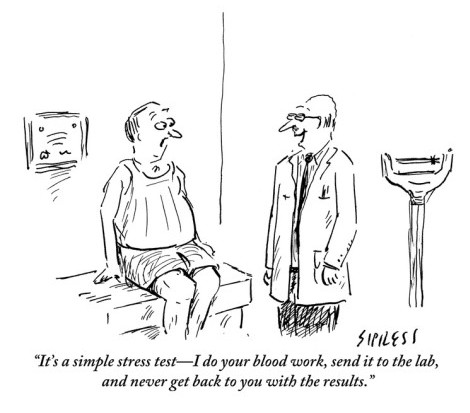
By now, I think just about everyone I know has shared this New Yorker comic with me:

david-sipress-it-s-a-simple-stress-test-i-do-your-blood-work-send-it-to-the-lab-and-nOkay, fine, it was only about five people, but I still find that significant. Of all the New Yorker comics that exist and of all the neurotic people that could jump to mind upon seeing them, this comic puts my friends and family in mind of me.

Fair.

Recently, I watched the movie Romantics Anonymous (Les émotifs anonymes) with a friend. (The movie is very sweet, and French, and available on Netflix, so if you’re into romances about socially anxious people and chocolate, check it out.) In it, a character claimed that the three most stressful situations in life are moving, weddings, and exams.

My friend wondered, “Are exams really that stressful?”

I said, “Maybe he means medical exams.”

She replied, “You would say that.”

Also fair.

Recently I underwent a new medical exam of my own, and alongside it my usual trio of Stressing, Obsessing, and Second-guessing (yes, that’s SOS for short).

In advance: I stressed over whether I was following the preparation diet properly. I went online the day before—never wise—and found prep instructions from other doctors that included instructions mine hadn’t, all of which it was too late to implement. I stressed over how my change in routine for the day of the test would affect me for the rest of the week. I stressed over getting another diagnosis. I stressed over not getting another diagnosis.

On the day of: I stressed about whether my doctor’s office was properly handling the referral and billing process for my insurance (with good reason, turns out). I stressed about whether I was blowing the right way into the breath tester thingamabob. I stressed about the fact that midway into the test the receptionist realized she’d overlooked a detail about my insurance.

Properly dealing with this detail, I learned, would involve time travel. I stressed about not knowing how to time travel.

For the rest of the week: I continued to stress about the insurance, making phone calls to two different doctor’s offices and to the insurance company and not knowing what to say once I got on the phone with any of them.

To one, I said, helplessly, “I feel like the middleman here; I don’t know what I’m talking about,” to which she replied, “You are the middleman. You’re the patient!” I also said, to the same receptionist, “I’m only twenty-three!” Poor thing, she had no idea she was in for an impromptu counseling session, but she handled it well. Maybe twenty-three isn’t that young, considering in some places and times I’d have several children by now and be managing a household. Be that as it may, it’s true: I had no idea what I was doing. And it was stressful.

When I got the results: I compared my chart to others online and stressed over whether my doctor had gotten the diagnosis right. Those graphs don’t look the same! I thought. The peaks aren’t right! I stressed about taking a potentially unnecessary antibiotic. I stressed about my insurance’s prescription coverage. I read studies, second-guessed my doctor’s choice of antibiotic, then worried that I wouldn’t hear back from the pharmaceutical company before the weekend to learn whether my new tablets were gluten-free.

Now: The test is over! All I have left to stress about is whether I’m taking my antibiotics with enough time before and after meals and between doses and with enough water and without lying down within the next 10 minutes—why is that?—and without forgetting a dose. I’ve woken up several mornings convinced I’d forgotten to take it the day before (no wonder I’m having nightmares).

Oh, and if all that’s not enough and I feel myself entering stress withdrawal, I can always stress about whether or not any of this will do me any good.

Or about how stressed I am.

Tell me how you deal with stress, and your thoughts on the top three most stressful situations in life. Do you too Stress, Obsess, and Second-guess?

If you’re looking for more on medical stress tests, the fine ladies behind Breaking Up With Captain Crunch and Sassy Celiac have both written hilariously about their colonoscopies—fun!

Tagged , , , , , , , , , , , , ,
Design a site like this with WordPress.com
Get started