Tag Archives: doctors

Good news, bad attitude

Guess what.

My test results came back!

I had been anticipating them with the same bated-breath anxiety that has preceded every report card or grade posting in my life (like I said, total Ravenclaw). When the email appeared in my oft-refreshed inbox, here’s what I found:

My tTG antibodies, which in January were hovering at some nebulous above-100 level, are down to 4. Single digits, baby! With the “negative” range defined as 1 to 3, that makes me practically normal.

My vitamin levels, which we all know I was having some trouble getting up, are now normal to HIGH, thanks no doubt to the multivitamin I’ve been dutifully taking (increasing my risk of cancer with every milligram, if the New York Times is to be believed). The one exception is the still somewhat low vitamin D, which is hard to believe considering how much sun I get. I mean, look at this healthy glow:

Photo on 6-27-13 at 8.51 PM

My WBC is just barely low and my RDW is just barely high, which according to Google indicates anemia, or maybe AIDS, or, most likely, nothing.

Everything else? Normal, normal, normal. Normal!

This is good news. It means my body is backing off. It means I’m doing this gluten-free thing right. It probably means, as my sister reminded me, that the Arrowhead Mills popcorn was perfectly safe. Phew!

With the active siege nearing an end, I suppose it also means that my little sprue city has begun to recover. Somewhere deep inside me, villi are getting to their feet, stretching out, feasting on now-overabundant nutrients. At peace at last, my body will, I suppose, turn its attention to patching wounds and rebuilding infrastructure and, from there, to business as usual. The battle is won.

But, like any good pessimist, I’m not satisfied. Eating away at the sense of victory is the fact that I still feel about the same.

If you’ll permit me to return to the report card metaphor: It’s a bit like getting an A in a class without feeling that you actually learned anything. There’s a sense that the instructor missed something, that the serviceable papers you wrote and the multiple-choice bubbles you filled in merely concealed the depths of your ignorance. That if the grader were just a bit more perceptive you’d have failed.

Thus, the picking through the results for abnormalities; thus, the restless Googling of unfamiliar abbreviations; thus, the overwhelming urge to diagnose myself with latent adult-onset type 1 diabetes or Sjögren’s Syndrome or acute hypochondria. Like any objective, abstract metric, the test results are unconvincing in the face of my subjective but oh-so-concrete feeling of being unwell.

I’ll see my doctor in a couple weeks to discuss the results, and if the visit is anything like the last one, she’ll tell me not to worry, that this takes time, that a handful of months—however long they’ve seemed, however many blog posts you’ve crammed into them—are brief in the scope of celiac recovery.

In the meantime, I’m curious to know, for those of you with celiac experience: which went first, the symptoms or the antibodies? 

And, for everyone: how do you think I should celebrate?
Tagged , , , , , , , ,

Stress Test

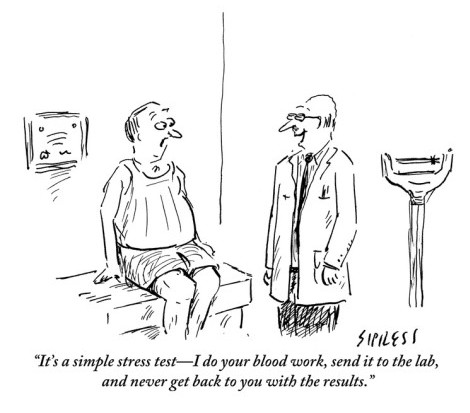
By now, I think just about everyone I know has shared this New Yorker comic with me:

david-sipress-it-s-a-simple-stress-test-i-do-your-blood-work-send-it-to-the-lab-and-nOkay, fine, it was only about five people, but I still find that significant. Of all the New Yorker comics that exist and of all the neurotic people that could jump to mind upon seeing them, this comic puts my friends and family in mind of me.


Fair.

Recently, I watched the movie Romantics Anonymous (Les émotifs anonymes) with a friend. (The movie is very sweet, and French, and available on Netflix, so if you’re into romances about socially anxious people and chocolate, check it out.) In it, a character claimed that the three most stressful situations in life are moving, weddings, and exams.

My friend wondered, “Are exams really that stressful?”

I said, “Maybe he means medical exams.”

She replied, “You would say that.”

Also fair.

Recently I underwent a new medical exam of my own, and alongside it my usual trio of Stressing, Obsessing, and Second-guessing (yes, that’s SOS for short).

In advance: I stressed over whether I was following the preparation diet properly. I went online the day before—never wise—and found prep instructions from other doctors that included instructions mine hadn’t, all of which it was too late to implement. I stressed over how my change in routine for the day of the test would affect me for the rest of the week. I stressed over getting another diagnosis. I stressed over not getting another diagnosis.

On the day of: I stressed about whether my doctor’s office was properly handling the referral and billing process for my insurance (with good reason, turns out). I stressed about whether I was blowing the right way into the breath tester thingamabob. I stressed about the fact that midway into the test the receptionist realized she’d overlooked a detail about my insurance.

Properly dealing with this detail, I learned, would involve time travel. I stressed about not knowing how to time travel.

For the rest of the week: I continued to stress about the insurance, making phone calls to two different doctor’s offices and to the insurance company and not knowing what to say once I got on the phone with any of them.

To one, I said, helplessly, “I feel like the middleman here; I don’t know what I’m talking about,” to which she replied, “You are the middleman. You’re the patient!” I also said, to the same receptionist, “I’m only twenty-three!” Poor thing, she had no idea she was in for an impromptu counseling session, but she handled it well. Maybe twenty-three isn’t that young, considering in some places and times I’d have several children by now and be managing a household. Be that as it may, it’s true: I had no idea what I was doing. And it was stressful.

When I got the results: I compared my chart to others online and stressed over whether my doctor had gotten the diagnosis right. Those graphs don’t look the same! I thought. The peaks aren’t right! I stressed about taking a potentially unnecessary antibiotic. I stressed about my insurance’s prescription coverage. I read studies, second-guessed my doctor’s choice of antibiotic, then worried that I wouldn’t hear back from the pharmaceutical company before the weekend to learn whether my new tablets were gluten-free.

Now: The test is over! All I have left to stress about is whether I’m taking my antibiotics with enough time before and after meals and between doses and with enough water and without lying down within the next 10 minutes—why is that?—and without forgetting a dose. I’ve woken up several mornings convinced I’d forgotten to take it the day before (no wonder I’m having nightmares).

Oh, and if all that’s not enough and I feel myself entering stress withdrawal, I can always stress about whether or not any of this will do me any good.

Or about how stressed I am.

Tell me how you deal with stress, and your thoughts on the top three most stressful situations in life. Do you too Stress, Obsess, and Second-guess?

If you’re looking for more on medical stress tests, the fine ladies behind Breaking Up With Captain Crunch and Sassy Celiac have both written hilariously about their colonoscopies—fun!

Tagged , , , , , , , , , , , , ,

Gluten nightmares (plus gratuitous cute baby photos!)

Do you dream in gluten?

If so, maybe you’re familiar with this nightmare: Someone presents you with a plate of cookies and tells you they’re gluten-free, then after you’ve eaten several…

2251078825_031ea94673_z

Original photo © tgilbers | Flickr

6696505675_c139d8c12d_z

Original photo © Lesley Show | Flickr

3680125_570588ff55_z

Original photo © Kris Krüg | Flickr

My first-ever gluten nightmare was like that (but without the adorable baby photos). I think in the dream it was my mom who gave me the cookies—sorry, Mom, I know you’d never really do that!

Last night I had a new one: I dreamed I ate a box of Triscuits. When someone pointed out Triscuits aren’t gluten-free, my dream self was baffled. “I just…forgot!” she said.

Ha, ha, dream self. No forgetting allowed.

And, of course, there’s the ever-recurring waking nightmare of the newly diagnosed: It’s a year from now, and my doctor is showing me my chart and saying, “Turns out, you’re an asymptomatic celiac who just happens to have lots of other stuff wrong with you!”

Terrifying.

Luckily, even after a sleepless night, cute photos of children eating cookies always cheer me up.

Tell me your gluten nightmares! And if you’re dozing off at your desk this Monday morning, here’s wishing you sweet but gluten-free dreams.

Tagged , , , , , , , , , ,

Help me write a letter to my doctor

Last week (erm, two posts ago…gosh, I’ve been lazy) I asked why doctors can’t just talk to each other. I wondered if all my docs could have put their heads together and figured me out faster. The consensus was “maybe, maybe not.”

Photo © Ben Weston | Flickr

Even though celiac disease is associated with a huge range of symptoms affecting virtually every system and function of the body, with implications going well beyond the gastrointestinal, it’s GI doctors who are overwhelmingly responsible for diagnosing it. Other doctors are less likely to be trained in recognizing it, and apparently also less likely to care. (Back in February, Jess of The Patient Celiac posted a selection of anonymous comments on an online doctors forum that included this gem: “Ugh. Is there any disease more boring and worthy of turfing to the GI guys than Celiac Sprue?”)

So although in an ideal world, any of my doctors could have diagnosed me separately or in collaboration (or a supercomputer could have), in the real world it was pretty much down to the one who specialized in intestines to diagnose me.

But she didn’t.

I saw a gastrointestinal doctor for the first time back in December/January of 2011 after half a year of symptoms (my insurance made it hard to see a doctor earlier, since I was in college out of state). In that half a year, I’d had an emergency room visit, I’d tried a strict low-FODMAP diet with no results (besides an initial placebo high that wore off after a week), and I’d worried a LOT.

The GI doc did a colonoscopy but—inexplicably—not an endoscopy or at the very least a blood test for celiac disease. She wasn’t interested in talking about food (turfing it to the dietitian guys, I suppose, though she didn’t set me up with one), and she sent me on my way with OTC meds and all but a pat on the head.

Since I first got my positive bloodwork results, even before I had a fully confirmed diagnosis of celiac disease, I’ve been toying with the idea of calling or writing to this doctor. Now that it’s nearly May—celiac awareness month, as you may be (heh) aware—it seems like a good time to follow through.

What I want to accomplish here is:

1) Tell her my story
2) Understand why she didn’t test me for celiac disease (or, if she did without my being aware, why she never contacted me with the results)
3) Let her know, if she doesn’t, that my particular symptoms are commonly associated with celiac disease
4) Encourage her to test for celiac disease before diagnosing IBS in the future.

What I don’t want to do is:

1) Come off as whiny
2) Come off as condescending
3) Offend her sense of her own expertise
4) Be immediately dismissed
5) Threaten a lawsuit.

Unfortunately, I’m a whiny, condescending, offensive, easily dismissed person prone to making accidental threats. So I need your help!

Have you ever written this kind of letter? Whether or not you have, do you have any tips for me? Any specific things I should say or not say?

Is it better to do this in writing or over the phone (in your opinion or experience)?

Do you feel this kind of patient-to-doctor education is possible and worthwhile? What are other ways to go about it?

Tagged , , , , , , , , ,
Design a site like this with WordPress.com
Get started