This was meant to be a lighthearted “second-favorite book character with celiac disease” post, in the vein of my Moaning Myrtle review. I was going to point to a particular scene in a Beverly Cleary book and say, “See, Ramona knows.” But when I located and reread the Ramona the Pest scene, I remembered some details that got me all righteously worked up about education and sent this post off in a totally different direction. I hope you’ll pardon my soapboxing. If you came for lighthearted, please check out my archives, where you will find plenty of absurd musing on fairy tales and brain fog. No doubt I will be back tomorrow babbling about citrus (no, but seriously).
If you’re still there, let me paint the scene for you: Kindergarten teacher Miss Binney corrals her rowdy class into something approaching order and reads aloud the story Mike Mulligan and His Steam Shovel, an inspiring tale about sticking to your guns and living up to your promises. In the face of great doubt, Mike proves the worth of his ancient steam shovel by digging the entire cellar of the new town hall in a single day, dawn to dusk. It’s a good story, and the kids, pesky Ramona included, are rapt. But they’re especially interested in one detail that the picture book skips past:
As Ramona listened a question came into her mind, a question that had often puzzled her about the books that were read to her. Somehow books always left out one of the most important things anyone would want to know. Now that Ramona was in school, and school was a place for learning, perhaps Miss Binney could answer the question. . . .
‘Miss Binney, I want to know—how did Mike Mulligan go to the bathroom when he was digging the basement of the town hall?‘
As I said, I was going to chop off the excerpt there and leave you with, “Anyone who places that much importance on being able to get to the bathroom probably has…” (…you see where I’m going with this.)
But when I kept reading, I found a part I’d forgotten: Miss Binney’s response.
Miss Binney’s smile seemed to last longer than smiles usually last. . . .
‘Boys and girls,’ she began, and spoke in her clear, distinct way. ‘The reason the book does not tell us how Mike Mulligan went to the bathroom is that it is not an important part of the story. The story is about digging the basement of the town hall, and that is what the book tells us.’
Miss Binney spoke as if this explanation ended the matter . . .
Miss Binney’s blunt summation, “not an important part of the story,” read from my present perspective, suddenly struck me as incomplete and misguided, as well as indicative of a larger problem in the way we’re socialized in school. Here Ramona and her classmates are thinking critically about a basic human function, and Miss B., the civilizing influence, the authoritative mouthpiece of society, is standing in front of them and explaining that it’s not important. As the story goes on to remind us, Miss B. showed her class the bathroom first thing, and she’ll surely lead them there in single file the requisite number of times a day, but other than that she doesn’t want to talk about it, doesn’t want to hear about it, and doesn’t want it popping up in her picture books.
Ramona—and good for her—learns from this that there are some lessons school won’t teach her. For now, at least, she “knew and the rest of the class knew that knowing how to go to the bathroom was important,” but for how long? How long until this understanding is beaten out of her by well-meaning teachers and other prudes? How long until she’s pretending her digestive system doesn’t exist and whispering the word bathroom like a shameful near-obscenity, if at all? And from there, how long until she’s bashfully tacking “Sorry, TMI” onto descriptions of stomach upset in a support group or a doctor’s office—or keeping quiet about it altogether?
Am I being melodramatic? Maybe a little. But whether or not I’m taking away what Bev wanted me to (and, judging from this article, I’m probably not), it’s what I’ve got. Sure, Miss Binney’s not precisely saying that using the bathroom in itself isn’t important; she means that it’s not related to the overall story, which is about the value of a good day’s work done right. But, even setting aside the implication that access to a bathroom and the necessary breaks to use it are not important to a good day’s work (which is in itself a troubling idea about labor to be teaching to our little future workerbots in public schools, and one beyond my ability to properly dismantle in the parenthetical space I’ve granted it here), Miss B.’s message includes more than her spoken words. Her clear discomfort, her abrupt response, her effort to shut down the dialogue and move on—all of these things tell the tykes that the bathroom is not something one should talk about.
I understand that early education teachers must live in constant fear of the off topic, and I understand that this is not without reason. Still, I wish Miss B.’s response—and the response of the real teachers on whom she is no doubt based—had been different.
I wish she’d said, “Good question, Ramona.” I wish she’d said, “Sometimes writers leave stuff out, even really important details like this, because they’re focusing on other things.” I’d love it if she’d said, “You know what, Ramona? That’s a plot hole that has never occurred to me in all my years as an educator. You just might make a fine editor one day.”
In sum, I wish she’d taken the question seriously and faced without discomfort a subject no one ought to disown, least of all a teacher of kindergarteners (a poop-obsessed clan if ever there was one). Because if we were all taught from kindergarten age to speak up about things that struck us as strange or unfair, and to discuss those things that strike us as compelling or important, we might have a better educated, more self-assured, and perhaps more just population.
More specifically, if we were taught from a young age that the bathroom, and what happens there, is important (which it is—digestion affects virtually every system in our bodies, and what comes out at the end of the process is just as worthy of attention as what goes in at the start) and that it’s okay and important to talk about it, more of us might talk to our doctors about the strange things we’ve noticed in our own bathroom habits, and digestive disorders from Crohn’s to colitis to celiac to food intolerances to IBS, that chimerical beast—might be discovered and dealt with earlier.
Moreover, if it were taught that it’s important and okay to talk about the bathroom, more kids might grow up to be gastroenterologists or digestive science researchers, because those fields might be recognized as the incredibly intricate and fascinating areas of study they are, rather than being widely considered the least glamorous and least compelling arenas of medicine. If it were important and okay to talk about the bathroom, we might have found a cure for ulcerative colitis by now; we might have a working celiac vaccine by now; we might have banished the diagnose of IBS and replaced it with true knowledge and solutions by now. If it were important and okay to talk about the bathroom, we might even be a bit closer to making that talk truly less important by eradicating digestive dysfunctions.
Finally, if it were important and okay to talk about the bathroom, we might be able to stop losing people (including many who are, in the grand scheme of things, not much older than those kindergarteners) to suicides precipitated by the depression that attends many digestive disorders, because they might feel comfortable speaking up about it and getting help, instead of becoming more and more hopeless and more and more humiliated by their unimportant condition until life itself starts seeming unimportant, too. (And, again, because we might have more researchers turning up results that could tangibly ease their symptoms.)
In short, although I know teachers have lesson plans to stick to and criteria to meet, I can’t help but feel that an important part of any teacher’s hard day’s work done right should be to encourage students to speak up about the things that trouble or confuse them, especially those things that concern the very most basic stuff of human functioning. And yes, that includes the bathroom.
Asking these questions shouldn’t make you a pest. It’s the refusal to listen to them that’s really annoying.
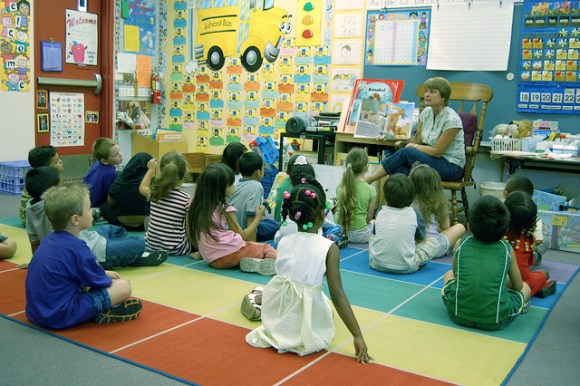
Photo © daveparker | Flickr
All excerpts from Ramona the Pest, © Beverly Cleary 1968.
Please share your thoughts! If you have kids, do you encourage them to speak up about “uncomfortable” topics? Do you speak up about digestive issues, if you have them? Are you (or your kids) shushed for talking about the toilet? How might we go about increasing our comfort level with this topic on a societal level? And do you think we should?
P.S. I know celiac disease isn’t all digestive trouble—trust me, I know—but this isn’t really a post about celiac disease. It’s a post about the BATHROOM. Which is, to me, very important.






 Based on a Sprue Story