Discovering “new worlds” of gluten-free

Embarrassing story time. You know the rhyme, “In 1492, Columbus sailed the ocean blue”? Well, I used to think it went, “In 141892…” Yup. That halcyon year 141892.

I have no idea what first put this wildly inaccurate detail into my head, but I suppose I felt the line scanned better that way. Even though I learned and relearned about Columbus every year through at least seventh grade, I managed to persist in the error until I was…well…too old. I just never gave it much thought.

Christopher Columbus statue

Boldly going where tons of people have gone before

Though it was dumb of me, it’s sort of appropriate, given that blithely perpetuated errors are the stuff of the education American kids receive about Christopher Columbus.

We learn he discovered America, but people already lived there and other sailors before him had stumbled on its shores. Plus, Columbus himself never admitted to discovering a “new” continent. He just called it India. Many of us also learned that Columbus was the first to suggest the world was round, when in fact educated folks of his time already knew it was. And he stands accused of many other things left out of the standard elementary school curriculum. When you really examine the Columbus story, there’s much that isn’t right.

Still, anyone who gives you a day off is a little bit of a hero. So in honor of Columbus Day—and rethinking things we’ve never thought through—here’s a list of a few discoveries I made while in search of something else entirely.

Went looking for onion rings and instead I found…bhaji

Bhaji are onion or vegetable fritters coated in my favorite ingredient ever—chickpea flour. You can fry or bake them, then dip in cucumber-mint-yogurt raita. You’ll forget you were ever looking for onion rings.

Went looking for cornbread and instead I found…arepas and pupusas

Folks who only ever order tacos are missing out on a whole world of corn patties. Some of the biggest producers of corn masa—such as Maseca—are now certified gluten-free, so you can enjoy safely (except perhaps where your arteries are concerned).

Went looking for “barley” and instead I found…buckwheat

You can buy whole buckwheat groats in bulk and make them into stir-fries, burgers, breakfast cereal, risotto, and deep-fried risotto balls (which I can attest are amazing). Buckwheat is so not just for crepes. Speaking of which…

Went looking for crepes and instead I found…dosas

Though you’ll have to hunt a bit to find the right ingredients to make these at home, dosas should usually be gluten-free (with the exception of cross-contamination). If you like crepes, Indian food, potatoes, and enormous portion sizes (and who doesn’t?), you’ll love these.

Went looking for pizza and instead I found…socca

You know about my love of socca already, but I had to include it, since it’s my greatest discovery of all time.

Have you tried any of these? Which do you like best?

I was not the first to discover these foods; people across the country and around the world kindly posted the recipes online, and others have eaten them for many years before I was around to Google them. I “discovered” these naturally gluten-free, not-meant-to-imitate-anything meals while intending to find something else.

The foods on this list aren’t what I originally went looking for—maybe just on the same latitude—but I’m glad I found them, and I look forward to charting ever-new terrain on my gluten-free journey.

Desserts, for example. When it comes to gluten-free flour blends, thar be dragons. When I quit skirting the shores (and clutching my King Arthur Flour mixes), I’m sure I’ll find all kinds of things I never intended to look for. Doing so may never get a holiday named for me, or a rhyme for kids to mess up when they recite it in 141892, but it’ll sure be fun.

Did you ever have silly misconceptions like my futuristic-Columbus invention? What naturally gluten-free foods have you discovered when you went searching for recipes for something else?

Tagged , , , , , , , , , , , , ,

Do you wear your snake-eating-a-unicorn tattoo on your sleeve? (Or, do you call yourself a “celiac”?)

Does illness define you? I’ve joked about this before, but it’s worth serious consideration. How much of a part of you is your health? And how much should it be?

Plenty of people identify with their illness enough to name themselves after it: diabetics, celiacs, Crohnies, Lymiesspoonies. The use of these names is vehemently opposed by others who consider them dehumanizing. “You wouldn’t call yourself ‘a cancer,’ would you?,” they prod. 

It’s a fair point, although many do call themselves “cancer survivors”—another way of identifying themselves by their disease. (Also, according to Wikipedia, some folks with terminal cancer reject this name in favor of cancer “diers.” I was unable to independently verify the name is used by anybody outside of Wikipedia. Have you heard of this?)

Look at just about any medical condition and I’m willing to bet you’ll find a subculture and nomenclature to go with it. You’ll find people affected by the condition who don’t participate in the subculture (or who don’t even realize it exists), and you’ll find people who have thrown themselves body and spirit into it. You’ll find people who hate that the subculture exists, and people who can’t imagine existing without it.

And in between you’ll find lots and lots of people totally confused about how much to participate, what to call themselves, and how much to allow their condition to matter in their lives.

Diagnosis identifies the disease, but we have to decide, afterwards, how to identify ourselves.

Author Hilary T. Smith, in her book Welcome to the Jungle, suggests diagnosis is like waking up one morning to find “a big old snake-eating-a-unicorn tattoo” on your bicep.

Seeing the tattoo, she writes, you might react in several ways:

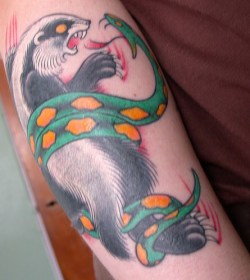
tattoo of badger fighting snake

I was unable to find an image of a snake-eating-a-unicorn tattoo, but I did turn up this snake-fighting-a-badger tattoo that I am thinking about getting sometime.
Photo © BreadnBadger | Flickr

Underidentification: “Ho ho ho! This is surely but an amusing temporary tattoo placed on me as a prank. It will certainly wash off in the shower.”

Medium-Low: “This tat is real, but I am going to wear long-sleeved shirts for the rest of my life to cover it up.”

Middle: “Living with this tattoo is going to be a b**** and a half, but it’s also kind of dope.”

Medium-High: “Short sleeves for me, baby.”

Overidentification: “This tattoo defines me, man. I’m going to tattoo the rest of my body with snakeskin and have a horn surgically implanted on my head.”

(Smith, Welcome to the Jungle. Conari Press, 2010)

The book is about bipolar disorder, which I myself don’t have (and no, I’m not just underidentifying). Still, especially as I got to the end of the list, I knew this applied to me.

Although I prefer not to call myself “a celiac,” I do give celiac disease, and being gluten-free, a lot of space in my life and identity. Sometimes, I wonder whether I’ve given it too much.

For example, when I renamed my Twitter handle @spruestory, I wondered if that was taking it too far. I mean, that’s my only Twitter handle, and it’s now named after my celiac disease blog. Was this really how I wanted to “brand” myself? Would I look back one day and wish I hadn’t?

Clearly, I decided it was worth it to change the handle (and that Twitter isn’t worth so much existential angst). After all, I’ll have this disease for life, so I doubt I’ll be looking back five, ten, fifty years from now and thinking, “Gee, I wish I hadn’t told everyone I had celiac disease.” Unless the whole world goes gluten-free or they discover a cure, five, ten, or fifty years from now I’ll still need to be upfront about my disease. I’ll still need to announce it on dates, to new friends in response to dinner invites, to strangers at restaurants before I order, to bosses and colleagues at work. It may not be the first thing I’ll talk about, but it will come up.

But will I one day wish I hadn’t talked so much about celiac disease? Will I wish I had identified with it less? Maybe. I wish it already, sometimes. But, as I said, this disease is for life, so I’ve got plenty of time to figure it out. Until I do, I think I’ll stay far away from tattoo parlors. No snakes, unicorns, badgers, or Xed-out sheaves of wheat for my bicep, thank you very much.

What about you? What do you refer to yourself as? Where do you fall on the snake-eating-a-unicorn identification spectrum? Has that changed over time? Are you happy with where you’re at now?

Tagged , , , , , , , , , , ,

Don’t know much about chemical sensitivity?

Have you seen the movie Safe?

It’s about a woman (Carol, played by Julianne Moore) who develops a mysterious and steadily worsening illness—most likely multiple chemical sensitivity.

I watched it in college. Though it was a great film, it encouraged me to dwell on my own mysterious illness, which had begun earlier that year. The film set up questions like, “Is her illness even real? Will she ever get better?” Watching it, I couldn’t help but wonder the same things about me.

Later, of course, I found out I have celiac disease, and that it could get better. I just have to not eat some things (okay, a lot of things). Except for avoiding crumbs, I don’t have to worry too much about my environment. I won’t find gluten in the air anywhere besides a bakery, and the worst chemical I contend with is natural flavorings.

cover of Allergic to Life by Kathryn Treat

But I remained curious about chemical sensitivity, which I didn’t know much about beyond its portrayal in the film.

Now, I’ve learned about it from Kathryn Chastain Treat, one of my earliest readers and strongest supporters. She blogs about her extreme chemical sensitivity, and she’s just finished a book: Allergic to Life.

To celebrate her book’s release, I asked her a few questions about what is still a misunderstood and mysterious disease.

Readers, we’d love to hear your answers to these questions, too!

What do you feel your experience has in common with the experience of people with celiac disease, gluten intolerance, or food allergies? What’s most different?

Kathryn: I feel that in some ways we are very similar. We can’t just go and eat anywhere or anything. I have food allergies, which causes issues similar to those that someone with celiac disease encounters when dining out or with family and friends.

What makes me different is that I have not only food allergies, but also sensitivities to chemicals (perfumes, colognes, fabric softeners) and mold. I do a lot of dining at outdoor cafes if they can tolerate my food allergies (which include foods that may contain mold, like vinegar and soy sauce) and if I can manage to find seating far enough away from someone who is very scented.

What misconceptions do people have about your illness? Which get you mad? Which do you think are just funny? How do you respond?

Kathryn: I believe people, including many in the medical profession, feel that my sensitivities to chemicals and mold are not that serious. They believe that if I can manage a short time in a store (with my mask) that I should be able to go anywhere anytime I want. I also feel that people believe because I do not work and stay at home that I just sit and watch television and eat bon bons in my fluffy slippers.

What makes me the maddest is not taking my symptoms seriously. I think the perception that I have all the time in the world because I don’t work is probably the funniest. They have no idea how much work it takes to stay as well as I have managed to get and how long it takes to clean my house.

I have responded that my total load of what my body tolerates varies from day to day. If I am having a good day, then I can make a trip to the store. I can’t do this every day or spend all day doing this because despite my mask, my body gets too overloaded with chemicals and I end up sick. Sometimes I just ignore it all together because it is hard to convince someone once they have their own preconceived ideas.

What’s the funniest thing that has ever happened to you as a result of being ill?

Kathryn: My younger daughter was here for a visit and we were scheduled to visit my older daughter. My younger daughter had her hair done earlier in the day. Not thinking (I blame my off and on again companion—brainfog), we just jumped in my car. Of course she put on one of my required tyvek suits to avoid bringing any fragrances or chemicals into my car. We started down the road, and about ten miles into our trip I was having difficulty. I was getting a headache, congested, and my voice was slowly getting more of a crackle in it. Suddenly it dawned on both of us that her hair was making me ill.

As soon as possible I pulled to the side of the road and we both jumped out. How were we going to make it safe for us to continue on our journey? We couldn’t go on the way things were and I couldn’t call anyone to come help us. We searched the back seat and then the trunk to find something we could put over her hair.

Aha! There it was, a white plastic garbage bag in my trunk. I always keep some in the car for emergencies or having to put someone’s belongings in it before they can ride with me.

We got the bag out of the trunk and tried to put it over her hair. The wind was blowing and gusts of air would get under the bag and fill it like a balloon. We fought and fought the wind and the air in the bag. Here we are on the side of the road, she is already wearing the white tyvek suit, and we are now trying to put a bag over her head.

Enter the highway patrol cruiser. Just as I thought things couldn’t be worse or crazier than they were, the officer gets out to see if we need assistance. I have to explain as simply as I can without appearing to be a lunatic that I have sensitivities to chemicals and my daughter has just gotten her hair done, making me ill. I also explained that we were trying to cover her hair up with the bag but the air kept getting inside the bag. I purposely tried to ignore the fact that she was dressed in this white suit. The officer, however, noticed and made some funny comment about her tyvek suit and Ghostbusters and then calmly walked over and helped us get the bag on her hair. I was then asked to move aside so that he could write down my license plate number, which was required because he had stopped to check our status. As he walked away, he said it bothered him too when his wife got her hair done.

The story doesn’t end there. A few weeks later our tenant came to pay rent. He was talking about having coffee with his highway patrol officer friends. One had commented about these two women on the side of the road and how he had to help one put a bag over the other one’s head. I immediately started laughing and told him that I was one of the women he rescued that day. Our tenant knows all about my sensitivities and about my story. He started laughing and said he couldn’t wait to tell this particular officer that he knows the women.

I knew the officer would most likely go back and tell the story to all his buddies. I mean, how often does this kind of thing happen?

Okay, now what’s the least funny?

Kathryn: The least funny thing was when I made a quick trip with my daughter into Target. We were getting what she and I needed when we ran into a woman pushing her shopping cart with a little girl trailing alongside her. She saw me with my mask and made the fastest turnaround I had ever seen someone make with a shopping cart. I am sure she thought that I was contagious, and what she never knew was that I was more likely to get sick being around her than her from being around me.

What book or movie character would you nominate as the mascot for chemical sensitivity?

Molly: This was my final question, but we’ve both been wracking our brains and haven’t come up with anyone yet (there’s gotta be a Harry Potter reference in here somewhere). I don’t want to nominate Carol, because Kathryn and Carol don’t seem too similar (watch the film and you’ll agree).

Can you think of one? Let us know if so! Also, be sure to share your own funny and unfunny health stories. And, of course, check out Kathryn’s book.

She is offering a giveaway of three autographed copies through Rafflecopter, and her book is available at Barnes and Noble and Amazon (prices vary). Autographed copies (US Only) will be available on her website.

This is stop #7 on her book blog tour, and you can find the rest on her blog.

Tagged , , , , , , , , , , , , ,

Gluten-free piñatas, and other celiac party games

I only just told you about the snacks at our last party, but we’re already menu-planning for the next. This one is in honor of the birth of a certain Libra you all know: my sister! To celebrate, we decided to channel our mom—an excellent themed-party-thrower if ever there was one—and make a piñata.

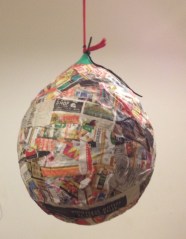
paper mache piñata in progress

Newspaper is gluten-free and also, unlike most printed products, often vegan.

There was a brief moment when we thought it wouldn’t work: paper mâché is made using flour, and our home is a flour-free zone. I’m also extremely averse to touching anything with gluten in it, inside the house or out. And our piñata dreams were not worth breaking out the sorghum flour.

Fortunately, cornstarch seems to do the trick. I don’t want to speak too soon—the piñata is still hanging in our kitchen to let the first layer dry, where I risk puncturing it prematurely every morning when I forget it’s there and headbutt it in the dark; and we haven’t yet decorated—but so far, so good.

Making the piñata got me thinking about other classic party games that could be made gluten-free. I know by now you’ve all tried Celiac Sorry!, but if you’re itching for more, here it is.

Which sounds like the most fun to you?

Silent line-up

The classic ice breaker. In this version, players must line up in order of their date of diagnosis without communicating out loud. This makes the hierarchy clear early in the party.

Simon says

One player is anointed Simon and calls out commands to the other players. If the command is prefaced with “Simon says,” players must do it. If not, players must not. Disobeying, whether on purpose or by accident, is grounds for dismissal. Nice Simons do not make commands starting with “Simon says” that end in “Eat a pizza.” Mean Simons do.

boy chasing girl in duck, duck, goose game

What we’d all like to do to everyone who glutens us.
Photo © amanky | Flickr

Duck, duck, gluten

All players sit in a circle except for one, who walks around tapping people on the heads one at a time saying, “Duck…duck…” until bored. Then he or she whacks a random person on the head hard enough to daze the seated player and yells “GLUTEN!”

This person, now “the Glutened,” must clamber up and chase the original player around the circle as the remaining players still sitting, do their best to trip the unlucky Glutened—simulating the action of our immune antibodies after we ingest gluten.

If the Glutened catches the Glutener before the Glutener can sit in the Glutened’s original spot, the Glutened wins, and has a full recovery. But otherwise, the Glutened is so consumed by gluten that he/she becomes the new Glutener, spitefully paying it forward to another poor duck. (Two things: 1) that’s not really how it works. 2) Ducks with celiac disease would be sad. They’d miss out on all the bread crumbs.)

Pin the villus on the intestinal lining

If you misplace the villus under the intestinal lining, then your villus is blunted. You lose.

Hide and sleep

Besides one, all players find cozy hiding spots. Being typically fatigued, they take the respite from socializing as an opportunity to catch some Zs. The remaining player tries to find them until brainfog sets in, then wanders off in search of gluten-free cake.

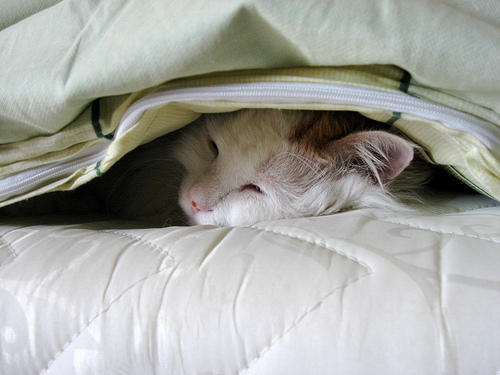
cat sleeping under blanket

Cats are really good at this game.
Photo © Yuxuan Wang | Flickr

Scavenger hunt

Everyone is given a list and set loose in a grocery store to find items such as “gluten-free sourdough pretzels” and “gluten-free filo dough.” They emerge hours later, groggy and miserable, having not found any of the items and cursing whoever wrote that stupid list. To lift their spirits, they binge on gluten-free cake.

Gluten-villus-celiac

Like rock-paper-scissors. Gluten flattens villus; villus starves celiac; celiac eliminates gluten.

Bobbing for apples

It’s like the traditional version, except no one trusts the gluten-freedom of the other players’ mouths enough to stick their own face into a shared bucket of water. Everyone stands around looking at the apples for a while, then wanders off to find gluten-free cake.

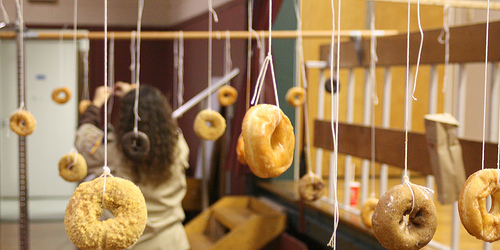
Donuts on a string

Forget it. GF donuts are too expensive to drop half of them on the ground.

The flour game

I discovered this on a UK “traditional party games” site, and it is so not gluten-free. I quote:

“Firstly you need to make the ‘flour cake’ by tightly compacting flour into a medium sized mixing bowl. Then turn this out on to a board and top with a large chunk of Mars bar. Each child takes it in turns to slice away sections of the flour cake ensuring the chunk of chocolate remains at the top. The child who eventually topples the chocolate from the top has to find it with their teeth.”

Basically, it’s Jenga, gone oh-so-wrong (especially in an age of increased allergies!).

*

And there you go! With the exception of that last one—unless you substitute cornstarch—you’re ready for your next celiac-themed birthday party.

As for us? No, we probably won’t play these, and our theme isn’t really “gluten-free.” But the food, drinks, piñata, and candy will be gluten-free (and nut-free!), and those in search of gluten-free cake will not be disappointed. Cross your fingers for us that the piñata actually breaks.

What’s your favorite party or parlor game? Do you prefer parties with or without themes? Have you ever made a piñata, and what candy did you fill it with? (P.S. Are we too old for piñatas?)

Tagged , , , , , , , , , , , ,
Design a site like this with WordPress.com
Get started