What I learned this weekend: 8 lessons about gluten-free food and family

My dad used to be a teacher, and to this day retains a penchant for educating. As kids, we knew we could ask him questions we were “just curious about” and rely on him to tell us all he knew…which we could then furiously transpose onto our homework sheets, which was of course the point all along. (When he caught on, he was not pleased.)

And Mom homeschooled my brother and me for the early days of our educations: Patrick through fourth grade, and me through second. Homeschooling may account for a few oddball tendencies in both of us, but that’s not really the point of this blog post.

The point is, it’s no wonder I developed a desire to teach. Both my parents had been modeling it since, I imagine, day one.

This past weekend, my sister and I visited for my mom’s birthday. We spent much of our time at home cooking together, in a paper-towel-covered kitchen using all-new definitely-safe gluten-free cookware and ingredients, testing recipes for my mom’s blog.

As is always the case, while visiting, I learned a few things. Here are some:

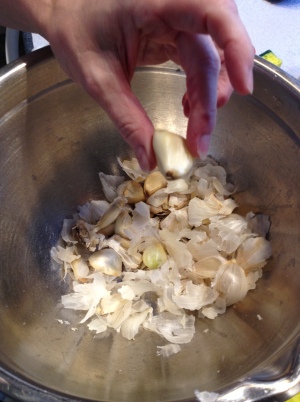
  1. If you put a head of garlic in a bowl, cover it with a lid, and shake it vigorously, it will unpeel itself. At least, some of it will.

    I suppose "vigor" is subjective.

    I suppose “vigor” is a subjective word.

  2. Adapting a non-gluten-free recipe really isn’t as simple as subbing in a gluten-free flour blend.
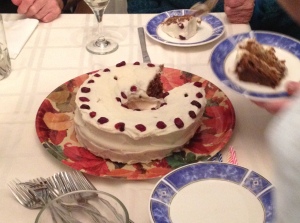
  3. But cakes underbaked in the middle can become bundt cakes at a moment’s notice.
  4. And still taste great.

    gluten-free spice cake

    No one ever would’ve known…except Mom was modeling honesty this weekend, too.

  5. Going gluten-free hasn’t decreased my seasonal allergies. It’s just that I’ve been living in a place with no natural flora or fauna. Back in Massachusetts, land of the beautiful fall foliage…a-choo!
  6. Parents have way more fun after their kids move out:

    brandy cocktails

    I also (re)learned that I don’t really like brandy.

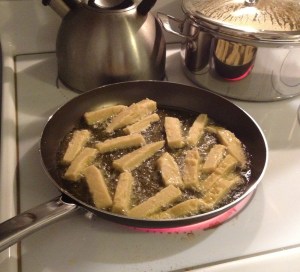
  7. Socca is still the best thing in the world, but panisses are definitely in the running. (Check out David Lebovitz’s recipe, which is similar to the one we used.)

    Is there anything that can't be made out of chickpea flour?

    Is there anything that can’t be made out of chickpea flour?

  8. My parents are the best parents a gluten-free gal (or two) could ever want.

I already knew the last one, but just want to be sure you do, too.

What have you learned about food and life from your family? Have you had any kitchen mixups or success with new recipes recently? And, for god’s sake, have you tried socca yet?

Tagged , , , , , , , , , , ,

What gluten means to me…mathematically

Once upon a time, I thought I wanted to be a teacher. Though I wound up in publishing instead (less public speaking), I hung onto some shreds of the dream. Most recently I’m turning them to—possibly—good use as a volunteer SAT tutor.

If you’ve ever wondered whether anything is harder than going gluten-free, teaching is. Apart from being confronted with your lack of any sort of coolness recognized by a high school junior, you also become intimately aware of every gap and shortcoming in your own training and memory. It’s humbling to flip through the tutor manual and realize you’ll need to reteach yourself the math before you can teach it to anyone else.

The manual, donated to the tutoring program by Kaplan, tells me to present the material in a way the kids can relate to. The same tactic comes in handy when reeducating myself. There’s a surprising amount of parallels between the SATs and gluten-free life. For example, “If you don’t know, skip it, because you’re only penalized for getting it wrong” is true of both unfamiliar food and unfamiliar SAT questions.

This also works for understanding specific concepts. Here, for example, is a thorough reintroduction to “systems of equations,” using gluten. If high school is a ways behind you, and your math score, like mine, was <800, you too may appreciate the refresher.

The problem: Solve the system of equations for gluten.

math2

To start, pick either equation, like this one:

math3

Next, subtract gluten from all sides (you got this) in order to isolate celiac (aww).

math4

So a celiac is an unhappy person without gluten. Sounds about right. Plug this definition into the other equation in place of celiac, like so:

math5

Clean it up…

math6

…and isolate gluten. Subtract the unhappiness from both sides…

math7

…and divide by –2 for the answer.

math8

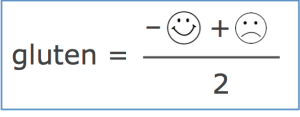
Looks like gluten equals divided feelings, mostly negative. True enough, but we’re not quite through. Since the opposite of happy is unhappy, we can change the negative smiley into a frown…

math9

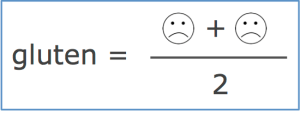
…add them up…

math9a

…and cancel the twos for the final answer:

math9b

There you have it. Gluten equals unhappiness. I’d say we don’t even have to check that answer.

Don’t worry, I’m not teaching the kids using gluten metaphors (talk about uncool!). Have you ever tried teaching or tutoring? Did/do you like it? How’s my math? And do you agree with the equations’ conclusion?

Tagged , , , , , , , , , ,

Hair today, gone tomorrow: hair loss, celiac disease, and a WebMD-style battle of the sexes

I’ve been posting a lot of serious stuff lately, so I thought I’d take a break to talk about something fun: hair loss.

I’ve always had thick hair. Like every other girl and probably plenty of guys, I’ve always wished it were different. When it was stick-straight, I longed for curls. When by the magic of hormones it went curly, I started straightening it. But never have I wished it were thinner.

Unfortunately, wishes don’t have much to do with it.

A couple of months ago, it became clear: I was shedding. Not a normal amount, but an “Is there even any left?” amount.

Okay, not quite this bad. Photo © boris drenec | Flickr

Okay, it was never quite this bad.
Photo © boris drenec | Flickr

“Your hair is everywhere,” Althea said. And she was right. It was on my pillow, my sweaters, my jacket, my desk and chair at work. It coated the floor like carpet and landed in most dishes of food I touched (you can gag, it’s okay).

According to the American Academy of Dermatology, everyone bids farewell to 50 to 100 strands of hair over the course of an average day. I’m pretty sure that’s how many I remove from the shower drain each morning.

Hair loss—like bloating—is associated with just about everything, including normal aging. And it’s not just for men; 40 percent of women show visible signs of hair thinning by age 40. And, like bloating, it’s upsetting.

In a rare departure from its usual brisk style, WebMD explains, of women:

Unfortunately, society has forced women to suffer in silence. It is considered far more acceptable for men to go through the same hair loss process. . . . the psychological damage caused by hair loss and feeling unattractive can be just as devastating as any serious disease, and in fact, can take an emotional toll that directly affects physical health.

and, of men:

Contrary to societal belief, most men who suffer from male pattern baldness are extremely unhappy with their situation and would do anything to change it. Hair loss affects every aspect of their life. It affects interpersonal relationships as well as their professional life. It is not uncommon for men to change their career paths because of hair loss.

Am I the only one who imagines these articles were written by one sad balding female staffer and one sad balding male staffer without consulting one another?

Anyway. When my problem showed no signs of going away on its own, I got a doctor’s appointment and, from there, a dermatology referral. The dermatologist took a two-second look at my hair, plucked out a strand, and started talking about “telogen effluvium” and “androgenic alopecia.” Finally, my ears caught a word I knew: “Rogaine.” Oh my god.

“So…it’s definitely falling out?”

“Yup!” the doctor replied, cheerfully, for all the world as if he’d never read that WebMD article about how distressing this was for me.

He went on: “Diseases sometimes accelerate stuff like this. You probably would have lost it anyway, but it’s happening four or five decades early because of celiac disease.”

I nodded, wide-eyed, and wailed internally, My hair, my beautiful hair!

Meanwhile, the good doctor concluded with a flourish: “Diseases suck!”

Got that right.

He wasn’t able to say why this would have developed months after I went gluten-free, or even if my “alopecia, unspecified” was definitely linked to celiac. He was able to give me a shampoo prescription, a few blood tests, and a “See me in six months.”

After that, there wasn’t much to do except pick up my (exorbitantly priced) shampoo, console myself with candy corn, take my new favorite doc’s advice, and wait. But I did ignore one piece of his guidance. He said cutting my hair wouldn’t help, but I’d had enough of finding it everywhere. So I marched myself into the salon, told the stylist to take it all off, and emerged with a new ‘do.
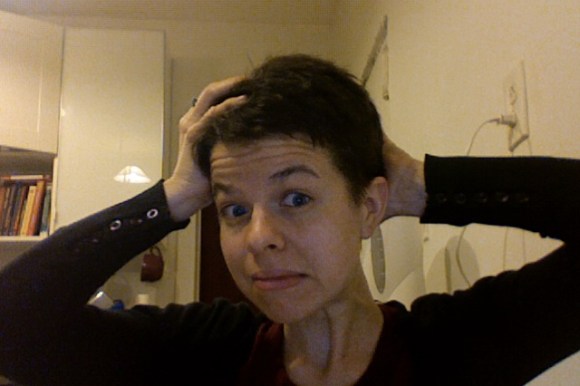
So it's still falling out. But at least shorter pieces of it are falling out.

It’s still falling out. But at least shorter pieces of it are falling out.

Having taken some decisive action, I immediately felt less “psychologically damaged.” 

A couple days later, the doctor’s receptionist called. “Your ferritin levels are low,” she said. “You need to take iron.”

Though they aren’t so low as to be out of the reference (normal) range, it seems they are low enough to be of dermatological concern. Some kind of nonstandard iron deficiency might also—I’m conjecturing, i.e., making this up—explain why I’ve never gotten that mystical gluten-free energy boost.

But who knows? I ordered my 324 mgs, and I’ll let you know in six months.

Till then, I’ll be rocking my new lack of hair. It’s a boon, really, because it opens the door to a whole new world of Halloween costumes, like this one:

Happy Halloween eve! May you receive only treats, no mean dermatological tricks.

Have you ever experienced hair loss from celiac, or from something else? How do you cope? And what are you dressing up as for Halloween tomorrow?

Tagged , , , , , , , , , , , ,

A Candy Corny Calligram for Lovers and Haters

.
Oh

you
small
sweet
treat in
three fall
hues! You
pain me yet
I can’t refuse.
You’re cloying,
but I eat up still;
I simply cannot get
my fill. Each year I say
That’s quite enough! But
sticking to it’s really tough.
When I went vegetarian, I gave
up eating gelatin, and thought that I
had got you beat, especially when I gave
up wheat. For Brach’s, the kind I always ate,
may contain wheat. I said, that’s great! I steeled
myself to say goodbye, and swore I’d manage not
to cry. It all might turn out for the best; perhaps I’d feel
that I’d been blessed. But, look! my sister said, let’s see,
Some brand MUST make it gluten-free. She turned out to be
fully right, as I learned surfing site-to-site. The Jelly Belly kind is
clean, of wheat & nuts & gelatine. So, yes, I bought us both a bunch
although it was a budget crunch. And now—surprise—I’m feeling sick,
from falling for your same old trick. I feel that I can eat and eat, but ALWAYS
you prove way 
too sweet. I thought I’d lost you—planned to mourn—but still you
haunt me, Candy Corn
. I’m sure that I will quit next year. Till then, I’ll savor every ear.

250px-candy-corn

For those who don’t gag at the thought of candy corn: Jelly Belly’s is gluten-free and (in my opinion, but not my sister’s) better-textured than the more traditional but iffier Brach’s. It’s also about a thousand times the price, so start saving up now for next year. (Or for the Christmas “reindeer corn”…oh dear.)

For everyone: happy almost-Halloween! What bad habit can’t you seem to quit?

Tagged , , , , , , , , , , , ,
Design a site like this with WordPress.com
Get started