It’s not easy being green (and gluten- or allergy-free)

Happy Earth Day! Yesterday in Prospect Park I saw two young guys tromping around the lake, drumming on reclaimed water cooler jugs and chanting “Reduce! Reuse! Recycle!,” with a group of kids and parents following behind and half-heartedly shaking the little recycled maraca-things they’d clearly made earlier in the outing. I’m sure Mother Nature found it cute. I found it a good reminder to write this blog post.

Gluten-free often gets lumped in with organic and green in marketing and in popular imagination. I find this odd. Sure, reading labels on processed foods may make you more aware of what weird chemicals you’re putting into your body, and from there you might make the leap to increased awareness of what those chemicals may do to, say, bodies of water. (Dana at Celiac Kiddo wrote a great post about beaver butt in breakfast cereal and what exactly “natural ingredients” means—related and definitely worth a read.)

But overall, I find it’s not that easy to be both green and gluten-free. I’m sure anyone who’s ever had to worry about gluten and allergy contamination can relate; maintaining a clean, contamination-free environment can involve a lot of waste.

There’s the inevitable pantry cleaning at the start and the rallying cry, “When in doubt, throw it out!” Might you have dipped a spoon into first the flour and then the sugar? Toss the sugar. Did a knife go onto toast and then into the jam? Ditch the jar. And while you’re throwing out food right and left, go ahead and buy yourself a new dedicated cutting board, and try not to think about plastic and landfills.

We’re encouraged to buy designated gluten-free toasters, which means double the appliances to plug in, using double the electricity—and no, I don’t believe you remember to unplug your appliances when they aren’t in use.

My sponge usage went through the roof when I went gluten-free, as I’ve written before. Besides that, there’s paper towels for cleaning, parchment paper for baking, and ziploc bags for everything. I also use a lot more soap, which may or may not be harmful to the environment.

And all that is just at home. There’s more! At the grocery store, where before I might have skipped bagging my potatoes and apples, now I worry about those mystery stains on the conveyor belt and opt for the extra plastic. Packaged ingredients, with their FDA-regulated ingredients labels and airtight seals, are my friends. And shopping from the bulk bins to reduce packaging? Forget about it! You don’t know where those scoops have been!

We nod approvingly at muffins being baked in a separate facility and shipped to our local bakeries in individual shrinkwrap. We ask that Chipotle employees wear new gloves while preparing our burritos. And when we can’t find safe places to dine out, we buy individually packaged power bars to see us through.

I’ve even started using more plastic utensils and cups, because I bring meals with me when I’m out instead of stopping off somewhere to eat, and because I don’t trust these items to be clean enough at friends’ homes (no offense).

If you seek organic and non-GMO foods, you may find it harder when purchasing gluten-free products, many of which include corn (here’s a pretty recent list of foods, maintained by a gluten-free, vegan mom blogger, that are non-GMO and gluten-free). I can’t seem to get worked up about GMOs myself, but I understand there’s a lot of anxiety surrounding their health and environmental impact—an anxiety that may be compounded by gluten or allergen concerns.

Organic, natural body care products may also be more likely to include wheat or dairy proteins because these are “natural” alternatives to the chemicals in the big guys. This means if you’re avoiding those proteins, you must reject the purportedly greener options.

For people with severe seasonal allergies to, e.g., pollen, there’s a whole other set of energy expenditures to add into the mix: more laundry-washing, more vacuuming, more air conditioning. Those with serious allergies may also drive their cars during this season more often than they walk or bike. (Amanda at Celiac and Allergy Adventures has written here about the measures she takes during asthma/allergy season.)

So you see? It’s not that easy being green! When we’re expending lots of extra energy ourselves to rigidly control our immediate environment, it’s harder to maintain some of those little footprint-reducing habits we once cherished. Luckily, this doesn’t mean you can’t be green.

The safest foods in the world for most allergies and the gluten-free diet are fresh fruits and vegetables—whole foods that (as long as you buy in season) are pretty darn low in environmental impact. You can even consider going meatless for at least some meals, which is touted far and wide as a simple way to reduce one’s environmental impact. Yes, it can also be a bit harder to maintain a balanced diet while avoiding gluten or allergens and meat and dairy/eggs, but it’s nowhere near as tough as some will have you believe.

You can still keep an eye on your overall energy and water usage (and a dishwasher, widely considered the most effective way to clean contaminated dishes for those lucky enough to own one, is also often more energy- and water-efficient than hand-washing).

And (unless you do have the aforementioned severe seasonal allergies) you can always plant a tree or make an effort to walk or bike more, use public transportation more, and drive less, none of which have much of anything to do with gluten.

Tell me: Do you consider yourself an environmentalist? What do you do to reduce your footprint, if so? Do you find it harder to do while on a gluten- or allergy-free diet? What are your tips for managing both at once? And how are you celebrating Earth Day?

Tagged , , , , , , , , , , , ,

Gluten-Free Astrology: Taurus (born April 20 – May 20)

Photo © Duncan Hull | Flickr

Photo © Duncan Hull | Flickr

Springtime is officially here, as is the month of the bull. If you’re an Aries who missed out on my first post, check it out and let me know if your horoscope came true (pssst, it probably didn’t, because I never heard anything about that new neighborhood restaurant—luckily I’m moving back to Manhattan this summer, where I’ll be surrounded with gluten-free bakeries). Sad to say, although the world may revolve around you, this post isn’t about you Aries folks! Moving right along, as the seasons and the stars inevitably do, this month’s Gluten-Free Astrology is all about Taurus.

Taurus begins today, April 20th, and extends through May 20th. It is a sign near and dear to my heart, as my May 23rd bday puts me right on the cusp. But who cares what I think? Let’s move on to the objective stuff!

The Gluten-Free Taurus is ruled by the planet Venus, named for the goddess of beauty, the arts, and pleasure. This means that as a GF Taurus, you’re into luxury, money, and property, but, because you tend to appreciate permanence and stability, you aren’t a spendthrift or a gambler. You may be a regular at a restaurant with a nice gluten-free menu you trust 100 percent, and you likely stick to tried and true gluten-free foods rather than leaping to try every new product that hits the market (maybe you haven’t even tried Udi’s gluten-free flour tortillas yet—if so, I’m with you, still savoring the memory of my last ever white-flour quesadilla and sticking to the corn kind for now).

You are placid but intimidating; your friends know they can depend on you, but woe betide any who provoke your bullish temper by suggesting you’re taking your gluten-free diet a little too seriously or trying to force you to eat gluten. Though you rarely succumb to anger, even your well-known patience and stability have their limits. This month, expect something or someone to threaten your sense of internal order and security—perhaps that restaurant you love will change their menu. Resist the urge to charge! After all, you’re happiest at home anyway. Quiet your offended turmoil by hosting a get-together for your loved ones and indulging your love of luxury by playing host to a fantastic dinner party. Don’t forget to invite me!

I’d be pleased to get an invite to any gathering you hosted, because it’s sure to be luxe. Also, although those who don’t know better may consider you stolid and plodding, your close friends know that underneath your responsible exterior is a romantic dreamer who loves beauty and art—Venus, remember? This month, find time to indulge your artistic sensibility (perhaps by cooking something incredible for that dinner party, or writing poetic comments on other people’s blogs). And try to share it a little! You tend to keep your passion projects secret, which only increases others’ false impression that you’re a bit boring. Use those hidden stores of energy for something that you truly care about, and if you must go about it slowly and painstakingly, well, that’s to be expected.

The body part ruled by GF Taurus is the neck and throat, so this month watch out for colds. Getting a cold in the springtime is the worst. You may also struggle with thyroid issues, not because they are commonly associated with celiac disease but because you’re a Taurus. Keep that throat healthy and find a little time to join the birds in song—your sensuous artistic side often manifests in a beautiful singing voice (my Taurean dad, born May 13th, is a great example).

Finally, not that you care much about such things, here are a few famous Taurus folks (besides my dad) to be aware of:

Thom Hartmann

Thom Hartmann

Thom Hartmann is a Taurus and a lunchtime regular at a gluten-free fish-fry joint, according to Triumph Dining. Whether or not you agree with his politics, you can’t deny that hosting a radio show is a pretty great way to exercise his Taurean mellifluous speaking voice and dogmatism. 

Sigmund Freud

Sigmund Freud

Sigmund Freud is another famous Taurus. Oral and anal fixations aside, there’s no evidence that he had issues with any kind of food, including gluten. But…so?

As a GF Taurus, your reliable taste and artistic opinion are always welcomed. So if you’re a Taurus, please let me know your thoughts in the comments! How do you plan to indulge your love of beauty, art, collectibles, and luxury this month?

Not a Taurus? What’s your sign, baby?

The “information,” such as it is, in this post has been largely ripped off from The Only Astrology Book You’ll Ever Need, by Joanna Martine Woolfolk, which is in fact the only astrology book you’ll ever need (need here being a relative term).

Tagged , , , , , , , , , , ,

Help me write a letter to my doctor

Last week (erm, two posts ago…gosh, I’ve been lazy) I asked why doctors can’t just talk to each other. I wondered if all my docs could have put their heads together and figured me out faster. The consensus was “maybe, maybe not.”

Photo © Ben Weston | Flickr

Even though celiac disease is associated with a huge range of symptoms affecting virtually every system and function of the body, with implications going well beyond the gastrointestinal, it’s GI doctors who are overwhelmingly responsible for diagnosing it. Other doctors are less likely to be trained in recognizing it, and apparently also less likely to care. (Back in February, Jess of The Patient Celiac posted a selection of anonymous comments on an online doctors forum that included this gem: “Ugh. Is there any disease more boring and worthy of turfing to the GI guys than Celiac Sprue?”)

So although in an ideal world, any of my doctors could have diagnosed me separately or in collaboration (or a supercomputer could have), in the real world it was pretty much down to the one who specialized in intestines to diagnose me.

But she didn’t.

I saw a gastrointestinal doctor for the first time back in December/January of 2011 after half a year of symptoms (my insurance made it hard to see a doctor earlier, since I was in college out of state). In that half a year, I’d had an emergency room visit, I’d tried a strict low-FODMAP diet with no results (besides an initial placebo high that wore off after a week), and I’d worried a LOT.

The GI doc did a colonoscopy but—inexplicably—not an endoscopy or at the very least a blood test for celiac disease. She wasn’t interested in talking about food (turfing it to the dietitian guys, I suppose, though she didn’t set me up with one), and she sent me on my way with OTC meds and all but a pat on the head.

Since I first got my positive bloodwork results, even before I had a fully confirmed diagnosis of celiac disease, I’ve been toying with the idea of calling or writing to this doctor. Now that it’s nearly May—celiac awareness month, as you may be (heh) aware—it seems like a good time to follow through.

What I want to accomplish here is:

1) Tell her my story
2) Understand why she didn’t test me for celiac disease (or, if she did without my being aware, why she never contacted me with the results)
3) Let her know, if she doesn’t, that my particular symptoms are commonly associated with celiac disease
4) Encourage her to test for celiac disease before diagnosing IBS in the future.

What I don’t want to do is:

1) Come off as whiny
2) Come off as condescending
3) Offend her sense of her own expertise
4) Be immediately dismissed
5) Threaten a lawsuit.

Unfortunately, I’m a whiny, condescending, offensive, easily dismissed person prone to making accidental threats. So I need your help!

Have you ever written this kind of letter? Whether or not you have, do you have any tips for me? Any specific things I should say or not say?

Is it better to do this in writing or over the phone (in your opinion or experience)?

Do you feel this kind of patient-to-doctor education is possible and worthwhile? What are other ways to go about it?

Tagged , , , , , , , , ,

Sprue News: What’s Funny About Your Honey

Photo © Ano Lobb | Flickr

Photo © Ano Lobb | Flickr

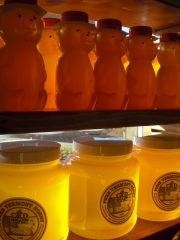
Do you buy local honey?

I don’t. I buy the cheap stuff, the kind that comes in an anonymous plastic bear. Every time I go to the store or farmer’s market to stock up, I go with the intention of upgrading this time around. And every time, the price differential meets me halfway and knocks me right back down to the generic bear priced juuust right.

Despite knowing I don’t buy it that often and that I can probably afford to pay a few extra bucks when I do, and despite the insistence of every locavore ever that the taste difference is worth it, I just can’t seem to make myself fork (spoon?) over the extra money for my honey.

But that might have to change.

Mark Bittman posted about “honey laundering” in his This Week in Food post last week. He linked to this summary of the issue on the Business Insider blog. Apparently, he and I are both a bit late to the party; this story has been unfolding for years. Back in August of 2011, the headline being picked up by every blog was “Asian Honey, Banned in Europe, Is Flooding U.S. Grocery Shelves.” (By the way, am I the only one who hears honey is “flooding” the shelves and immediately imagines a viscous tidal wave of honey verrrry sloooowly and stickily overtaking the grocery stores? Is that the whole point of the headline? I don’t know; it took me an embarrassingly long time to get the “honey laundering” joke, so maybe my pun-dar is on the fritz today.)

According to the Food Safety News article, “A third or more of all the honey consumed in the U.S. is likely to have been smuggled in from China and may be tainted with illegal antibiotics and heavy metals.” Yikes.

According to that same 2011 article, “Another favorite con among Chinese brokers was to mix sugar water, malt sweeteners, corn or rice syrup, jaggery, barley malt sweetener or other additives with a bit of actual honey. In recent years, many shippers have eliminated the honey completely and just use thickened, colored, natural or chemical sweeteners labeled as honey.” As of February of this year, sophisticated laser technology has confirmed that your “honey” bear may be another beast entirely.

Photo © brixton | Flickr

Photo © brixton | Flickr

Apparently much of the “Chinese” honey back in 2011 was actually from India, where it was known to be produced in such a way as to include these dangerous contaminants. Although the EU was firm in rejecting it (apparently they’re more grossed out by tainted honey than horsemeat), the FDA made excuses to welcome it in. Honey contamination is an issue made difficult to control by its international scope and all kinds of export and import regulations that I’m not qualified to explain (read the real news coverage).

If you search the United States Department of Justice archives for honey, you turn up stories about honey smuggling dating back to 2009 and earlier. (You also learn about such fascinating things as honey oil, which is apparently another name for hash oil, “a concentrated, honey-colored liquid” that is “produced by steeping cannabis in liquid butane” and was seized by police in a drug bust in 2005, along with “cheesecake, nut ball, 2 dozen chocolate chip cookies, cookie dough, and 10 pounds of butter”—enough munchies for the entire squad.) Now, finally, the Department of Justice is recognizing the issue and dealing out some charges.

And I’m finally thinking about making some changes to my personal honey consumption, too. Why? Is it because buying cheap honey supports an international smuggling operation? Not really. Is it because the cheap honey might contain antibiotics or lead?

No! It’s because it might contain GLUTEN!

Let me roll that one back for you: cheap honey may be largely composed of sugar water, malt sweeteners, corn or rice syrup, jaggery, barley malt sweetener or other additives. Barley malt? That has gluten! It’s why I can’t eat regular Rice Krispies (though I tried the brown rice ones recently and they’re fine by me).

Since I don’t know whether or not my container of honey includes barley, and this is clearly not a case where I can call the manufacturer directly (since the manufacturer could be in Thailand, or China, or India, or just about anywhere), I’m tossing that silly old bear from my cupboard and replacing it with a brand I can trust.

Is it totally backwards to care more about potential gluten contamination than potential lead poisoning? Maybe. But whatever gets you there, right?

Have you been following the honey controversy and have you ever had a problem with contaminated honey? Do you avoid generic brands and if so, what kind do you prefer to buy? Do your purchasing decisions in general take this kind of issue into account?

P.S. I focused on this particular news story today because it actually relates to the theme of my blog. I did want to note that I’ve been following the story of the explosions in the Boston Marathon and that, thankfully, none of my Bostonian friends and family were anywhere near there. If your loved ones were affected, know that my thoughts are very much with you.

Tagged , , , , , , , , , , , , ,
Design a site like this with WordPress.com
Get started