My new gluten-free NYC apartment: a paean

My new apartment’s wonderful,
though not without its quirks.
We’ve everything we’ll ever need—
assuming that it works.

A fourth-floor walkup—healthy, right?—
ignore the crumbling stairs.
My bedroom is (still) windowless,
but meh—fresh air—who cares?

We’re not in Brooklyn, near our friends,
or even close to work—
and if we don’t get AC soon,
I think I’ll go beserk.

The stovetop and the water tap
don’t get—precisely—hot;
the dishwasher does not get things
as shining as it ought.

The toilet leaks, the ceiling squeaks,
the countertops are few—
but GF ears are thrilled to hear
“appliances are new.”

The neighbors keep the volume pumped
throughout the day and night—
but dinner’s safe, my roomie’s great,
and so I feel all right.

The walls may quake, the tiles break,
the fruit flies come to breed—
but everything is gluten-free,
and that’s all that I need.

*

Since a picture’s worth a thousand words, here are a few. Yes, I was exaggerating for poetic effect (it wouldn’t be a New York apartment without a quirk or several). But I wasn’t kidding about the walkup. Every step of that is real, and my aching GF glutes are proof.

A messy workspace, just for us—with wooden spoons that it's okay to have because all the meals are gluten-free! And yes, that's a dishwasher, beloved of the neurotic and the gluten-phoboic, and a washer-dryer, which has nothing to do with gluten but is awesome.

A messy workspace, just for us—with wooden spoons that it’s okay to have because all the food in the house is gluten-free! And yes, that’s a dishwasher, beloved of the neurotic and the gluten-phoboic, and a washer-dryer, which has nothing to do with gluten but is awesome.

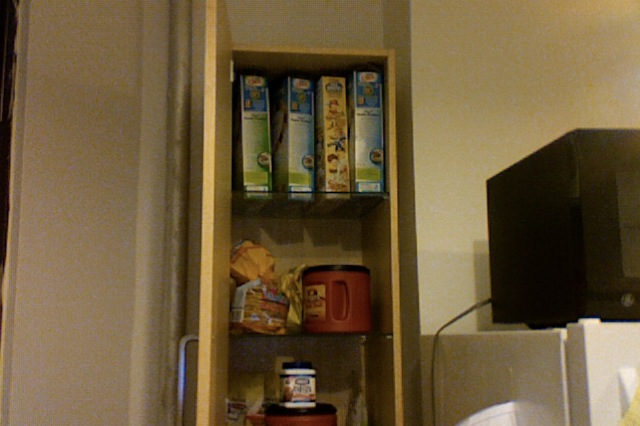
This is the pantry of someone who buys Chex by the carton. Not to mention bulk coffee (yes, I'm hooked again).

This is the pantry of someone who buys Chex by the carton. Not to mention bulk coffee (yes, I’m hooked again).

This is the beautiful, comfortable, more-expensive-than-anything-I'll-ever-be-able-to-afford-on-a-book-publishing-salary designer couch that I inherited when my office reorganized—and that my poor dad and coworker wrestled all the way up four flights of stairs only to find it was too large to fit through the hallway. It went home to Brooklyn in exchange for my old roommate's Ikea couch. Luckily tears are gluten-free, though I'm not sure crow is safe to eat.

This is the beautiful, comfortable, more-expensive-than-anything-I’ll-ever-be-able-to-afford-on-a-book-publishing-salary designer couch that I inherited when my office got reorganized—and that my poor dad and a helpful acquaintance wrestled all the way up four flights of stairs only to find it was in fact too large to fit through the hallway and into the door. It went home to Brooklyn in exchange for my former roommate’s Ikea couch. Luckily tears are gluten-free, though I’m not sure about all the crow I ate.

*

To those who sympathized when I bemoaned my loss of mess or worried that I’d be homeless right about now, thanks for the support. Maybe there’s a gluten-free dinner party in our future.

To those in New York:

a) You feel me on the quirks, right?
b) I’ve still got a whole bunch of tickets to give away to the Celebrate Celiac event this Saturday, so leave me a comment on my last post if you’d like to go, and I’ll get your name on the list. Until then, hope you’re holed up somewhere with an AC unit on high.

Tagged , , , , , , , , ,

Why I Celebrate Celiac, and you should, too (plus: giveaway!)

In my last entry, I asked how I should celebrate my newly low antibodies. (The response was nearly unanimously in favor of alcohol—but I’ve kept my perch on the wagon for now, thanks very much.) This post is about celebrating something just a little different: celiac, itself.

When I got my first-ever celiac bloodwork results back in January and started sharing the news (one relative or friend at a time, shyly, haltingly—prior to my Internet-overshare era), the reactions were generally positive, along the lines of:

“I hope that’s it, so you’ll have an answer,”
or, “Awesome, you’ll finally feel better now!”
or, “Just wheat, rye, and barley? That doesn’t sound so bad.”

Then I’d start rambling about cross-contamination, and strict diet for life, and six months to two years to feel better, and I watched the faces slip and fall. The replies changed to:

“Maybe I don’t hope you have it after all,”
and, “Oh my god, I’m so sorry,”
and, “That’s terrible.”

Which is correct?

Well…obviously the best, most celebration-worthy thing would have been to never get sick in the first place (or—if you believe those insufferable “no sunshine without rain” folks—to get sick, be miraculously cured, and live the rest of my life with a renewed appreciation of my own good health). Being sick is not, you know, preferred.

But, as a second choice, a disease with a relatively foolproof cure—even an excruciatingly slow-motion, longterm cure—is way, way better than a disease or syndrome with no known cure. As long as I’m a good little gluten-free girl, my health is (knock on wood) far more likely to improve than worsen. That’s something to celebrate.

Of course, since I’m not feeling tiptop yet, it can be tough to get my celebratory feelings going. For inspiration, I can always visit the smart and often funny posts around the blogosphere on the “good side” of celiac (like this one, this one, and this one). If you’ll indulge me in jumping on the bandwagon, though, here are the top three tangible things I celebrate about celiac:

1) Community. I know everyone has said it already, but that’s because it’s true. The online celiac and gluten-free community is super supportive and full of passionate, intelligent, interesting voices. As a resident of New York City, land of “hate thy neighbor” and “not here to make friends,” I sometimes feel a bit community-spirit-starved. Sharing my thoughts and hearing all of yours is a real treat.

2) New adventures. This blog, the gluten-free grocery aisle, fascinating followup tests…all previously uncharted territory, all kinda neat. (Yes, even the tests. Spending a morning blowing into a balloon every twenty minutes to measure gut bacteria is something that everyone should experience at least once, preferably preceded by fasting.) If I hadn’t gotten celiac disease, there’s a strong possibility I would still have no idea that buckwheat groats are, like, the best grainlike substance ever. I would also probably not have a bag of xanthan gum in my pantry, as I do now (albeit, I must shamefacedly confess, an unopened one).

3) Savings. What? Gluten-free food is expensive? Okay, yes, some of it is. I too have had those six-dollar mini-muffins and air-filled bags of chips. But you know what else is expensive? Eating out in New York. And you know who doesn’t do that? Baby celiacs. This is why my student loan collectors also celebrate celiac.

Add all that to the prospect of—any day now, fingers crossed—my fully restored health and vigor, and you’ve got yourself something to, at the very least, tolerate and, on a good day, celebrate. But how (besides the obvious, you buncha lushes) to celebrate?

That’s easy. Come to the New York City Celebrate Celiac event! Hosted by Gluten Free Calendar, it’s happening on Saturday, July 13th, from 10 a.m. to 1 p.m., at the Affinia Manhattan Hotel in Astor Hall. I’ll be there to meet any of you who can make it, and I’ll be unveiling some fun new blog-related stuff while I’m at it. Here’s some extra info on the event at the NYC Celiac Meetup page. If you live in the area, mosey on down for performances, activities, vendors, collective effervescence, and, most importantly, my autograph.

Kidding! But I really would love to say hi face to face. That’s why I’m pleased to be giving away 10 tickets to the event. At $5 a pop (or $4, if you buy online here), they’re pretty affordable as is, but if you, like me, have been blowing through your I-don’t-eat-out-at-restaurants-anymore fund, every little bit helps. And, hey, that’s five more dollars you can spend on merch. Not that that’s what blogging’s all about.

To win a ticket, just comment on this post letting me know what you celebrate (or what you don’t celebrate, if you insist on being mopey) about celiac. Considering the scant probability of my having more than ten readers in the New York metro area, you probably won’t face stiff competition, but you’re still welcome to follow me and share the giveaway on Twitter to get extra entries and to celebrate our community here in the Big Gluten-Free Apple (don’t forget to include @spruestory so I’ll know).

For everyone outside of the area who’s read to the end of this post, I hope you’ll still join me, virtually, in celebrating celiac…if only because things could be a whole lot worse.

Tagged , , , , , , , , , , ,

Good news, bad attitude

Guess what.

My test results came back!

I had been anticipating them with the same bated-breath anxiety that has preceded every report card or grade posting in my life (like I said, total Ravenclaw). When the email appeared in my oft-refreshed inbox, here’s what I found:

My tTG antibodies, which in January were hovering at some nebulous above-100 level, are down to 4. Single digits, baby! With the “negative” range defined as 1 to 3, that makes me practically normal.

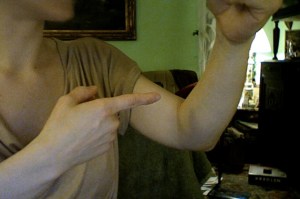
My vitamin levels, which we all know I was having some trouble getting up, are now normal to HIGH, thanks no doubt to the multivitamin I’ve been dutifully taking (increasing my risk of cancer with every milligram, if the New York Times is to be believed). The one exception is the still somewhat low vitamin D, which is hard to believe considering how much sun I get. I mean, look at this healthy glow:

Photo on 6-27-13 at 8.51 PM

My WBC is just barely low and my RDW is just barely high, which according to Google indicates anemia, or maybe AIDS, or, most likely, nothing.

Everything else? Normal, normal, normal. Normal!

This is good news. It means my body is backing off. It means I’m doing this gluten-free thing right. It probably means, as my sister reminded me, that the Arrowhead Mills popcorn was perfectly safe. Phew!

With the active siege nearing an end, I suppose it also means that my little sprue city has begun to recover. Somewhere deep inside me, villi are getting to their feet, stretching out, feasting on now-overabundant nutrients. At peace at last, my body will, I suppose, turn its attention to patching wounds and rebuilding infrastructure and, from there, to business as usual. The battle is won.

But, like any good pessimist, I’m not satisfied. Eating away at the sense of victory is the fact that I still feel about the same.

If you’ll permit me to return to the report card metaphor: It’s a bit like getting an A in a class without feeling that you actually learned anything. There’s a sense that the instructor missed something, that the serviceable papers you wrote and the multiple-choice bubbles you filled in merely concealed the depths of your ignorance. That if the grader were just a bit more perceptive you’d have failed.

Thus, the picking through the results for abnormalities; thus, the restless Googling of unfamiliar abbreviations; thus, the overwhelming urge to diagnose myself with latent adult-onset type 1 diabetes or Sjögren’s Syndrome or acute hypochondria. Like any objective, abstract metric, the test results are unconvincing in the face of my subjective but oh-so-concrete feeling of being unwell.

I’ll see my doctor in a couple weeks to discuss the results, and if the visit is anything like the last one, she’ll tell me not to worry, that this takes time, that a handful of months—however long they’ve seemed, however many blog posts you’ve crammed into them—are brief in the scope of celiac recovery.

In the meantime, I’m curious to know, for those of you with celiac experience: which went first, the symptoms or the antibodies? 

And, for everyone: how do you think I should celebrate?

Tagged , , , , , , , ,

Got worms? A review of The Wild Life of Our Bodies, by Rob Dunn

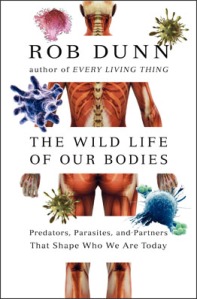
“You should rewild your gut,” my sister said to me one day, conversationally, over the phone. She said this in part because it’s the kind of thing people say to me all the time, but also in part because she’d just read The Wild Life of Our Bodies (Harper, 2011) and was eager to proselytize. When it comes to books, there’s a vacuum in me that yearns to be filled (perhaps by an intestinal worm—but we’ll get to that later), so I was an ideal soul to target.

wildbodies_cover

Althea tells me I’m the first person she recommended the book to who actually read it. Too bad, because it’s solid pop science (I, as a generally non-pop-science reader, enjoyed it), and it’s full of a lot of great tidbits for those of us who spend our days preoccupied with parts of the body that normal people are fortunate enough to forget exist.

Subtitled Predators, Parasites, and Partners That Shape Who We Are Today, the book’s central takeaway (which author Rob Dunn makes explicit only on the second-to-last page) is that “our bodies and lives only make sense in the context of other species. Only by looking at other lives do we really understand our own.” Although Dunn is careful to make clear just how much of what he’s writing is unproven, the ideas he presents do make good sense of senseless things.

For instance, why do we have allergies or autoimmune diseases? How did our bodies get so darn stupid? In a childhood game of “stop hitting yourself,” there’s always a sadistic older sibling in the background causing the trouble. When our own insides won’t stop hitting themselves, though, what on earth is to blame? Tell me you haven’t wondered this yourself once, twice, or every day. Dunn wondered, too. The hypothesis he describes in response is sort of the opposite of “stop hitting yourself.” It’s not that some outside force is taking the immune system by the hand and making it hurt itself; it’s that the immune system, used to having a force to act against, is hurting itself out of what amounts to habit—or boredom.

Life, as a wise candlestick once said, is so unnerving for a servant who’s not serving. Like the servant in that awkwardly classist formulation, the immune system, finding its original function unneeded, casts about for something to do with all of the useful skills it’s evolved. And in the process, it manages to mess things up for us pretty thoroughly. Here’s what Dunn thinks went down.

Once, he suggests, we all had intestinal worms. They snuck in through unfiltered water or burrowed up through the soles of our feet, and they made themselves at home within our guts. In response, our immune systems sprang into action, producing antibodies to oust the unwanted guests. But, if the worms stuck around long enough and seemed not to be causing much damage, peacekeeping cells developed, too, allowing our bodies to settle into equilibrium. “This isn’t so bad,” they told the immune system, in essence. “Chill out.”

Now, clean as we are, we have no worms, but our systems, having evolved to defend us, remain slap-happy. In the absence of true parasites, they attack other stuff—stuff that isn’t in itself bad, like pollen or gluten or choice bits of our own intestines. And, unfortunately, in the absence of real threats, our peacekeepers, which might have buffered us against such needless attacks, seem to have assumed we’d be okay on our own and departed on a long, naturally selected vacation.

Dunn adds on to that one more idea—his favorite, he calls it—that a parasite, if present, would also have secreted compounds that could calm our immune systems, even bamboozle it into thinking the worm belonged. Without this gentle resistance to which it is accustomed, the immune response is even more vicious. Like the kid whose arm continues reflexively to bat back and forth even once his brother has tired of the game, our immune systems carry on lashing out—or, really, lashing in, since there’s not much to lash out against—and causing us more harm than good.

The solution? It is, of course, to dose yourself with worms (rewild your gut). Maybe. You’ll have to read chapter 4 to figure out whether or not that’s a good idea.

Other highlights, for me, included discussions of:

  • making germless animals
  • gut bacteria’s role in metabolism and obesity
  • hand sanitizer’s counterproductive legacy
  • anxiety and panic disorders as remnants of our past lives as prey
  • hairlessness as a protection against bugs and the diseases they transmit
  • the relationship between disease and disgust

Throughout, Dunn uses far clearer analogies and demonstrates a much stronger grasp of science than I have in this post (although my neuroscientist sister did approve its content). For anyone who’s ever wondered what good an appendix is, or what causes Crohn’s disease, or how bad for us city living is really, The Wild Life of Our Bodies is well worth a read. If you do decide after reading it to go get yourself some worms, I hope you’ll tell me all about it.

Tagged , , , , , , , , ,
Design a site like this with WordPress.com
Get started