Tag Archives: gluten-free diet

Pride and Prejudice and Gluten

It is a truth universally acknowledged, that a celiac man in possession of a good fortune, must be in want of a wife.

However little known the appetite or baking ability of such a man may be on his first entering a neighbourhood, this truth is so well fixed in the minds of the surrounding families, that he is considered the rightful property of some one or other of their daughters.

Someone, after all, must take on the hard but fulfilling task of baking her way through that fortune, one bag of superfine rice flour at a time.

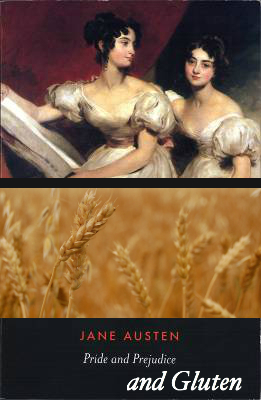
So begins PRIDE AND PREJUDICE AND GLUTEN, the classic novel reimagined to include something scarier than ballroom dancing and zombies alike. 
prideprej

When Mr. Bingley moves into the neighborhood, he doesn’t know quite what he’s getting himself into. He quickly learns he has entered a zone of intensely elevated celiac prevalence, brought on no doubt by many years of marrying one’s cousin and so forth.

Just as quickly, the news spreads that a likely young bachelor has let Netherfield Park. The gritty gifted cupcakes begin pouring in, as do the invitations with postscripts appended in the beautiful script that comes naturally to those women who have spent years practicing, all to the effect of, The buffet will have hummus.

Bingley good-naturedly agrees to attend, and brings along his friend, Darcy, with whom he pleads, hovering by the refreshments table in the grand tradition of non-dancers at balls, “Come, Darcy, I must have you try a bite of this.”

“I certainly shall not. You know how I detest anything gluten-free, unless I am particularly acquainted with the brand. With such a spread as this it would be insupportable. If there were any traditional baked goods, I might consider it, but alas, there is not a cracker or pudding in the room it would not be a punishment to eat.”

Having overheard all, Elizabeth Bennet—snarky before her time and with a measured but abiding pride in her own talent for recipe development, which though passable is widely understood, even by Elizabeth herself, to be inferior to her sister Jane’s—writes Darcy off as the worst kind of gluten-eating boor: too proud of his own lack of immune response to gluten, too prejudiced to try the teacakes at which Elizabeth has slaved away, combining four different recipes and throwing out three batches before she got them just right.

“I could easily forgive his pride,” Elizabeth sniffs, “if he had not mortified mine.”

You may think this story over before it has even begun, but there are twists and turns to come as Jane Bennet and Bingley fall in love over millet scones and buckwheat biscuits, then are driven apart by Darcy’s cynical remarks about their future children’s double genetic risk and the Bennet family’s inappropriate dinnertime discussion of matters gastrointestinal. After a suitable amount of mutual anguish, the two come together again as the beautiful and gluten-free always do.

In between, there’s a spot of trouble for Lydia, the youngest Bennet daughter, involving one Mr. Wickham, a roguish character who never truly intended to keep his kitchen cross-contamination-free. Darcy, it seems, has known all along that Wickham’s promises were as thin as the paper towels he wouldn’t actually use to wipe up his own crumbs. It is Darcy who alerts the family, though sadly not before a glutening catastrophe to which he refers in only the most euphemistic of terms; this is, after all, a novel of manners.

Darcy’s aid in this matter, and then in reuniting Jane with Bingley, endears him somewhat to Elizabeth, but what seals the deal is a letter he sends her with, enclosed, his recent positive biopsy results. It is revealed that his excessive pride was born of his fear that he himself may all too soon be forced to sup on sandwiches insupportable by their fragile bread, and piecrusts made of grains his family would scorn as peasants’ fare. Furthermore, it was persistent gluten exposure that caused his irritability and dour physiognomy.

The twin barriers of Darcy’s gluten eating and terrible personality now removed, there is nothing to stop Elizabeth from wedding him immediately, which she so does. As in the original, they all live happily ever after, except for Lydia.

*

So what do you think? Will Keira Knightley agree to take the lead?

Text adapted from Jane Austen’s Pride and Prejudice, now in the public domain. Wheat image from jayneandd at the Flickr Creative Commons. Book cover image stolen shamelessly from Penguin—they can afford it.
Tagged , , , , , , , , , ,

It’s not easy being green (and gluten- or allergy-free)

Happy Earth Day! Yesterday in Prospect Park I saw two young guys tromping around the lake, drumming on reclaimed water cooler jugs and chanting “Reduce! Reuse! Recycle!,” with a group of kids and parents following behind and half-heartedly shaking the little recycled maraca-things they’d clearly made earlier in the outing. I’m sure Mother Nature found it cute. I found it a good reminder to write this blog post.

Gluten-free often gets lumped in with organic and green in marketing and in popular imagination. I find this odd. Sure, reading labels on processed foods may make you more aware of what weird chemicals you’re putting into your body, and from there you might make the leap to increased awareness of what those chemicals may do to, say, bodies of water. (Dana at Celiac Kiddo wrote a great post about beaver butt in breakfast cereal and what exactly “natural ingredients” means—related and definitely worth a read.)

But overall, I find it’s not that easy to be both green and gluten-free. I’m sure anyone who’s ever had to worry about gluten and allergy contamination can relate; maintaining a clean, contamination-free environment can involve a lot of waste.

There’s the inevitable pantry cleaning at the start and the rallying cry, “When in doubt, throw it out!” Might you have dipped a spoon into first the flour and then the sugar? Toss the sugar. Did a knife go onto toast and then into the jam? Ditch the jar. And while you’re throwing out food right and left, go ahead and buy yourself a new dedicated cutting board, and try not to think about plastic and landfills.

We’re encouraged to buy designated gluten-free toasters, which means double the appliances to plug in, using double the electricity—and no, I don’t believe you remember to unplug your appliances when they aren’t in use.

My sponge usage went through the roof when I went gluten-free, as I’ve written before. Besides that, there’s paper towels for cleaning, parchment paper for baking, and ziploc bags for everything. I also use a lot more soap, which may or may not be harmful to the environment.

And all that is just at home. There’s more! At the grocery store, where before I might have skipped bagging my potatoes and apples, now I worry about those mystery stains on the conveyor belt and opt for the extra plastic. Packaged ingredients, with their FDA-regulated ingredients labels and airtight seals, are my friends. And shopping from the bulk bins to reduce packaging? Forget about it! You don’t know where those scoops have been!

We nod approvingly at muffins being baked in a separate facility and shipped to our local bakeries in individual shrinkwrap. We ask that Chipotle employees wear new gloves while preparing our burritos. And when we can’t find safe places to dine out, we buy individually packaged power bars to see us through.

I’ve even started using more plastic utensils and cups, because I bring meals with me when I’m out instead of stopping off somewhere to eat, and because I don’t trust these items to be clean enough at friends’ homes (no offense).

If you seek organic and non-GMO foods, you may find it harder when purchasing gluten-free products, many of which include corn (here’s a pretty recent list of foods, maintained by a gluten-free, vegan mom blogger, that are non-GMO and gluten-free). I can’t seem to get worked up about GMOs myself, but I understand there’s a lot of anxiety surrounding their health and environmental impact—an anxiety that may be compounded by gluten or allergen concerns.

Organic, natural body care products may also be more likely to include wheat or dairy proteins because these are “natural” alternatives to the chemicals in the big guys. This means if you’re avoiding those proteins, you must reject the purportedly greener options.

For people with severe seasonal allergies to, e.g., pollen, there’s a whole other set of energy expenditures to add into the mix: more laundry-washing, more vacuuming, more air conditioning. Those with serious allergies may also drive their cars during this season more often than they walk or bike. (Amanda at Celiac and Allergy Adventures has written here about the measures she takes during asthma/allergy season.)

So you see? It’s not that easy being green! When we’re expending lots of extra energy ourselves to rigidly control our immediate environment, it’s harder to maintain some of those little footprint-reducing habits we once cherished. Luckily, this doesn’t mean you can’t be green.

The safest foods in the world for most allergies and the gluten-free diet are fresh fruits and vegetables—whole foods that (as long as you buy in season) are pretty darn low in environmental impact. You can even consider going meatless for at least some meals, which is touted far and wide as a simple way to reduce one’s environmental impact. Yes, it can also be a bit harder to maintain a balanced diet while avoiding gluten or allergens and meat and dairy/eggs, but it’s nowhere near as tough as some will have you believe.

You can still keep an eye on your overall energy and water usage (and a dishwasher, widely considered the most effective way to clean contaminated dishes for those lucky enough to own one, is also often more energy- and water-efficient than hand-washing).

And (unless you do have the aforementioned severe seasonal allergies) you can always plant a tree or make an effort to walk or bike more, use public transportation more, and drive less, none of which have much of anything to do with gluten.

Tell me: Do you consider yourself an environmentalist? What do you do to reduce your footprint, if so? Do you find it harder to do while on a gluten- or allergy-free diet? What are your tips for managing both at once? And how are you celebrating Earth Day?

Tagged , , , , , , , , , , , ,

Sprue News: What’s Funny About Your Honey

Photo © Ano Lobb | Flickr

Photo © Ano Lobb | Flickr

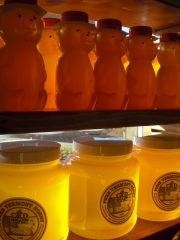
Do you buy local honey?

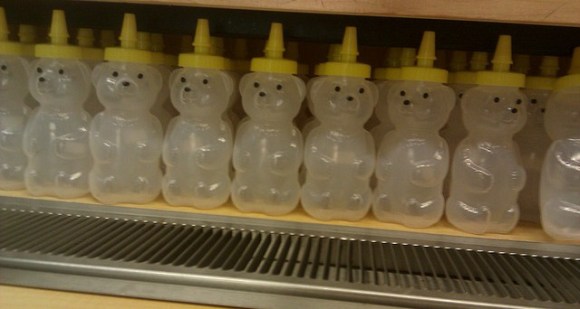
I don’t. I buy the cheap stuff, the kind that comes in an anonymous plastic bear. Every time I go to the store or farmer’s market to stock up, I go with the intention of upgrading this time around. And every time, the price differential meets me halfway and knocks me right back down to the generic bear priced juuust right.

Despite knowing I don’t buy it that often and that I can probably afford to pay a few extra bucks when I do, and despite the insistence of every locavore ever that the taste difference is worth it, I just can’t seem to make myself fork (spoon?) over the extra money for my honey.

But that might have to change.

Mark Bittman posted about “honey laundering” in his This Week in Food post last week. He linked to this summary of the issue on the Business Insider blog. Apparently, he and I are both a bit late to the party; this story has been unfolding for years. Back in August of 2011, the headline being picked up by every blog was “Asian Honey, Banned in Europe, Is Flooding U.S. Grocery Shelves.” (By the way, am I the only one who hears honey is “flooding” the shelves and immediately imagines a viscous tidal wave of honey verrrry sloooowly and stickily overtaking the grocery stores? Is that the whole point of the headline? I don’t know; it took me an embarrassingly long time to get the “honey laundering” joke, so maybe my pun-dar is on the fritz today.)

According to the Food Safety News article, “A third or more of all the honey consumed in the U.S. is likely to have been smuggled in from China and may be tainted with illegal antibiotics and heavy metals.” Yikes.

According to that same 2011 article, “Another favorite con among Chinese brokers was to mix sugar water, malt sweeteners, corn or rice syrup, jaggery, barley malt sweetener or other additives with a bit of actual honey. In recent years, many shippers have eliminated the honey completely and just use thickened, colored, natural or chemical sweeteners labeled as honey.” As of February of this year, sophisticated laser technology has confirmed that your “honey” bear may be another beast entirely.

Photo © brixton | Flickr

Photo © brixton | Flickr

Apparently much of the “Chinese” honey back in 2011 was actually from India, where it was known to be produced in such a way as to include these dangerous contaminants. Although the EU was firm in rejecting it (apparently they’re more grossed out by tainted honey than horsemeat), the FDA made excuses to welcome it in. Honey contamination is an issue made difficult to control by its international scope and all kinds of export and import regulations that I’m not qualified to explain (read the real news coverage).

If you search the United States Department of Justice archives for honey, you turn up stories about honey smuggling dating back to 2009 and earlier. (You also learn about such fascinating things as honey oil, which is apparently another name for hash oil, “a concentrated, honey-colored liquid” that is “produced by steeping cannabis in liquid butane” and was seized by police in a drug bust in 2005, along with “cheesecake, nut ball, 2 dozen chocolate chip cookies, cookie dough, and 10 pounds of butter”—enough munchies for the entire squad.) Now, finally, the Department of Justice is recognizing the issue and dealing out some charges.

And I’m finally thinking about making some changes to my personal honey consumption, too. Why? Is it because buying cheap honey supports an international smuggling operation? Not really. Is it because the cheap honey might contain antibiotics or lead?

No! It’s because it might contain GLUTEN!

Let me roll that one back for you: cheap honey may be largely composed of sugar water, malt sweeteners, corn or rice syrup, jaggery, barley malt sweetener or other additives. Barley malt? That has gluten! It’s why I can’t eat regular Rice Krispies (though I tried the brown rice ones recently and they’re fine by me).

Since I don’t know whether or not my container of honey includes barley, and this is clearly not a case where I can call the manufacturer directly (since the manufacturer could be in Thailand, or China, or India, or just about anywhere), I’m tossing that silly old bear from my cupboard and replacing it with a brand I can trust.

Is it totally backwards to care more about potential gluten contamination than potential lead poisoning? Maybe. But whatever gets you there, right?

Have you been following the honey controversy and have you ever had a problem with contaminated honey? Do you avoid generic brands and if so, what kind do you prefer to buy? Do your purchasing decisions in general take this kind of issue into account?

P.S. I focused on this particular news story today because it actually relates to the theme of my blog. I did want to note that I’ve been following the story of the explosions in the Boston Marathon and that, thankfully, none of my Bostonian friends and family were anywhere near there. If your loved ones were affected, know that my thoughts are very much with you.

Tagged , , , , , , , , , , , , ,

For the record

You know when keeping a food log sucks? When you get to the end of a day and realize it looks like this:

Breakfast: Sugary cereal

Snack: ~1/3 jar of Dark Chocolate Dreams peanut butter

Lunch: Half a bag of tortilla chips with salsa and hummus

Snack #2: Gluten-free cookies

Dinner: Frozen premade Indian dinner, peanut brittle

Exercise: Skipped


You know when it sucks worse? When you’ve had a week of days that look like this:

Breakfast: Unsweetened whole-grain hot cereal with flax and almond milk

Lunch: Sweet potatoes, pinto beans, carrot sticks

Snacks: Reasonable portions of nuts, fruit and vegetables

Dinner: Tempeh, apple, and onion stir fry with brown rice and spinach

Exercise: Lots of walking, plus 45 minutes on the elliptical

. . . but you still feel like crap.

Photo © Ben Haley | Flickr

Photo © Ben Haley | Flickr

Amirite? I know my paleo friends are just waiting to pounce on that second entry, much as their ancestors descended upon prey in the savanna. There are at least as many different definitions of an ideal diet as there are calories in a third of a jar of peanut butter. My own sense that a whole-foods, plant-based diet should make me feel healthy is shored up largely by dogma and selective reading. Still, at the end of most days, I feel I’ve made pretty good food choices. But does it make a difference? My answer is in black (or blue, depending on pen color) and white.

When other people go on and on about how great their unprocessed veg*n diets make them feel, I often struggle with the urge to hurl butternut squash at their heads. I know intestinal healing comes first, and I’m sure an overall healthy diet is probably working invisible heart-protective magic, yadda yadda, but I can’t help but wonder: What’s the point of eating well if an unhealthy gluten-free diet and a healthy gluten-free diet leave me feeling exactly the same? For that matter, what’s the point of eating a healthy or unhealthy gluten-free diet if I feel worse on average than I felt when I was eating gluten? Why bother doing it right if I’ll still feel wrong?

When I start asking myself this kind of question, that’s when I know it’s time to call in the big dogma. Six months to two years to feel better on a gluten-free diet, I remind myself, mantralike.

Six months to two years. That’s a lot of days worth of food logs. Might as well make them good ones . . . well, most of them, anyway.

Photo © Tyler Dawson | Flickr

Photo © Tyler Dawson | Flickr

Tagged , , , , , , , , , , , ,
Design a site like this with WordPress.com
Get started