Why don’t doctors just talk to each other?

You know that old conversation starter/essay prompt, “If you had to pick five people, famous or not, dead or alive, real or imaginary, to invite to a dinner party, who would you choose?”

There are variations with different numbers and types of people, but the question’s basic thrust, I think, always comes down to a mix of “Who do you most want to talk to?” and “Who do you most want to talk to each other?” In other words, what combination of people in all the world and all of history do you feel would produce the most interesting dialogue?

This question was an option for my college admissions essay. I didn’t choose it, probably because I feared my taste in famous and historical companions would not pass muster. I’m still not sure it would, even after my four years of cultural grooming.

But lately I’ve been thinking about it again, not so much in terms of a fantastic philosophical discussion I could arrange, but in terms of a conversation I could trigger that would have immense utility for me personally. What if, a couple years ago, I’d thrown a dinner party for all of my different doctors—my old general practitioner, the emergency room doc I saw one time, the gastroenterologist who prescribed OTC medication, the ob-gyn, the dentist—and proposed the conversation starter “Diagnose Molly”? (Personal health makes for great dinner conversation.)

Could they have done it? Could they have laid out all my different symptoms on the table and connected the dots, instead of each focusing myopically on a different piece of my health? Or would they refuse to talk to each other, kick each other under the table, pick at their meals? Would the GP look down on the GI doc and the emergency room doc fixate on his beeper and the dentist drift into fantasies of his future yacht?

Maybe they’d manage it if I threw a celiac disease expert in there. Or gave them access to WebMD.

Wouldn’t it be nice, though, if instead of a splintered, segmented health care system, we had doctors who spoke to one another? Of course, doctors have so many other patients to deal with that they would never have time for a little conference focused just on me.

But what if they . . . you know . . . shared their records with one another in an organized way, using the advanced technology we have available for preserving and sharing information? Might that not have helped? Might the pieces not have come together faster?

Is that such a fantasy? Is it science fiction? If you ask me, it shouldn’t be.

I’m off to Washington, DC, today to visit my brother and see some cherry blossoms. Have a nice weekend, and tell me who you’d invite to a dinner party if you could pick any five people.

Tagged , , , , , , , ,

Sprue stories: The Bedbug Edition

Photo © Bloody Marty

Photo © Bloody Marty

Last summer, I had a bit of a scare. As I lay in bed one night, my leg became oddly . . . itchy. I scratched, but the itch returned. My hand crept down again and again, even though I told myself I was making it worse. Finally, I yanked off the covers and took a peek. There, on my leg—on MY leg—were three small bumps, all in a row.

My heart seized.

Google, which I raced to check, confirmed that the three-bump pattern was linked to bedbugs. I stripped my sheets, flipped over my mattress, and found, around the edges, small black bits that I was certain resembled the Google images of bug-infested beds.

Google also told me it was not recommended to vacate the premises or sleep in a different room, which risks spreading an infestation. In a rare instance of disobedience to Google, I refused to return to my room. Instead, I sat huddled and horror-stricken in my dining room at my computer late into the night.

The following days were bleak. I’m not proud to say I threw out a whole lot of things, washed and dried everything else several times and then kept it all in trash bags, getting dressed at my front door because I was so scared I might spread the bugs. I dragged my roommate out to buy an expensive vacuum from Manhattan’s only 24-hour hardware store, I thought about nothing but bedbugs, I told several people we had bedbugs, and I even canceled a visit to Buffalo to see my sister because—again—I feared spreading the bugs. I slept little and cried a lot. In short, I completely lost it.

And then we didn’t have bedbugs after all. The inspector came, looked at the “samples” I’d been collecting, looked at my mattress, and laughed. The “infestation” on my mattress was dust, collected over a year of not vacuuming the mattress. The samples were of, well, baby beetles and cockroaches, which is still gross but better than the alternative. The panic I’d undergone was just that: panic. So . . . phew. Embarrassing, but . . . phew.

Good things that came out of my bedbug scare include:

– I threw out some old clothes that I had no business wearing in public anyway.
– I bought a vacuum.
– I learned a valuable lesson about finding out before freaking out.

I also learned a lot about bedbugs. Now that I’ve learned a lot about gluten, too, I want to talk about how much they have in common.

First, a few differences.

Bedbugs are not found in wheat, rye, barley, and oats (though look out for grain weevils).
– Gluten cannot move around of its own volition (though flour particles can drift around in the air for a while, according to some sources).
– Bedbugs do not give bread its characteristic elasticity and stretch.
– Gluten does not suck your blood.

On to the fun part: the similarities.

Both are very small.

But it’s a myth that bedbugs are microscopic. They are more like the size of that single crumb that can take someone with severe gluten sensitivity out of action for days or weeks.

Both affect some people and not others.

Bedbugs are picky creatures. Monogamous, even. A couple can sleep together in the same bed every night and the bugs might attack one of them but not the other. Relatedly, bedbugs cause reactions in some people and not in others, and the range of response severity is wide (some rare people are even allergic to the point of anaphylaxis). Gluten, too, affects some people and not others; a couple might eat the same pasta dinner every night and the gluten might destroy one set of intestines but not the other. And for those lucky affected individuals, symptoms range from minimal to life-threatening.

Both disproportionately affect travelers.

Bedbugs can be spread through staying in hotel rooms and taking buses and other modes of transit, where they are dislodged from luggage or traveler’s clothing and hide out awaiting you. Brooklyn writer John Hodgman claims that the first thing he does upon returning home after a trip is strip naked and wash the clothes off his back—and that this is what every careful human should do to avoid bedbugs. Similarly, as we all know, traveling is difficult for those with gluten issues. You need to pack safe food to bring with you or locate gluten-free dining establishments, or else risk encountering gluten along the way. There has been some concern about the bedbug epidemic’s effect on New York City tourism, and in my opinion the small number of gluten-free-only establishments per capita here in the Big Apple should scare away tourists, too.

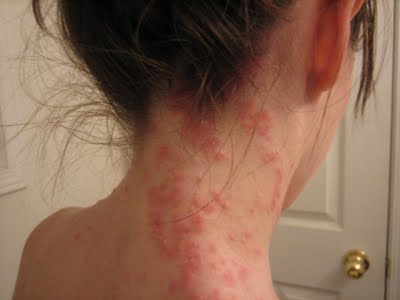
Both can cause an itchy, painful skin rash.

bed-bug-bites

Rash caused by bedbug bites

Dermatitis herpetiformis (triggered by gluten)

Dermatitis herpetiformis (triggered by gluten)

Yes, I chose less severe images than I could have.

Both hide in cracks and crevices.

According to the University of Kentuckybedbugs camp out “along and under the edge of wall-to-wall carpeting, especially behind beds and sofas; cracks in wood molding; ceiling-wall junctures; behind wall-mounted pictures, mirrors, outlets and switch plates; under loose wallpaper; clothing and clutter within closets; and inside clocks, phones, televisions and smoke detectors.” According to Jane Anderson at About.comgluten hides in the crevices of your toaster, scratches in nonstick pans, pores of cast iron pans, scrapes in cutting boards, and minuscule cracks in spatulas, spoons, and rolling pins. And yes, people do have concerns that both gluten and bed bugs are in your computer (bugs in the warm hard-drive-y area, gluten in the keyboard and mouse, and both, of course, swarming the internets).

Both attract online sensationalizing.

I discovered a whole world I never knew existed (and sort of wish I still didn’t): bedbugger forums. These are places where the afflicted gather to share horror stories about the extent of their infestation, botched exterminations, and quixotic home control methods. They are zones of intense fear and fear-mongering, stoked to ever greater levels, and they are not a good way to avoid the whole stress thing. Your life is over!, many of the posters trumpet. You can run, but you’ll take them with you! Buy a PackTite or all is lost! Similarly, although celiac disease forums often feature reasonable, supportive posts, they also have plenty of hopelessness to go around. If you want to send yourself into a downward spiral of obsessing over your illness, you can manage it by poking around celiac.com. Actually, a very thoughtful and perceptive post on one of those bedbugger forums made the connection quite well:

“I just wanted to say that I have a chronic, potentially debilitating illness and when I was first diagnosed I went to some internet forums and after reading story after story, thought my life was over. But it turns out most people with this illness actually end up living full and painless lives (these days, anyway) but these were not the people posting on the forums! . . . people come together in these support forums when they are not having success solving their problem, or when they need understanding or advice, not when the problem is under control and they aren’t thinking about it anymore. So we are not getting an accurate picture of success and failure here.”

Both also attract media sensationalizing.*

Bedbugs are everywhere! Bedbugs are spreading! Bedbugs are in your local public library! Bedbugs are (ironically) in the Health Department! Bedbugs are in your lingerie! Bedbugs are at home, at work, and at school! Similarly, gluten is everywhere! 50 percent of Americans are sensitive to gluten! Gluten is at home, at work, and at school! Gluten is in envelopes (maybe)! Gluten is in ketchup (maybe)! Gluten is in imitation crab (well, yes, but it’s gross anyway)! Gluten may not be in your lingerie but I wouldn’t count on it! *Some of this is sensationalizing; some of it is just true. But it’s comforting to call it sensationalizing.

Both have the capacity to drive you completely and utterly bonkers. . .

Especially if you’re me. Both are linked to stress, anxiety, and depression. The mechanisms are not completely clear from research in either case, but from a common-sense standpoint, it makes perfect sense. Bedbugs and gluten cause physical pain and are hard to eradicate, a bit disturbing, and potentially thought-consuming. Having them around is stressful? Um, obviously. It’s easy to become anxious that either might be present at any time and in any place, especially with all the hype surrounding both.

. . . but not if you deal with the problem correctly, in about the same way.

Step 1 is to make sure you actually have a problem (by inspection or by diagnosis).
Step 2 is to do your research carefully, not believing everything Google tells you.
Step 3 is to learn to love cleaning.
Step 4 is to put into practice all the necessary cautionary measures you can.
Step 5 is to be patient.
– And Step 6, though really you should be doing this all along if you can, is, as in many things, to stay calm and avoid catastrophizing. Life will go on, even if you do come across bedbugs or gluten.

Remember: Bedbugs bite, gluten bites, but don’t let your life bite.

Now that I’ve finished grossing you out, are there any similarities or differences I’m missing? Have you had any experience with bedbugs? If so, I’m so sorry! Any other tips for handling it?

Tagged , , , , , , , , , , ,

Hunger, service, advocacy, and pizza

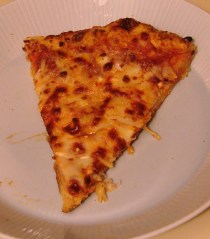
Domino's Wisconsin 6 Cheese Pizza Slice

There’s a homeless shelter in walking distance of my apartment, where I volunteer once a month. It’s “transitional,” meaning it’s intended for families who need short-term housing assistance (though I’m not entirely sure what “short term” means, because I volunteered there several times last autumn, then recently signed up for the same volunteer project again and encountered many children I recognized from the fall). The project I do is called “Read to Me.” We volunteers come in, read with one or two kids each for about 45 minutes, then the kids do a craft, then they get pizza.

As you might expect, the reading is tolerated but the pizza is the main event. The kids get jittery and excited as pizza time nears, chanting, “We want pizza!” and—even more tellingly—actually settling down upon being told that was the condition for receiving the pizza. The kids are of all different reading levels, all different personalities, and all different shapes and sizes, but they’re united in their love of pizza.

But one kid, small for his age, chanted along with the rest but barely nibbled the very tip of his slice, getting his hands smeared with grease but otherwise hardly touching the pizza. When the others were clamoring for seconds, he just sat quietly. I couldn’t help but notice, and to wonder why this would be. Obviously, there could have been any number of reasons why this kid wasn’t eating his pizza: maybe he’d had breakfast late, maybe he was picky, maybe he didn’t actually like pizza but enjoyed joining in the collective effervescence of anticipating it. There was no real reason to jump to the conclusion that pizza made him feel sick, but I did wonder if that could be it. 

For a kid who has certain food intolerances or celiac disease, pizza could be a painful present. I wondered if there was any chance he did, and if so whether he was diagnosed and whether the shelter staff was aware. I wondered whether their being aware would make any difference. Introducing gluten-free options to a pizza party for 30 kids adds logistical issues and extra expense. This particular party was no-frills: plain cheese pizza with juice drinks and fruit snacks that were already in the shelter’s cupboards. The only difference might have been that this boy would have been told not to eat the pizza, to simply go without.

I know I see the world through gluten-colored glasses recently, and I try to work against my own tendency to see celiac everywhere. I’m really not claiming that this boy has celiac disease. But watching him not eat that pizza got me thinking. From a statistical standpoint, it’s of course true that some people in homeless shelters have celiac disease or food allergies. I am not sure what kind of food is provided on a day-to-day basis in homeless shelters, but given the ubiquity of pizza and cake as special treats and the high representation of wheat and allergens in, for example, public school cafeterias, I have a feeling there isn’t much accommodation of special dietary needs. I wonder if any accommodations are made to avoid or treat diabetes. If anyone knows more about this, I’d love to hear from you in the comments.

Similarly, some families whose incomes qualify them for food stamps must contend with food allergies or food-related disorders like celiac disease. This is troubling because, according to the image below, the most subsidized and therefore cheapest foods in the US are wheat, corn, and soy—two out of three of which are on the list of the top eight allergens, and one of which of course contains gluten. (And corn really isn’t a particularly nutrient-rich food compared to other whole grains and is often used in highly processed forms such as syrup.)

60609_375547115892353_1317881117_n

As much as I’m in favor of cooking from scratch using whole foods, and as much as I feel that this can in the long run be considerably cheaper than convenience foods, convenience foods really are more convenient than whole foods, or at least they seem as though they are—especially to a parent with multiple jobs, long commutes, health issues of their own, older and younger family members to support, and any number of other issues that impact the energy and time folks have available to cook. And gluten-free/otherwise “safe” (dairy-free, organic, low-sodium, low-sugar, etc.) convenience foods are almost always more expensive and difficult to find than their counterparts.

1166663921_00905Sure, I might consider it easy and inexpensive to buy a package of corn tortillas and a few cans of beans, sauté them with onions and garlic and spices, top them with cheese, tomatoes, and lettuce. With this kind of simple recipe in one’s back pocket, there’s not much need to ever buy a premade meal. But people need to know the simple options available, and they need to get past the initial grocery shopping barrier, where a stressed shopper may find it easier to throw a few bags and boxes into a cart and get in line rather than visit several aisles to select fresh ingredients. Then, even if the time to cook a fresh, lower-sodium, lower-sugar, no-allergen meal is about the same as to cook, say, Hamburger Helper or Kraft mac & cheese, people need to know and believe that it is.

I don’t think parents of any economic bracket are feeding their kids peanut butter if it’s going to send them into anaphylactic shock—though please correct me if I’m wrong—but for parents of children with celiac disease who must choose between feeding their kids food that makes them ill or not feeding them at all, the “correct” choice is clear but incredibly unfair. Feeding a kid with celiac disease a sandwich is “just” going to cause them discomfort, albeit in some cases severe discomfort (as well as long-term intestinal damage that can be reversed in the future). Living Without covered this topic some time ago in this article, which includes this wrenching quotation from a mom discussing the available options at her local food bank: “My daughter will just have to live with diarrhea.”

But she shouldn’t have to. No one should. People who have (or whose children have) celiac disease and who can’t afford groceries, much less pricier gluten-free staples like bread and cereal, need to be able to get gluten-free food from shelters, food banks, and soup kitchens. Foods stamps need to cover gluten-free or allergen-free food. Companies need to donate things other than peanut butter and wheat pasta to food banks (which, from what I can tell, actually prefer to get donations of money or time from average citizens, since the foods donated are sometimes unsuitable). We need to provide support for those in need that addresses all their needs. 

I found out about Food Bloggers Against Hunger yesterday, and I didn’t try to officially sign up since it was so last minute and I’m not really sure I’m a food blogger anyway. But I felt inspired to join in, so I wrote this post. Check out the other posts and consider sending a letter to your Congress reps asking them to protect SNAP funding.

I fully understand that in a time when we’re fighting to keep even the financial assistance we already provide to the hungry, it may seem excessive to ask for even more specialized care. But I think it’s important. Celiac disease advocacy, though important, seems to often focus on issues of available food and awareness in restaurants and, recently, in college dining halls. As important as this may be, it concentrates our energy on spaces that already cater to the relatively privileged. I feel that we as celiac or food allergy advocates need to broaden our scope, to focus on the pressing daily reality of starvation in our country and in others. I’m just not totally sure how to do it, which is why I’m opening this up to you now.

Do you agree we as celiac or food allergy advocates need to broaden our scope? What concrete things can we do for those of us who are struggling to get by? What things do you do already to help the hungry, whether food-restricted or not? Do you support SNAP funding?

Tagged , , , , , , , , , ,
Design a site like this with WordPress.com
Get started