
I’ve got doctors on the brain recently, probably because I’ll be seeing a new one next week. I get excited about a new doctor almost the way some people anticipate a first date. Will I like her? Will she “get” me? Will she at least be better than the last loser? Might she—dare I dream she could be the One? The doctor I’ll want to commit to forever, in sickness and in health?
I am hoping this new doc will work out. But lately I’ve wondered if I’ve been looking for care in all the wrong places. What if the doctor for me isn’t like those others I’ve known? What if my Dr. Right isn’t even human? That’s right—I’m talking about Watson.
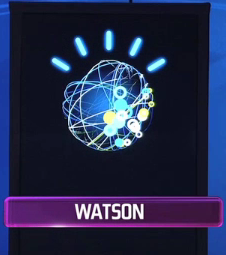 According to an article in the Atlantic, a future in which computers process symptoms, test, diagnose, prescribe, and even perform surgery is no idle daydream. Picture this: you walk into your doctor’s office and he/she sits in front of you with a laptop or tablet, typing in your symptoms (or recording them via voice recognition technology), and then you both wait as the system crunches the data and spits out a list of potential diagnoses and tests to be ordered. Or, maybe, the symptom-listing step is bypassed entirely, because you’ve already been walking around with sensors in your clothing or on your smartphone that have been feeding information about your bodily processes directly into the system, leaving you to fill in only the less quantifiable information—the psychological stuff, perhaps, if they haven’t found a way to quantify it yet. The doctor, in this scenario, wouldn’t be much more than an accessory to the work of the computer.
Personally, I’m intrigued. I’d love to know that my symptoms were being recorded in a database longer lasting than my memory or a doctor’s poorly executed scrawl on a clipboard (it’s mind-boggling to me how backwards and unsystematic our current electronic medical records are). I also appreciate the idea of my symptoms being systematically investigated for patterns, without ignorance or biases clouding the picture. Research is moving too quickly and medical practices are too overbooked for doctors to be able to keep up with the volume of new knowledge or prioritize it appropriately. A computer, properly “trained,” perhaps could.
The Atlantic article references a TechCrunch article from 2012, in which writer Vinod Khosla writes compellingly about “Dr. Algorithm” eventually replacing 80 percent of physicians, with the remaining 20 percent continuing to make themselves redundant by helping the computers improve at diagnosing illness. The Atlantic article characterizes doctors’ response to this prediction as “skepticism, derision, and anger.”
I’m sympathetic. Since I work in book publishing, you might say that I’m living in a glass house when it comes to throwing technological stones. After all, people love to claim that publishing houses are on their way out. Why work with a publisher when you can use CreateSpace? Who needs a publicist when there’s Twitter? Why bother with an editor when you can just turn on spell check?
From my perspective in the publishing industry, I see the oversimplifications implicit in these questions. I know that editors do more than check spelling, and I don’t think that what they do do—isolate and clarify ideas, improve upon the readability, accuracy, and quality of writing, and push authors to consider cuts or additions that would not occur to them, given their proximity to the material—will be made redundant anytime soon. Beyond that, anyone who self-publishes must face the difficulties of designing a beautiful cover and interior, working out the intricacies of metadata and ebook distribution through multiple channels and formats, and finding the time for the kind of promotion that allows a book to sell more than a hundred copies or so. People in publishing have developed expertise in these things and do them on a daily basis. It’s hard to say exactly which traditional publishing professions will still be in play ten or fifty years from now and how the industry as a whole will look, but I do feel safe predicting that it won’t be dead yet.
Similarly, I think it would be oversimplifying to ask, “Who needs doctors when we have WebMD?” WebMD is a fantastic tool, and more sophisticated systems like Watson offer even wilder possibilities. Still, as the Atlantic goes on to note, doctors “do more than process data. They attend at patients’ bedsides and counsel families. They grasp nuance and learn to master uncertainty. For their part, the innovators at IBM make a point of presenting Watson as a tool that can help health-care professionals, rather than replace them.”
Doctors—those mystical good ones, anyway—provide something a computer cannot: connection on a human level. A real, warm hand to hold in trying times, a shoulder to lean on, a compassionate face, a soothing tone. Will we see doctors become, essentially, medical counselors? Will, perhaps, the top 20 percent go on diagnosing alongside the computers, while the rest simply provide the “human” care they’re currently too busy to give?
I must admit, I scoffed a bit at this idea. My mind went to a recent NYT Well blog post about “failing” medical students, which discusses a certain student who couldn’t handle the pressure of working with patients but “did extremely well on all her tests,” so her professor found it difficult to fail her. The prof claimed there were “no multiple choice exams when it comes to things like clinical intuition, communication skills and bedside manner.” Many commenters on this post pointed out that medical schools prioritize the memorization of data for standardized tests over the teaching of those “soft skills” that the Atlantic article suggests may be doctors’ most critical contribution in the future.
On a personal note, I’ve had terrible doctors when it comes to soft skills. They were uninterested in communicating with me, they were too harried for empathy, and as for providing a shoulder to lean on, they may as well have worn barbed-wire epaulettes. Their “hard” skills weren’t stellar, either—they couldn’t seem to cobble my symptoms together into a diagnosis, and they all had their own pet distractions: one harped on fiber, one was big into prescriptions, and one always managed to turn the conversation back toward ear wax. I’ve never felt confident in my doctors’ ability to help me, and in the end, like many people, I had to ask to be tested for celiac disease (and then ask—beg, really—for my test results, too). Would these doctors improve if they had more time to relax and speak with their patients, or would they just become even more useless? I don’t know for sure, but faced with docs like mine, I’m ready for the robot revolution.
But I do have one friend in med school who talks a lot about her doctor-to-patient training as though it’s the part of school that interests her most: the part in which students role-play difficult conversations about health or meet real patients to learn about their medical history. My friend is smart, too, and if she retains her interest in interacting with patients and doesn’t get burnt out by school, she just might be the face of the future of medical care. If the doctor I’m about to meet is anything like this friend, I’ll feel like I’m in good hands—though that doesn’t mean I’ll stop doodling Watson’s name in the margins of my notebook anytime soon.
How do you feel about the idea of robots taking over the stethoscope? Heady daydream, or science-fiction nightmare?



 Based on a Sprue Story