Author Archives: Molly

Sprue News: What’s Funny About Your Honey

Photo © Ano Lobb | Flickr

Photo © Ano Lobb | Flickr

Do you buy local honey?

I don’t. I buy the cheap stuff, the kind that comes in an anonymous plastic bear. Every time I go to the store or farmer’s market to stock up, I go with the intention of upgrading this time around. And every time, the price differential meets me halfway and knocks me right back down to the generic bear priced juuust right.

Despite knowing I don’t buy it that often and that I can probably afford to pay a few extra bucks when I do, and despite the insistence of every locavore ever that the taste difference is worth it, I just can’t seem to make myself fork (spoon?) over the extra money for my honey.

But that might have to change.

Mark Bittman posted about “honey laundering” in his This Week in Food post last week. He linked to this summary of the issue on the Business Insider blog. Apparently, he and I are both a bit late to the party; this story has been unfolding for years. Back in August of 2011, the headline being picked up by every blog was “Asian Honey, Banned in Europe, Is Flooding U.S. Grocery Shelves.” (By the way, am I the only one who hears honey is “flooding” the shelves and immediately imagines a viscous tidal wave of honey verrrry sloooowly and stickily overtaking the grocery stores? Is that the whole point of the headline? I don’t know; it took me an embarrassingly long time to get the “honey laundering” joke, so maybe my pun-dar is on the fritz today.)

According to the Food Safety News article, “A third or more of all the honey consumed in the U.S. is likely to have been smuggled in from China and may be tainted with illegal antibiotics and heavy metals.” Yikes.

According to that same 2011 article, “Another favorite con among Chinese brokers was to mix sugar water, malt sweeteners, corn or rice syrup, jaggery, barley malt sweetener or other additives with a bit of actual honey. In recent years, many shippers have eliminated the honey completely and just use thickened, colored, natural or chemical sweeteners labeled as honey.” As of February of this year, sophisticated laser technology has confirmed that your “honey” bear may be another beast entirely.

Photo © brixton | Flickr

Photo © brixton | Flickr

Apparently much of the “Chinese” honey back in 2011 was actually from India, where it was known to be produced in such a way as to include these dangerous contaminants. Although the EU was firm in rejecting it (apparently they’re more grossed out by tainted honey than horsemeat), the FDA made excuses to welcome it in. Honey contamination is an issue made difficult to control by its international scope and all kinds of export and import regulations that I’m not qualified to explain (read the real news coverage).

If you search the United States Department of Justice archives for honey, you turn up stories about honey smuggling dating back to 2009 and earlier. (You also learn about such fascinating things as honey oil, which is apparently another name for hash oil, “a concentrated, honey-colored liquid” that is “produced by steeping cannabis in liquid butane” and was seized by police in a drug bust in 2005, along with “cheesecake, nut ball, 2 dozen chocolate chip cookies, cookie dough, and 10 pounds of butter”—enough munchies for the entire squad.) Now, finally, the Department of Justice is recognizing the issue and dealing out some charges.

And I’m finally thinking about making some changes to my personal honey consumption, too. Why? Is it because buying cheap honey supports an international smuggling operation? Not really. Is it because the cheap honey might contain antibiotics or lead?

No! It’s because it might contain GLUTEN!

Let me roll that one back for you: cheap honey may be largely composed of sugar water, malt sweeteners, corn or rice syrup, jaggery, barley malt sweetener or other additives. Barley malt? That has gluten! It’s why I can’t eat regular Rice Krispies (though I tried the brown rice ones recently and they’re fine by me).

Since I don’t know whether or not my container of honey includes barley, and this is clearly not a case where I can call the manufacturer directly (since the manufacturer could be in Thailand, or China, or India, or just about anywhere), I’m tossing that silly old bear from my cupboard and replacing it with a brand I can trust.

Is it totally backwards to care more about potential gluten contamination than potential lead poisoning? Maybe. But whatever gets you there, right?

Have you been following the honey controversy and have you ever had a problem with contaminated honey? Do you avoid generic brands and if so, what kind do you prefer to buy? Do your purchasing decisions in general take this kind of issue into account?

P.S. I focused on this particular news story today because it actually relates to the theme of my blog. I did want to note that I’ve been following the story of the explosions in the Boston Marathon and that, thankfully, none of my Bostonian friends and family were anywhere near there. If your loved ones were affected, know that my thoughts are very much with you.

Tagged , , , , , , , , , , , , ,

Why don’t doctors just talk to each other?

You know that old conversation starter/essay prompt, “If you had to pick five people, famous or not, dead or alive, real or imaginary, to invite to a dinner party, who would you choose?”

There are variations with different numbers and types of people, but the question’s basic thrust, I think, always comes down to a mix of “Who do you most want to talk to?” and “Who do you most want to talk to each other?” In other words, what combination of people in all the world and all of history do you feel would produce the most interesting dialogue?

This question was an option for my college admissions essay. I didn’t choose it, probably because I feared my taste in famous and historical companions would not pass muster. I’m still not sure it would, even after my four years of cultural grooming.

But lately I’ve been thinking about it again, not so much in terms of a fantastic philosophical discussion I could arrange, but in terms of a conversation I could trigger that would have immense utility for me personally. What if, a couple years ago, I’d thrown a dinner party for all of my different doctors—my old general practitioner, the emergency room doc I saw one time, the gastroenterologist who prescribed OTC medication, the ob-gyn, the dentist—and proposed the conversation starter “Diagnose Molly”? (Personal health makes for great dinner conversation.)

Could they have done it? Could they have laid out all my different symptoms on the table and connected the dots, instead of each focusing myopically on a different piece of my health? Or would they refuse to talk to each other, kick each other under the table, pick at their meals? Would the GP look down on the GI doc and the emergency room doc fixate on his beeper and the dentist drift into fantasies of his future yacht?

Maybe they’d manage it if I threw a celiac disease expert in there. Or gave them access to WebMD.

Wouldn’t it be nice, though, if instead of a splintered, segmented health care system, we had doctors who spoke to one another? Of course, doctors have so many other patients to deal with that they would never have time for a little conference focused just on me.

But what if they . . . you know . . . shared their records with one another in an organized way, using the advanced technology we have available for preserving and sharing information? Might that not have helped? Might the pieces not have come together faster?

Is that such a fantasy? Is it science fiction? If you ask me, it shouldn’t be.

I’m off to Washington, DC, today to visit my brother and see some cherry blossoms. Have a nice weekend, and tell me who you’d invite to a dinner party if you could pick any five people.

Tagged , , , , , , , ,

Sprue stories: The Bedbug Edition

Photo © Bloody Marty

Photo © Bloody Marty

Last summer, I had a bit of a scare. As I lay in bed one night, my leg became oddly . . . itchy. I scratched, but the itch returned. My hand crept down again and again, even though I told myself I was making it worse. Finally, I yanked off the covers and took a peek. There, on my leg—on MY leg—were three small bumps, all in a row.

My heart seized.

Google, which I raced to check, confirmed that the three-bump pattern was linked to bedbugs. I stripped my sheets, flipped over my mattress, and found, around the edges, small black bits that I was certain resembled the Google images of bug-infested beds.

Google also told me it was not recommended to vacate the premises or sleep in a different room, which risks spreading an infestation. In a rare instance of disobedience to Google, I refused to return to my room. Instead, I sat huddled and horror-stricken in my dining room at my computer late into the night.

The following days were bleak. I’m not proud to say I threw out a whole lot of things, washed and dried everything else several times and then kept it all in trash bags, getting dressed at my front door because I was so scared I might spread the bugs. I dragged my roommate out to buy an expensive vacuum from Manhattan’s only 24-hour hardware store, I thought about nothing but bedbugs, I told several people we had bedbugs, and I even canceled a visit to Buffalo to see my sister because—again—I feared spreading the bugs. I slept little and cried a lot. In short, I completely lost it.

And then we didn’t have bedbugs after all. The inspector came, looked at the “samples” I’d been collecting, looked at my mattress, and laughed. The “infestation” on my mattress was dust, collected over a year of not vacuuming the mattress. The samples were of, well, baby beetles and cockroaches, which is still gross but better than the alternative. The panic I’d undergone was just that: panic. So . . . phew. Embarrassing, but . . . phew.

Good things that came out of my bedbug scare include:

– I threw out some old clothes that I had no business wearing in public anyway.
– I bought a vacuum.
– I learned a valuable lesson about finding out before freaking out.

I also learned a lot about bedbugs. Now that I’ve learned a lot about gluten, too, I want to talk about how much they have in common.

First, a few differences.

Bedbugs are not found in wheat, rye, barley, and oats (though look out for grain weevils).
– Gluten cannot move around of its own volition (though flour particles can drift around in the air for a while, according to some sources).
– Bedbugs do not give bread its characteristic elasticity and stretch.
– Gluten does not suck your blood.

On to the fun part: the similarities.

Both are very small.

But it’s a myth that bedbugs are microscopic. They are more like the size of that single crumb that can take someone with severe gluten sensitivity out of action for days or weeks.

Both affect some people and not others.

Bedbugs are picky creatures. Monogamous, even. A couple can sleep together in the same bed every night and the bugs might attack one of them but not the other. Relatedly, bedbugs cause reactions in some people and not in others, and the range of response severity is wide (some rare people are even allergic to the point of anaphylaxis). Gluten, too, affects some people and not others; a couple might eat the same pasta dinner every night and the gluten might destroy one set of intestines but not the other. And for those lucky affected individuals, symptoms range from minimal to life-threatening.

Both disproportionately affect travelers.

Bedbugs can be spread through staying in hotel rooms and taking buses and other modes of transit, where they are dislodged from luggage or traveler’s clothing and hide out awaiting you. Brooklyn writer John Hodgman claims that the first thing he does upon returning home after a trip is strip naked and wash the clothes off his back—and that this is what every careful human should do to avoid bedbugs. Similarly, as we all know, traveling is difficult for those with gluten issues. You need to pack safe food to bring with you or locate gluten-free dining establishments, or else risk encountering gluten along the way. There has been some concern about the bedbug epidemic’s effect on New York City tourism, and in my opinion the small number of gluten-free-only establishments per capita here in the Big Apple should scare away tourists, too.

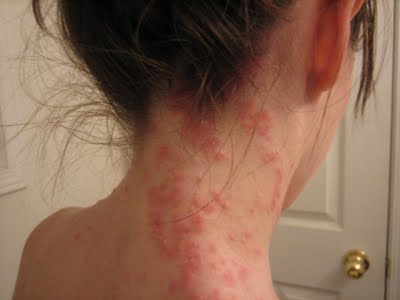
Both can cause an itchy, painful skin rash.

bed-bug-bites

Rash caused by bedbug bites

Dermatitis herpetiformis (triggered by gluten)

Dermatitis herpetiformis (triggered by gluten)

Yes, I chose less severe images than I could have.

Both hide in cracks and crevices.

According to the University of Kentuckybedbugs camp out “along and under the edge of wall-to-wall carpeting, especially behind beds and sofas; cracks in wood molding; ceiling-wall junctures; behind wall-mounted pictures, mirrors, outlets and switch plates; under loose wallpaper; clothing and clutter within closets; and inside clocks, phones, televisions and smoke detectors.” According to Jane Anderson at About.comgluten hides in the crevices of your toaster, scratches in nonstick pans, pores of cast iron pans, scrapes in cutting boards, and minuscule cracks in spatulas, spoons, and rolling pins. And yes, people do have concerns that both gluten and bed bugs are in your computer (bugs in the warm hard-drive-y area, gluten in the keyboard and mouse, and both, of course, swarming the internets).

Both attract online sensationalizing.

I discovered a whole world I never knew existed (and sort of wish I still didn’t): bedbugger forums. These are places where the afflicted gather to share horror stories about the extent of their infestation, botched exterminations, and quixotic home control methods. They are zones of intense fear and fear-mongering, stoked to ever greater levels, and they are not a good way to avoid the whole stress thing. Your life is over!, many of the posters trumpet. You can run, but you’ll take them with you! Buy a PackTite or all is lost! Similarly, although celiac disease forums often feature reasonable, supportive posts, they also have plenty of hopelessness to go around. If you want to send yourself into a downward spiral of obsessing over your illness, you can manage it by poking around celiac.com. Actually, a very thoughtful and perceptive post on one of those bedbugger forums made the connection quite well:

“I just wanted to say that I have a chronic, potentially debilitating illness and when I was first diagnosed I went to some internet forums and after reading story after story, thought my life was over. But it turns out most people with this illness actually end up living full and painless lives (these days, anyway) but these were not the people posting on the forums! . . . people come together in these support forums when they are not having success solving their problem, or when they need understanding or advice, not when the problem is under control and they aren’t thinking about it anymore. So we are not getting an accurate picture of success and failure here.”

Both also attract media sensationalizing.*

Bedbugs are everywhere! Bedbugs are spreading! Bedbugs are in your local public library! Bedbugs are (ironically) in the Health Department! Bedbugs are in your lingerie! Bedbugs are at home, at work, and at school! Similarly, gluten is everywhere! 50 percent of Americans are sensitive to gluten! Gluten is at home, at work, and at school! Gluten is in envelopes (maybe)! Gluten is in ketchup (maybe)! Gluten is in imitation crab (well, yes, but it’s gross anyway)! Gluten may not be in your lingerie but I wouldn’t count on it! *Some of this is sensationalizing; some of it is just true. But it’s comforting to call it sensationalizing.

Both have the capacity to drive you completely and utterly bonkers. . .

Especially if you’re me. Both are linked to stress, anxiety, and depression. The mechanisms are not completely clear from research in either case, but from a common-sense standpoint, it makes perfect sense. Bedbugs and gluten cause physical pain and are hard to eradicate, a bit disturbing, and potentially thought-consuming. Having them around is stressful? Um, obviously. It’s easy to become anxious that either might be present at any time and in any place, especially with all the hype surrounding both.

. . . but not if you deal with the problem correctly, in about the same way.

Step 1 is to make sure you actually have a problem (by inspection or by diagnosis).
Step 2 is to do your research carefully, not believing everything Google tells you.
Step 3 is to learn to love cleaning.
Step 4 is to put into practice all the necessary cautionary measures you can.
Step 5 is to be patient.
– And Step 6, though really you should be doing this all along if you can, is, as in many things, to stay calm and avoid catastrophizing. Life will go on, even if you do come across bedbugs or gluten.

Remember: Bedbugs bite, gluten bites, but don’t let your life bite.

Now that I’ve finished grossing you out, are there any similarities or differences I’m missing? Have you had any experience with bedbugs? If so, I’m so sorry! Any other tips for handling it?

Tagged , , , , , , , , , , ,
Design a site like this with WordPress.com
Get started